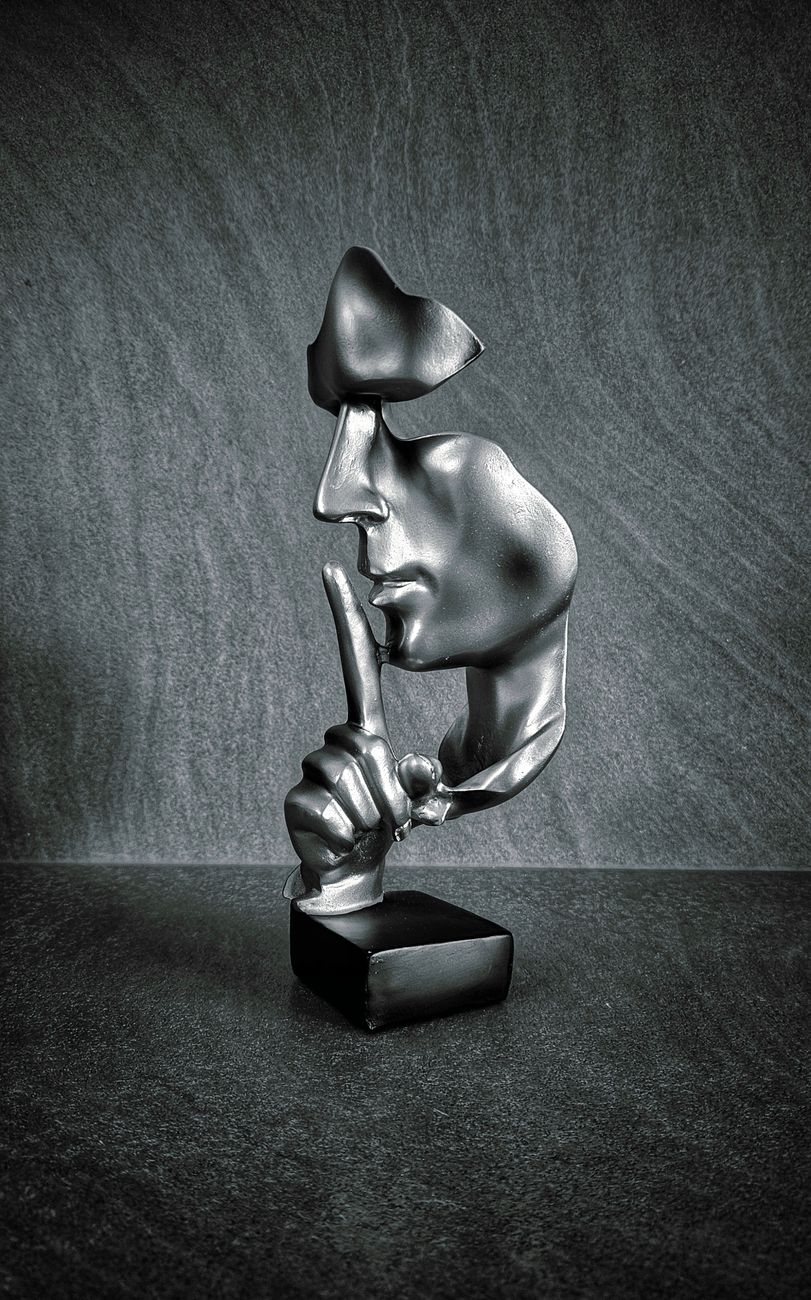
“I have a thousand brilliant lies
For the question:
How are you?I have a thousand brilliant lies
For the question:
What is God?If you think that the Truth can be known
From words,If you think that the Sun and the Ocean
Can pass through that tiny opening Called the mouth,
O someone should start laughing! Now” (Daniel Ladinsky, inspired by Hafiz)
Lao Tzu: “Those who know do not speak; those who speak do not know”
Part I: What Can and Can’t Be Said?
Q: Would you agree with Lao Tzu’s statement that “those who know do not speak and those who speak do not know”? And if so, how come you keep speaking?
Fool: I would never disagree with Lao Tzu. And yet, Lao Tzu spoke those words! He used speech to point out the limits of speech. So, a certain kind of speech is still helpful.
Q: Would you say he contradicted himself?
F: No. Lao Tzu spoke in the spirit of reversal or negation. What he said was a quieting insight into the limits of language, but a limit is not a full deletion of language.
Q: What can and can’t words do?
F: We can fully sense any object in front of us without the need for words. All the qualities of the object are palpable, but “go without saying.” I don’t need to know a word for the color of the object in order to see it. I don’t need to know a word for its smell or shape. It’s only when there’s a practical need to distinguish utilitarian qualities of an object that words become helpful as positive identifications.
People used to claim that ancient people couldn’t see the color blue. But the experience of blueness was always a vivid human experience. Nevertheless, for a long time there was an absence of any practical need to distinguish blue from dark green. This didn’t mean they were less observant or narrower in perception…
Q: … but perhaps less intelligent? A capacity to notice distinctions and make use of them is a sign of greater intelligence. And having a larger vocabulary surely equates to more intelligence?…
F: …More intelligence in a positive direction, carrying more knowledge or memory, which is helpful in a rational, manipulative or focused direction – I would call this “brain athleticism”, which our culture favors. But this intelligence has overshadowed and weakened a negative form, that penetrates certainty, exposes limitations in knowledge, and receives wisdom from a wider perspective than any particular focus.
In fact, by developing a larger vocabulary for different shades of color, we are not necessarily becoming more sensitive to color itself. We are becoming more attuned to artificial categories of color, to names and words, instead of allowing color to remain a direct and ultimately unnamable experience, with its own shifting qualities, depending on light, shade, angle of sun, and contrasting environment.
And the name of a color will both sharpen our focus on that shading and prejudice us into seeing a generalized categorical “type” of color, rather than seeing the actual shifting qualities that morph and run from every defined boundary of knowledge.
The same is true of seeing anything, including human beings. We see “who” a person is based on the categorization we’ve created. Not just “white” or “black” or “Asian”, but “Tom” or “Dick” or “Sally”. We see the stories of one another.
So, this knowledge – this intelligence we gather about the world – can easily become a stupefying prejudice that holds our thinking within biased expectations and dulls our sensitivity to nuances that stray from these expectations.
Q: Are you implying that the more we “know” another person, the less sensitive to them we become?
F: Yes, are we seeing the person? Or, are we seeing the stories – the categories of character — we tell about them (and us)?
If we conflate these behavioral patterns with who we are, then we end up feeling trapped within these patterns. We buy into the categories of identity that the world assigns to us, and disappear into those scripted roles.
So, our perceptual range of motion – our flexibility – diminishes if we Know too much. Then we tend to think within the ruts of what has already been thought.
Part 2: Is Identity Only Language?
Q: Doesn’t this “script”, or the stories we tell about ourselves, reflect something real about us? Don’t our real experiences in life give us true shape and character?
F: A story is shaped by real experience. And the story shapes behavior. But a human being is distinct from the stories and behavioral patterns that develop.
The only signs of an actual human being (of “true character”) are found in losing self-consciousness and acting without the duplicities of self-defensiveness and self-promotion. All such “characteristics” are signs of entrapment within a false Self.
The real person is found in moments of mercy, altruism and compassion, which only happen in the absence of self-consciousness. A real person can’t be characterized, but can be felt as a spirit of reversal itself – in a capacity to laugh easily and lightly at one’s own expense, quickly admitting mistakes, reversing course, because the fictional structure of Self isn’t worth defending. These are signs of a real, if ultimately unnamable human being.
But our habits of behavior aren’t typically revelations of ourselves, but only revelations of patterns of duplicity (personality patterns) that hold us trapped.
Q: Aren’t we identifying the key qualities of a person in “getting to know them” as Sally or Tom? Don’t we obtain essential practical knowledge of their real tendencies and behaviors?
F: We learn to recognize the stories people tell about themselves. That’s real information, describing a habit of thought (a habit of behavior). But a behavioral trait isn’t the real person, it’s the story of themselves they’ve come to believe and enact.
It’s a category we’ve placed over the reality of ourselves, which has overwhelmed our experience of life, and trapped us within that script.
Q: If I call a liar a liar, isn’t that an honest assessment of who they are? Isn’t that an insight? Won’t you merely end up being too soft on liars and murderers by saying “it’s not really them”?
F: These judgements of liars and murderers are real insights into patterns of thought and behavior, but not insights into human essence.
A better metaphor might be that liars and murderers are entirely subsumed under a script. They are unable to stop being this scripted character. That’s true for all of us who confuse our habits of behavior (of thinking and acting) with who we really are. This conviction traps us in the role.
But murderers and liars are also trapped by the weight of their own history. They have to erase empathy categorically to avoid feeling the debt they have accrued in these roles. In this situation, the Self reveals itself as a mental parasite. It traps, deforms and devours the energy of their real existence. It “runs them”, as David Bohm phrased it.
We can kill the parasite, but the person needs to be healed. This is not being soft. Because healing is nothing short of Hell. (Maybe we could call Hell an inevitably painful hospital in the suburbs of Heaven).
Murderers and liars are being run by automated reflexes determined by linguistic scripts that have overwhelmed any sense of who they really are. And we help them remain possessed by failing to distinguish the parasitic disease from the real person.
And this applies to us in a more manageable form as well. A failure to distinguish our unfathomable being from who we think we are is a mostly asymptomatic form of the same parasitism. We are also made numb by hating the patient. This is also an automatic lack of empathy. If we can’t see the human suffering in a liar and murderer, then we also can’t heal. Because we’re also patients in the same hospital, and require the same loving distinction between patient and disease.
Q: Are you saying that a simple surface re-definition of murderers as “patients” will change them into nice people?
F: I’m saying it might be a better metaphor, not a new definition. It would leave us less susceptible to “being run by thought”. And it would suggest a different way to respond to psychopathy, rather than simply punishing it, which only worsens it and infects us.
Our problem may be that we have this great gift to name and distinguish qualities of experience for practical purposes, as metaphors. But our thinking is no longer free enough from these designations to see them as merely metaphors. And so, we latch onto these characterizations of others and ourselves as if they could pin down this fathomless and dangerous world into something real and solid.
And this parasitic fear leads to a compulsive, narrative voice in our head, which is constantly naming and characterizing everything in us and around us automatically – it’s part of the disease. The disease adds a narrative voice-over to direct experience even when there is no practical need for words, because it is running in circles, in an unacknowledged panic. And we end up caught in a filter of interpretation, perceiving our own mental categories as a primary experience, and get trapped there without noticing it, losing contact with the unarticulated actuality of life itself. And this state of mind leaves us susceptible to parasitic invasion (to fascism or its antagonistic counter-forces (vengeance)).
Part 3: Why Does Silence Seem Difficult?
Q: Why can’t we simply tell one another to shut the brain down for a while, widen its perspective, and “be quiet”? Why do we need to go through all these “negative” words to shut down the system of language?i
F: The reflex system that prompts thought and language today is far more overwhelming. And this is the whole premise of Beckett’s trilogy of novels, especially “The Unnamable” – the inability to turn off thought.
It’s harder now because the personal Self has become more important. And this Self is the central structure of language. The Self is composed of narrations of memory, justifications of belief, refutations of previous incarnations of ourselves (as well as other people’s interpretations of us), all of which are linguistic formations, along with the images and feelings they produce. The articulated color category of “me” is so convincing that we’ve lost the ability to see life itself in its truer colors.
So, for us today, we’d feel compelled to ask, “why should I be silent? What will it get me?” We’d seek an ulterior purpose, which generates noise. Then we end up listening to stop the next word from rising as a means to becoming a “silent person” (a better category of Self). And that becomes a far more repressive entrapment in thought than speech itself.
Or, as the voice in the “The Unnamable” put it: “… it is all very fine to keep silence, but one has also to consider the kind of silence one keeps. I listened. One might as well speak and be done with it.”
But in Lao Tzu’s era, perhaps not speaking was a more natural way of being. They weren’t buzzing at such a high pitch from all the technological gadgets beeping at us, the media, the propaganda of schooling (to be someone important), the fears this engenders in not being worthy. This is the system of thought – the matrix – descending on us to a degree it didn’t descend on earlier cultures.
Maybe in Lao Tzu’s era and culture, a homeopathic-sized drop of language might suffice to quiet the mind. It would be enough to remind us of the default state. Now we seem to need more statements of reversal to dis-enchant the mind from its verbal hypnosis.
Q: So, how do we achieve silence by a negative approach?
F: It’s not an achievement. It’s the absence of trying to do anything about our own noise. After all, why do you want to achieve silence? It’s a noisy desire, isn’t it? It fights its own condition.
So, right there, by surrendering this absurd effort, silence is there by default.
And this silence isn’t necessarily the absence of words, but a different way of hearing words. So, the meaning of silence begins to morph as we realize that words can still be used without disturbing a state of silence.
Q: Doesn’t that seemscontradictory? Are you saying it’s possible to speak silently?
F: The second form of your question is open-ended, which means it was spoken from a state of silence. Some genuine loss for words prompted you to wonder and be receptive.
There may be a subtle edge to the question, which is trying to trap the speaker in a contradiction. But the question also indicates a receptive state of mind, which means it arose from silence itself.
And for the interviewee, the challenge of “explaining” silence also provokes a “loss for words.” So, we’re both in a state of silence at this moment, even though we are relating to words.
If I’m merely “at a loss” because I’m still searching for words, then there is no silence. But if this loss is more categorical, then I stop looking within the category of language, and begin to notice actual behavior – the deceptive craving for the solidity of words (which is a craving for a solid Self).
Part 4: The Possibility of a “Silent Language” or Something Akin to Bohm’s “Rheomode”
Q: Is “craving” a behavior or merely an emotion?
F: Craving is a reactive behavior of thought, which carries an emotional charge. It’s a positively charged battery of behavior, but it’s not really “me”.
Also, emotions and behaviors can’t be separated. We can read the thoughts behind our emotional reactions and vice versa. The craving for words is a behavior in the sense that it’s a highly charged attempt to substantiate a reality of “me” from words, emotions and images (or memories). This self is not a real being but a thought avatar (or egregore). It’s a behavior that occurs habitually or automatically. it’s something our culture taught us to do from an early age. It’s one way of processing life, but not “the only way.”
We could call this behavior “selving” to make it stand out as a creative behavior or performance, rather than a real being.
So, this artificial word “selving” calls attention to its own artificial or fictional nature. So, it shares a quality with Bohm’s Rheomode form of language. It “relevates” its own function (in Bohm’s language), preventing us from conflating map and territory, so that we aren’t merely being automatically “run by thought”, as Bohn says.
So, it’s a way of using language (or a form of language) from a broader and more receptive or silent perspective.
Using this form of language allows us to silently notice the urge to speak (or to “selve”) without being compelled by this urge…
Q: So, you’re saying that silence isn’t merely an emptiness or lack of intelligence or meaning? It holds intelligence?
F: Yes, it sees through the noise of attributed or projected meaning — “seeing the truth in the false and the false in the true”, as Krishnamurti phrased it.
Q: But are these words nevertheless building another filter of interpretation that draw us away from life itself?
F: Do these words pin us down or leave us more open-ended?
If our script tells us that “everyone is selling an answer”, then this script curtails our capacity to hear the reversal of answers.
But in pointing this pattern out, the pattern is momentarily interrupted. We begin learning only when knowledge falls apart. In that moment, we can recognize our answers (our positive language) as an objective influence on perception, like specialized goggles of some sort. So, we aren’t made gullible into believing that our microscopic or macroscopic or infra-red visions are telling us the “whole truth”. And this wider perspective than language leaves us open-ended, even while benefitting from the specialized insights of language.
But these words we hear would also have to be spoken in the spirit of reversal or negation. It’s what Bohm tried to talk about with his “Rheomode” experiment, probing the potential of language to be inherently proprioceptive and aware of its own fraying edges, which frees us to raise questions and wonder metaphorically, rather than “know”. In Bohm’s language, this is where Thought gets converted into Thinking. A more active play with category, in a less defined and rigid manner.
If the words are spoken in the spirit of reversal, release and metaphor, then it’s up to the reader whether or not they hear this in the same spirit.
So, the question can’t be answered positively. It depends on whether we see the distinction in these forms of language.
Q: And you are claiming that Lao Tzu spoke in this distinct form of language, which you call a negative language? Is it a different language or only a different way of relating to language? Does language actually change, or are we hearing it differently?
F: Both change. Our relationship to language changes and the nature of language itself changes. We’re describing the same change from two points of view.
If we see language as only an information delivery system, then this positive or conclusive manner of using words is reflected in a language that tends to be sticky and tends to cling to perception like an absolute truth, like an overlay or transparency we can’t distinguish from the lens of our own eyes.
A deceptive approach to language is reflected in a deceptive and sticky form of language.
But if we see language as an insightful story or fiction (a controlled folly), then language is made humble, creatively unsettled (non-sticky) and proprioceptive by this approach. Then it can reveal the limitations of its own reach, generating a natural immunity to getting stuck in dogma, or in its own grid of knowledge.
Part 5: Language As Futility or “Controlled Folly” (Castaneda)
Q: But is it possible to find words – to converse – while remaining in a state of receptive silence?
F: It depends on whether we seek words positively and conclusively, or whether we are quietly receptive to where words fall short. When we notice the limitations of conventional thinking or cliche, we’re immediately obtaining intimations of something more than what we realized. These new perspectives condense out of silence, like droplets of moisture from empty air. We don’t seek them, they seek us. Words that appear unbidden from silence itself aren’t reflex thoughts, but insights. These aren’t answers. They tend to be negative observations of the limitations of conventional wisdom, or more refined questions.
In other words, we can remain quietly receptive even while speaking or listening to conversations. We can hear a tone of voice, the automated reactivities of a limited system of thought, the implicit assumptions driving that system. All of these words can be heard and understood without speaking. And vice versa, we can speak droplets of negative truth only while remaining quietly receptive to a world beyond the positive grasp of words.
And this intelligent silence can obtain insights that settle the noise of confusion — words like Lao Tzu’s, which can reverse a closed mind, or restore an open-ended perspective, where the question — what is silence? — deepens and widens in the absence of answers.
What we speak in silence aren’t answers, but encounters with “something more” than what we thought.
Speech of this sort seems similar to Carlos Castaneda’s (Don Juan’s) notion of “controlled folly”. This phrase is negative, in that it highlights the “folly” of language, while still using language. Controlled folly is doing what inevitably fails, knowing that whatever we do will come up short, will not positively grasp “silence” or “the Tao”. But doing it anyways, because the failure is a perpetual insight into what exceeds language.
Q: Wouldn’t we become weary and dejected if everything we did was a “folly” or a “fiction”? Isn’t this the very futility that defines the post-modern malaise — this loss of any capacity to believe in Grand Narratives; this inability to believe in any reality beyond language itself?
F: Well, we don’t have a choice. Folly and fiction are facts of language. We can’t describe “the Tao” in words. It’s a folly to try. And yet I’m trying to speak about all this anyways, because this is my “predilection.” Not everyone’s. But I See through the filter of language. I don’t get stuck in that filter. because I use it as a known folly, as a conscious fiction, so that it becomes proprioceptive, a kind of mirror that constantly illuminates its own frame, its own limits. So, every time I use words as a controlled folly the experience of linguistic futility catapults perception through the event horizon between map and territory, leaving nothing but receptive silence or clarity.
So, words can’t describe or communicate the Tao, but they can trigger it by their own failure or folly.
Q: But the post-modern culture interprets this folly as meaninglessness. It hasn’t triggered anything as far as I can see.
F: When our culture discovered that life’s “assigned” (or positive) meanings are all invented or fictional, the culture interpreted this assigned meaninglessness as a conclusion about life itself. And this is very odd if you dwell on it a while. If all assigned meaning is merely fictional, then why did this culture latch onto a dark and depressive meaning? Do you see what I mean?
Why did it proclaim that “life is meaningless” if all such proclamations are fictional, including that very conclusion? They’re not taking their insight far enough to reach through their own filter, to the other side of noise.
All we actually discovered here is the beautiful neutrality of linguistic uncertainty, of never coming to a dead conclusion. This means we live in an infinite mystery, and not a finite box. It’s good news that we mistook for bad news. I mean, if there are no “Big Narratives” available, then why does our culture assign a big, dull, materialistic Narrative to everything?
There’s no reason why this insight into futility, folly and fiction should make us pessimistic. It’s not a valid judgement of life itself, but only a projection of our own discomfort with open-ended mystery.
Part 6: Is Negative Language Also Futile?
Q: Lao Tzu spoke a language of negation or reversal more than 2,000 years ago, and yet we’re noisier than ever. If negative language isn’t capable of ending this “Voice” (as Beckett called it), then isn’t this form of language also futile?
F: A noisy entrapment in the system of thought will exhaust itself sooner than the spirit of reversal. Stupidity exhausts itself eventually, if only by driving the species extinct.
Whether negation is futile is the wrong end of the stick. The question should be asked of thought itself. Will it ever give up its own futile escape from futility?
Q: So, why haven’t negative observations such as Lao Tzu’s or Krishnamurti’s or Bohm’s, (or Beckett’s exposures of the whole futility at great depth), ever worked?
F: Well, how often do people even consider this distinction in forms of language and how this affects our so-called human nature? We tend to believe in the story of a settled human nature, which is a self-fulfilling prophecy (another Grand Narrative).
How widely is all this even considered?
Yes, it’s futile to quiet the voice one thought at a time, which is what a world focused on personal salvation and personal improvement tends to do. We stay focused on the narrow level and dismiss the broader view as too abstract, philosophical and impersonal. This “dogma” limits the effectiveness of negative language.
The personal ambition to be silent is futile because it’s a dictatorial attempt to impose unity on a divided mind, which only causes more division. (Hence, “all these Murphys, Molloys and Malones…” that erupt in Beckett’s trilogy).
The entire category of positive thought has to be exposed as an illusion, not just one thought or idea at a time.
Just as we can get caught in categorical prejudices, categorical negations of these prejudices are also possible. Only if we see the futility of all these assertions of self as a categorical whole, does this nullify the urge for a perpetual Voice (or fake Self).
But negative language (the language of reversal) is already free from “the voice.” It is already a restoration of silence. It’s just that we’ve resisted extending this insight categorically. Probably because this kills our sense of Self. We shy away from what we perceive as our own death, even though it’s only the death of a fiction or folly, which opens into something more.
Q: Can you elaborate on this fear of death. How does this relate to an irrepressible voice?
F: Let’s presume that the voice is trying to be silent, but mistaking its own conclusions with silence. Maybe it assumes that an Answer will put an end to its nervous agitation; that it will silence itself with the correct answer.[i]
But every word is imperfect. And Thought hasn’t recognized this as a categorical limitation on itself. It thinks “I haven’t found the right answer yet, so I have to keep churning.” It doesn’t reflect enough on its own categorical limitations to notice that words can’t put anything to rest “out there”, only here, within itself.
But Thought is afraid of this silence-restoring refutation of its capacity to know things positively. Fathomless silence feels like death. Without reiterating myself constantly, the self dissolves.
If this addiction to a false Self dissolved, that would be a good thing. It would remove the battery from the system of thought. The Self is that battery.
So, the roots of our compulsion to overthink are tied to the category of “me”. We forget that this sense of Self is a fictional category (like blue) that we’ve invented for practical reasons.
So, words feel compulsive because we think we can know ourselves (know reality) better by articulating ever more nuanced categories of ourselves. But in doing this, we don’t end up “knowing ourselves” at all. We only end up making a more nuanced vocabulary.
The more we “know” ourselves in this way – as in I’m not just average blue, but aqua-marine or cyan, or azure or cerulean, and so forth, creating an infinity of shades of Self, which creates a kind of mechanical analog of individuality and uniqueness (like the uniqueness of a shuffled deck of cards) – the more we merely expand the web of language that distracts us from our actual life.
So, it’s as if we’ve been wounded by this web of language in which we’re caught. It has severed the Yang from the Yin. It has severed the Self from this actual Being.
So, this false duality within consciousness is a wound that bleeds a compulsive stream of speech (at a volume and speed unprecedented in history), because we’re constantly trying to stitch together the giant cut within us, using a form of language to rejoin what that very form of language severs.
Part 7: Contradictions and Paradoxes
Q: Aren’t you inventing a duality between positive and negative forms of speech, or “Self” and “Being”?
F: When language is functioning in a balanced state, there is no need to mention the negative and positive categories of language (or the Self and Being as divided qualities). If they work together, there’s no duality. Then the two eyes blend. But when we become cross-eyed or one-eyed, the missing function needs to be noticed. This “noticing” isn’t creating the duality, but calling attention to the imbalance.
Q: You keep saying, “we’re not who we think we are.” But doesn’t this infer a positive knowledge of ourselves as something superior to what we imagine? Wouldn’t this be another kind of conclusive conviction?
F: To paraphrase Lao Tzu, “those who know who they are can’t say it, and those say who they are, don’t know themselves.” We are not the person we have “in mind”, that’s all we need to know. That’s enough to leave our being untouched by sticky forms of language. As Beckett’s unnamable character said: “I seem to speak, it is not I, about me, it is not me.”
This generates a faith that requires no name. We don’t need a written creed to have faith. We can have faith in what exceeds us.
In the same way that a balanced language continues even after we realize that no positive language can articulate the Tao, so, also, a kind of self-concept continues even after we realize that “I am not I.” It’s a self that is made of words and stories, but transparently so. At its best, it’s a proprioceptive fiction. And when this is seen clearly, it shuts down the source of chatter.
Q: But on the one hand you are criticizing language as a blinding filter, while praising language as a means of dissolving the filter. And yet you’re also calling this filtering function a necessity. Can you clarify these contradictions?
F: They’re not contradictions if they’re all true simultaneously. Then it’s paradox, which requires a wider view.
A grid of understanding produced by language is in fact necessary. This grid is like a special set of goggles. We look through these grids of understanding (or theories, assumptions or stories) in order to manipulate otherwise indistinguishable features of the world for practical purposes.
An arbitrary range in a continuum of electromagnetic radiation can be called “the color blue”. This allows us to “see” blue in a more isolated form and focus on that color to produce certain utilitarian effects. Language makes “things” appear in the world for our use.
But if we never remove our thing-provoking goggles, then we end up seeing the earth merely through utilitarian frames, as gravel, oil, gas, real estate, etc.. And then we lose sight of the earth as a whole living being. And this means we end up focusing on the goggles or grid itself, rather than looking through them at a more real world.
So, language is helpful, but obsessive language is not. This overuse converts the necessary grid of metaphoric language into a blinding filter.
And there are other somewhat suppressed functions of language, which don’t build grids, but dissolve grids. Here language peers through itself, erasing its tendency to become conclusive and dogmatic. It’s a white-blood-cell form of language, which is Lao Tzu’s form. It calls attention to the ragged edges of our grids of understanding, like Bohm’s Rheomode or Beckett’s collision with positive futility. Or, Zen Koans, or indigenous North American “Sacred Clowns”.
And poetry is also an example of what could be called a language of reversal or negation. It is language that breaks the habits of grid-like thinking (cliché) and restores a dynamic relationship to what lies beyond language, which is the unnamable actuality.
So, all of those seemingly contradictory factors are simultaneously true. This is why strictly categorical thought is categorically not very intelligent. It sees contradiction in what is really an inviting paradox. It tries to hold everything in a stable language, making language the boss, rather than using language as a shape-shifting tool of something beyond thought and language.
Final Chapter: A Proper Love for Language
Q: So, do we love words too much or hate words too much?
F: Maybe we love language too much in a destructive (positive) direction; and too little in a healing (negative) direction.
I mean, most of us have a love/hate relationship to language. Because on the one hand, we are obsessed with words and constantly chattering to ourselves, which is how we try to edit and defend the boundaries of our self-definitions. And on the other hand, we hate this trap and feel cut off by our habitual word-frames from real, divergent experiences, and genuine relationship.
So, primarily people have stopped listening carefully to words, and don’t take as much pleasure in them as they once did. After all, almost all we ever hear now is the chatter of marketing propaganda in society and the chatter of self-marketing propaganda inside our own skulls. So, we’re sick of the words we can’t stop craving. We hate our craving for words.
But you can also genuinely love language for its second function, as a way of reversal, which includes poetry, philosophy and even scientific theory — I consider Bohm’s theories a form of poetry too, because they are ways of performing a perspective, rather than finalizing an answer. He mentions “theory” having its origins in the word “theater.”
But we can extend this appreciation of language by seeing it through the filter of shamanism or alchemical magic. Language does real work from this angle. Scientific theory, mathematical formulae, chemical symbology, musical notation are all forms of incantation that conjure from the infinite potential of the void various material rabbits that otherwise can’t materialize. There is no “thing” until we isolate it with these positive “spells” of words.
But positive enchantments are dangerous if they are used self-deceptively (for personal power). Then they require a more powerful corrective form that can awaken us from any enchantment that goes too far, such as fascism, nationalism, or any rigid form of identity.
I think we have to remain grounded in an intelligence that is less knowledgeable and “athletic” and more uncertain and receptive. This is where Lao Tzu’s language arises; a language that negates certainties and restores receptivity. This language isn’t personally authored, but is the wider world (the Tao) expressing a restorative silence through an individual tongue. And this material tongue serves mainly as a cipher or decipherer of what comes through the body/brain from that deeper well of silence that is our true life-source.
Q: Have these charms of disenchantment in fact brought you any closer to the Tao in your real life (outside this page)?
F: The final effect of all these words depends (again) on whether my foolish addiction to the act of writing ends up undermining the Tao it otherwise restores. It’s not the fault of the words in that case. But the fault would lie in my foolish relationship to words, which become like a retreat center I can never leave without losing my way.
This writing all seems to be heading towards its own categorical death, one way or another. For these words to be true charms of dis-enchantment, they’ll need to end. I’m not saying it’s a goal. But the full impact of what is being written is tending towards a critical juncture. It’s impossible to know who will die first: the “me” who places too much importance in what is written; this form of negative writing; or the body itself, taking all three out at once. But everything has to end in order to complete its meaning.
Q: Are you saying that writing is a “retreat” from life itself?
F: The real meaning of a “retreat” is a place where retreating from life (escaping life) is no longer permitted. Here is where I confront life without retreating. The mundane mind that refuses to reflect on itself is the real retreat from life.
But it’s an open question, a lovely paradox, whose resolution takes form here and leaves these prints. One can see where they lead or drift away. Language can become a retreat from life or a refusal to retreat. That’s the question.
[i] See, for instance, this passage from “The Unnamable”:
“Strange notion in any case, and eminently open to suspicion, that of a task to be performed, before one can be at rest. Strange task, which consists in speaking of oneself. Strange hope, turned towards silence and peace. Possessed of nothing but my voice, the voice, it may seem natural, once the idea of obligation has been swallowed, that I should interpret it as an obligation to say something. But is it possible? Bereft of hands, perhaps it is my duty to clap or, striking the palms together, to call the waiter, and of feet, to dance the Carmagnole. But let us first suppose, in order to get on a little, then we’ll suppose something else, in order to get on a little further, that it is in fact required of me that I say something, something that is not to be found in all I have said up to now. That seems a reasonable assumption. But thence to infer that the something required is something about me suddenly strikes me as unwarranted. Might it not rather be the praise of my master, intoned, in order to obtain his forgiveness? Or the admission that I am Mahood after all and these stories of a being whose identity he usurps, and whose voice he prevents from being heard, all lies from beginning to end? And what if Mahood were my master? I’ll leave it at that, for the time being. So many prospects in so short a time, it’s too much.”
—
Relevant essays:
Neither Materialism Nor Idealism
I prefer Peter Coyote’s reading of Castaneda’s “Controlled folly”, but can’t find an excerpt other than these:
1) Controlled Folly 1 of 6
 Negative Geography
[…] is what my previous essay was also going on about (long and complicated as it was, I apologize, but I needed to dig into this […]
LikeLike
[…] “Speaking Silence” has been improved. […]
LikeLike