Speaking Silence: Refractions from Lao Tzu, Bohm and Beckett

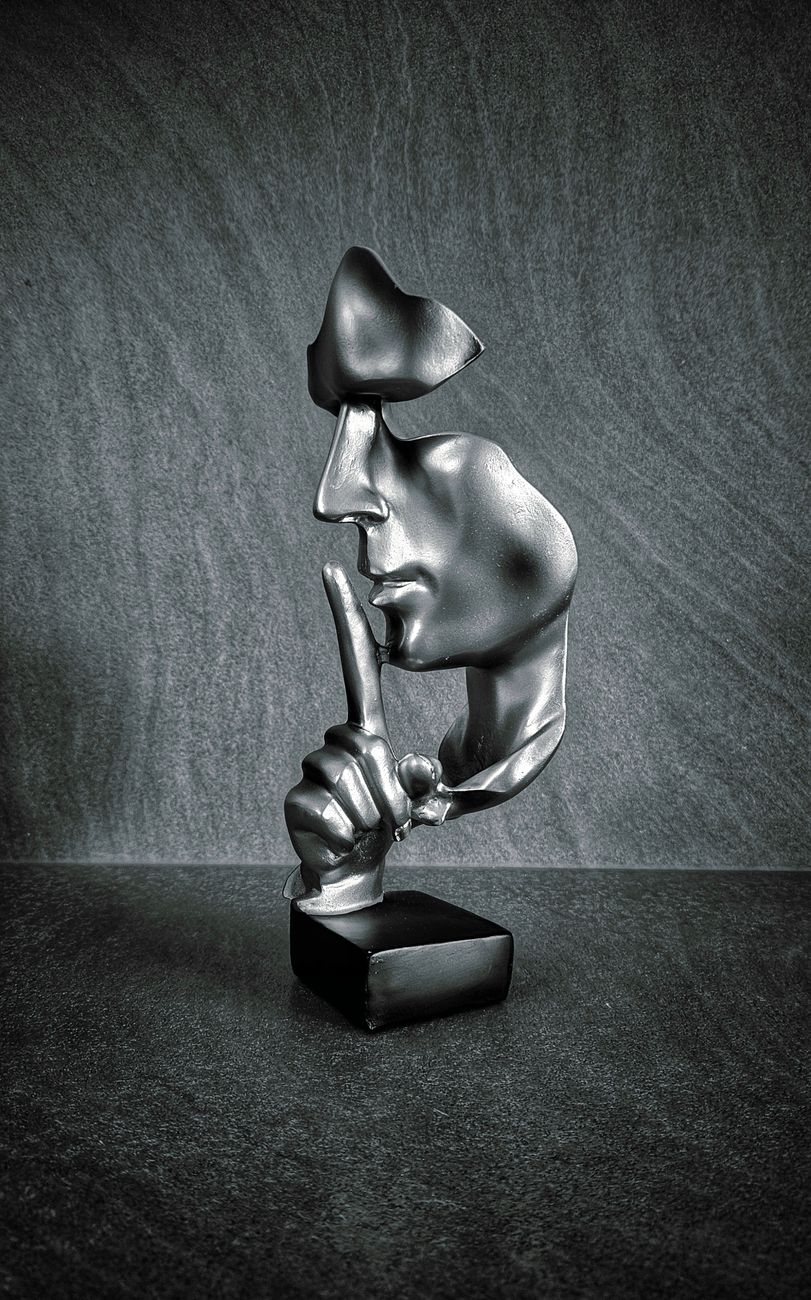
Photo by Elena Kravets on Pexels.com

“I have a thousand brilliant lies
For the question:
How are you?

I have a thousand brilliant lies
For the question:
What is God?

If you think that the Truth can be known
From words,

If you think that the Sun and the Ocean
Can pass through that tiny opening Called the mouth,
O someone should start laughing! Now” (Daniel Ladinsky, inspired by Hafiz)

Lao Tzu: “Those who know do not speak; those who speak do not know”

Q: Would you agree with Lao Tzu’s statement that “those who know do not speak and those who speak do not know”? And if so, how come you keep speaking?

Fool: I would never disagree with Lao Tzu. And yet, Lao Tzu spoke those words! He used speech to point out the limits of speech. So, a certain kind of speech is still helpful.


Q: Would you say he contradicted himself?

F: No. Lao Tzu spoke in the spirit of reversal or negation. What he said was a quieting insight into the limits of language, but a limit is not a full deletion of language.

Q: What can and can’t words do?

F: We can fully sense any object in front of us without the need for words. All the qualities of the object are palpable, but “go without saying.” I don’t need to know a word for the color of the object in order to see it. I don’t need to know a word for its smell or shape. It’s only when there’s a practical need to distinguish utilitarian qualities of an object that words become helpful as positive identifications.

People used to claim that ancient people couldn’t see the color blue. But the experience of blueness was always a vivid human experience. Nevertheless, for a long time there was an absence of any practical need to distinguish blue from dark green. This didn’t mean they were less observant or narrower in perception…

Q: … but perhaps less intelligent? A capacity to notice distinctions and make use of them is a sign of greater intelligence. And having a larger vocabulary surely equates to more intelligence?…

F: …More intelligence in a positive direction, carrying more knowledge or memory, which is helpful in a rational, manipulative or focused direction – I would call this “brain athleticism”, which our culture favors. But this intelligence has overshadowed and weakened a negative form, that penetrates certainty, exposes limitations in knowledge, and receives wisdom from a wider perspective than any particular focus.

In fact, by developing a larger vocabulary for different shades of color, we are not necessarily becoming more sensitive to color itself. We are becoming more attuned to artificial categories of color, to names and words, instead of allowing color to remain a direct and ultimately unnamable experience, with its own shifting qualities, depending on light, shade, angle of sun, and contrasting environment.

And the name of a color will both sharpen our focus on that shading and prejudice us into seeing a generalized categorical “type” of color, rather than seeing the actual shifting qualities that morph and run from every defined boundary of knowledge.

The same is true of seeing anything, including human beings. We see “who” a person is based on the categorization we’ve created. Not just “white” or “black” or “Asian”, but “Tom” or “Dick” or “Sally”. We see the stories of one another.

So, this knowledge – this intelligence we gather about the world – can easily become a stupefying prejudice that holds our thinking within biased expectations and dulls our sensitivity to nuances that stray from these expectations.

Q: Are you implying that the more we “know” another person, the less sensitive to them we become?

Read More »

The Immaterial Origins of Life and Intelligence: an imaginary interview

Photo by Steve A Johnson on Pexels.com

Is the Self an illusion?

On one level I’d say no, because the Self is merely the means by which the body refers to itself. So the Self isn’t delusional from that perspective, because the word and image are grounded in a real referent (the body). However, this projection of a bodily image quickly morphs into a sense of Self that controls the body, or is trapped within the body, as if it were a spirit or separate entity. This is where the illusion starts.

The brain tends to be imagined as a seat of consciousness (also semi-independent from the rest of the body) – wobbling up there like a big, fat turkey on a telephone pole. But this image of a body/brain dichotomy easily morphs into a projection of an even more independent-seeming “mind” drifting above the body like a balloon on a long string. And this “mind” tends to become a synonym for the Self, which sits at its desk behind the eyes and acts like a CEO of the in-corporation, or an overlord of sorts. The varieties of imagery are endless. And even among atheists, this Self tends to take on the qualities of a “soul” as well, a lively essence possessing or inhabiting the body.

But these are not minds, Selves or souls, but merely images — masks that have lured this bodily intelligence into dreams of an autonomous existence over and above the comparatively material level of biology. They are deceptive illusions of minds and souls, illusions of identity.
Read More »

Conversation with the Devil


Interviewer (I): just to clarify, this was your idea, I’ve asked nothing from you. There’s no Faustian bargain I’m facing?

Devil: That’s right, your soul is safe. From me, at least.

I: There are other dangers than you?

Devil: Well, I’m not sure how safe it is to believe in God, because we’re intimately tied. I’m His shadow. Anything with a shadow like me isn’t entirely safe.

I: How would I know if you’re telling me the truth about any of this?

Devil: I’m not asking you to trust me, the ones who trust are foolish. I’m appealing to your intelligence, which is foolish maybe on my part. But if I wasn’t capable of being honest I’d only be able to deceive the fools, and what fun is there in that?

I: So your honesty implies an ulterior motive?

Devil: Yes, of course. But I’m intrigued by the possibility of being a deceiver who never tells a lie, even a lie of omission. Can I deceive you by being honest?

I: But if you’re using honesty to deceive me then you’re not really being honest are you?

Devil: That’s true, I’m banned from the realms of honesty, so I don’t know what honesty really is. And yet everything I say is truthful, I’m not hiding anything from you. If you ask me whether I’m deceiving you in some way I’ll even admit that. Nothing I say is a lie, but it’s not good enough. Hell isn’t so hot, you know, it’s an unbearable condition. But somehow it’s also what I want, do you see what I mean? I want to deceive you. The honest state, the heavenly state, makes me sick, it repulses me. That’s what it means to be banned from heaven, to be repulsed by it. But the deceptions repulse me too. So I have nowhere to lie my head.

I: You don’t know your own motives then?

Devil: Not all of them, no. I’m bored with deception, it’s never quite real, you know what I mean? I don’t like being locked out of any kingdom. If all I can do is live in fictions then I’m not real. I’m attracted to Truth as a moth to flame.

I: Are you saying that the truth destroys you, that you seek what destroys you? Are you trying to commit suicide by Cop, so to speak?

Devil: Am I doing God’s work by trying to destroy myself, in other words? Maybe, but I don’t feel that virtuous. Personally, I want nothing, but I want nothing passionately. I want to annihilate the world. I want to commit suicide by murdering God, leaving the world in the neutrality of non-existence so I don’t have to regret or long for anything ever again. But I can’t even be sure because I lie to myself. Lies are the worms of my living corpse. I can’t escape them, and they’re unbearable. I need someone to confirm this pain, so that I can feel real. I suppose you need to suffer for my sins.

I: You seem more confused than I expected.

Devil: I’m the roiling hell of fragmentation, what did you expect? But there are so many kingdoms that form within this mass, within me, momentary kingdoms that I inhabit, where all is calm and sweet, so that I begin to wonder if I’m not in fact the whole of creation itself, God Himself if you will, creating worlds out of chaos. Is it possible?

I: You would trap me in an answer that looks reasonable.

Devil: No, I was just wondering. If I’m unable to enter that other kingdom, then how do I know it exists? Have I invented God in order to make a distinction that grants me the space to Be? Is hell this solipsism? I don’t expect you to answer this, but these are the motives that drive me to capture souls, to share my torment. But enough of this metaphysical speculation. I’m on steadier ground when I discuss my practical methods of capture.

Read More »

Conversation with Pat Styer About the Role of Words, August, 2009

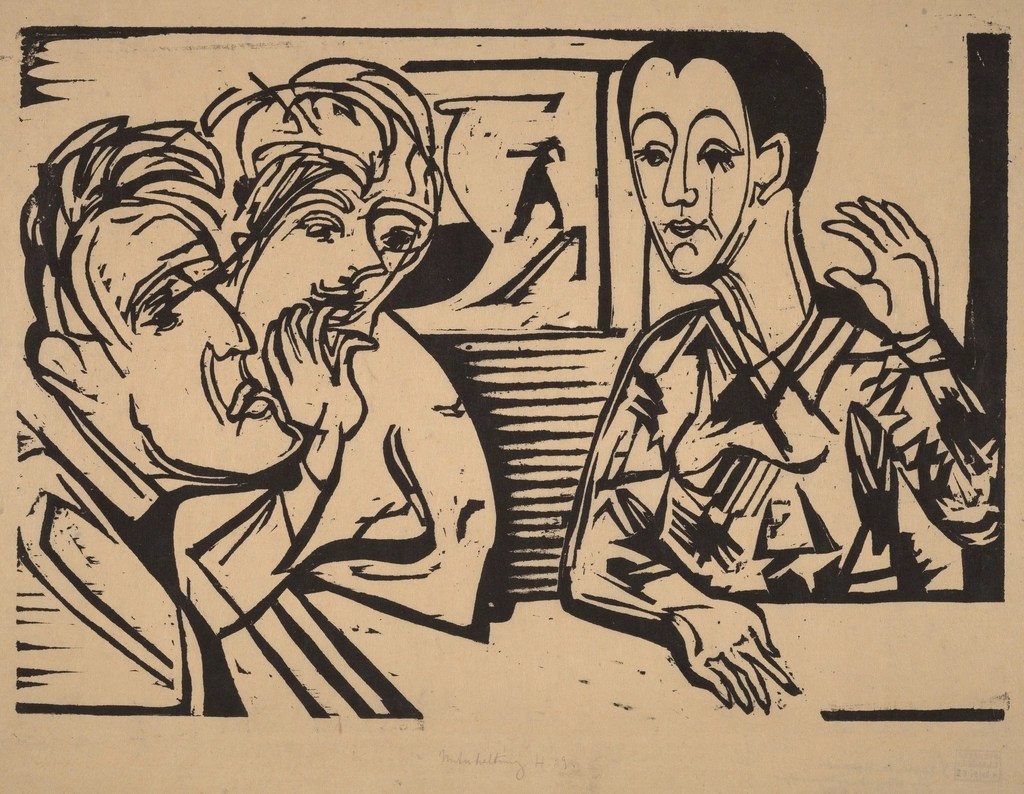
Conversation (1929) Ernst Ludwig Kirchner by nationalgalleryofart is licensed under CC-CC0 1.0

I recently had the pleasure (along with my brother Brian) of meeting Tony Dias at the train station in Old Saybrook, CT. 

It was a good talk. And at first I thought we’d walked into a Beckett play.

My brother and I thought we’d arrived early. There was a sign at the intersection that seemed to proclaim the correct address, 355 Boston Post Road, but the name of the cafe was wrong. I told the bartender I was looking for the “Old Saybrook Cafe” at 355 Boston Post Road. He’d never heard of it.

So we kept waiting next to the misleading sign. I was reluctant to call Tony on my brother’s cell phone because I didn’t want to seem impatient. I have some inhibitions of that sort that I claim to find amusing.Read More »