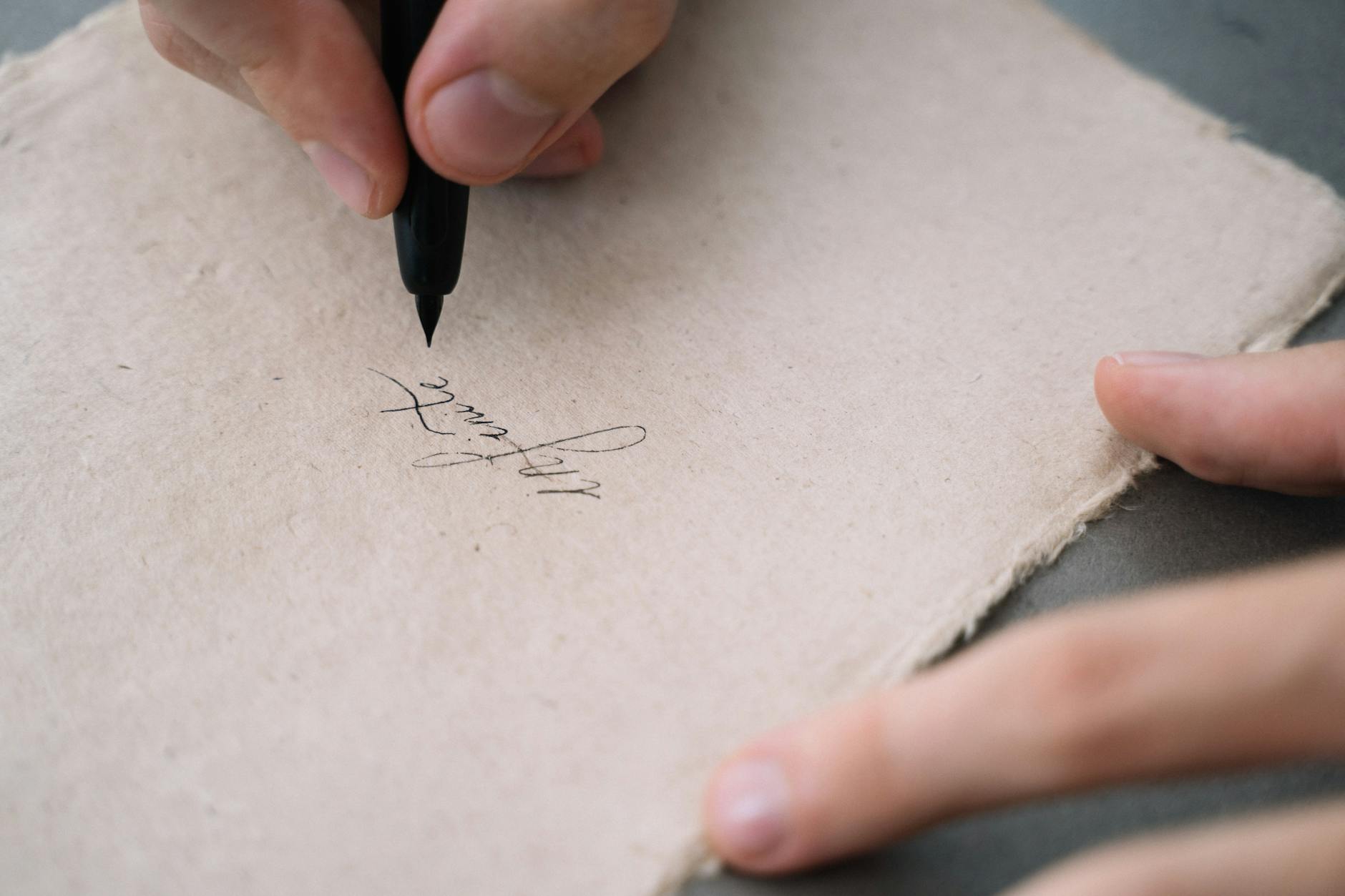
Everyone is already writing their lives with disappearing ink (whether as auto mechanics or second basemen, or writers, and so forth). Everything we do will evaporate and be unrecallable after a few years, decades at most. So, we’re all using evaporating ink, readable only for a short while.
But I think most of us tend to feel that we are doing something meaningful or “necessary”, even though many of us know that “personal legacy” is an illusion. So, for many the need to do something meaningful has nothing to do with creating a personal legacy. It’s unrelated to the length of time the ink of our activities remains visible.
Let’s test this.
So, now let’s reduce the ink’s lasting mark to only 1 year. If you and I knew that everything we’re going to do would disappear in 1 year – that our names would be forgotten, our children and grandchildren would forget us (which they do after a generation or two or three at most), would we still put our heart into what we’re doing?
My feeling is that about 95% of us would stop being motivated if we knew that every trace of our good name would disappear from consciousness in one year. But five percent would probably continue. (I’m basing this guess on the 3.5% rule, and rounding up to 5%. This rule essentially identifies the critical mass of a population necessary for revolution. I’m projecting this “rule” as a general mark for how many people at any given time are radically motivated to act on behalf of something larger than themselves, including a world that extends beyond their own spilled ink).
Why would 5% continue to “write” their lives if they knew their work would disappear so quickly?
My guess is that one year is still long enough for feedback loops to form in relation to what we “write”. In one year, we would also have enough time to reconsider what we’ve done, or learn how to do it all a little better. And this might be long enough to benefit the community, even if our own individual droplet dissolves. Our name, our copyright (so to speak), our trace, would be erased. But the changes we helped introduce in our own small way would live on in other people after we were forgotten. Those who are motivated more by communal interests – perhaps 5% — (rather than merely personal interests) might still remain interested in what they’re doing, because they would be attuned to a community larger than themselves.
Now let’s reduce the ink’s lasting mark to 15 minutes. Here, I’d guess that another 95 percent of the remaining sliver of the population would probably lose their motivation to continue their work. It’s too short a period to cause any lasting ripples in the community after we are forgotten. What’s the point of writing anything down if it will all evaporate in only 15 minutes? Would you continue?
However, I’d like to guess that perhaps 5% of the remaining sliver of the population might continue “writing their lives” even in the face of almost immediate extinction. What would be their motivation?
Why would we act even in the face of utter disinterest, uninterest, false interest (which is worse) and immediate and lasting invisibility? After all, fifteen minutes isn’t long enough to serve the person or the community.
But one last motivation remains possible, which is an orientation towards eternity. And eternity is a reality that surpasses the significance of the individual or even the communal. Our life-work would remain a direct response to an eternal flow of meaning, beauty and love. We would still remain agents of an eternal world in that short window of time. In fact, this orientation would strengthen in the absence of distracting illusions of personal and communal importance.
To participate even for a split second in this flow of being is to be part of eternity. And, what’s more, the insights, the visions, the unique juxtapositions of meaning, the breakthroughs of old dead ends, the ways through a maze that had stopped Leonardo in his tracks or confused Newton, these massive discoveries that happen in the privacy of a fleeting vision, or which take momentary material shape in a vanishing life, can still contribute their momentum to the course of an eternal flow, without the need for static memorials to ourselves or fetishes of the past.
That invisible eternity is already the only real reality, preceding and exceeding every little vanishing lifespan. A lifespan can’t have any meaning without that invisible eternity. Because even if you lived a trillion years it would remain an insignificant blip of time, still just invisible ink.
There is something that seems to last, but it’s not the individual forms themselves. Notice how many times per day our thoughts erupt in a sense of personhood or personality, and then disappear. Sometimes the mind seems to grow attached to a particular personality and wants to be lastingly known as “that kind of person.” Maybe for a while, we’re loving and patient. And perhaps we hope this version of us will last. But in another 20 minutes something usually changes. Maybe we are suddenly triggered into being irritated and impatient and have thoroughly lost any contact or memory of the calm and gentle person we were a moment ago. And then that personality dies too. All our different habits of mind rarely last longer than 15 minutes even now.
But if any of these personalities were to sit down at a typewriter and adopt a writerly perspective, peering through each of our personalities as a play of light and shadow, we would have no emotional attachment to these short-lived shapes of self. We might enjoy them in passing, without time to mourn them.
And when we pull this timeless vantage point into some material or even merely essayic form, the activity is significant, even though the form remains fleeting. That’s because the work we do fuses three fields — the material, the semi-material and the immaterial — opening a passage from the time-bound to the timeless realm. And this fusing of matter and meaning (time and timelessness) – a fusing of a material alphabet, a semi-material imagination and an immaterial insight — creates a conduit through which the new world (the new mind) emerges, even if the structure exists for only 15 lousy minutes.
That conduit is death itself, giving birth to something new. The “me” and the community of “us” must die for the new world to emerge. Then our quick death (our own irrelevance, our essential anonymity) has meaning and is no longer so painful.
I would take the short life of a butterfly rejoicing in a patch of milkweed over living a billion years as a self-important dictator.
Terrence McKenna once said that almost everybody who takes DMT meets “machine elves” who teach us how to use language to enrich the world. “Speak! Do it! Make it!” they kept encouraging the DMT visitors to their plane of existence. The ink we spill, the blood that flows for only a short time, connects the different planes of existence, opening a conduit of creativity. Merely by speaking from our hearts (even as we fade into invisibility), we change the world, because at that point we know (not theoretically) that we’re inseparable from the world.
And it’s interesting to note that a DMT trip apparently lasts only 5 minutes but can often change people’s lives in drastic ways.

