The Transhuman Religion, or The Limits of Machine Intelligence

Photo by Oktay Ku00f6seou011flu on Pexels.com

Machine intelligence promotes a religious doctrine. Or, rather, it replaces a cosmic vision with a simulation of cosmic order. It overlays a universe of unfathomable depths with a closed and predictable vision of the universe. It spreads a doctrine of perfection, control and power over the real world. And this doctrine is as invisible as a plastic transparency placed over a projected image. We can’t easily peel the real from the false, which make us susceptible to this religion’s dogmas.

Essentially, programming is subliminal missionary work. It substitutes a life-oriented morality of “good” and “evil” or “healthy” and “diseased” with a mechanical morality of ‘the useful” and the “the useless”, or “the valuable” and the “the worthless.” It preaches an inanimate universe, which requires external manipulation.

The profane transmutation of a living being into an object of manipulation is a substitute form of Mass. The cries of the tortured pervert the worshipper’s last traces of sorrow and empathy into pure sensation, the most addictive and unholy substance. More and more pain is needed to keep the sensation from ending, which would reveal the true horror of oneself to oneself. In this way, an orientation to hell is created. A hell for living things; a heaven for the machine itself.

This is how the congregations of hell are formed; by perversion and substitution.

The algorithms are the established norms of worship. They offer unholy sacraments of wish-fulfillment. Porn sites, for instance, are extremely popular substitutes for worship. By imbibing in the algorithm’s endless pleasures, the human is reduced to a generator of desire, a battery for powering the machine itself. By losing oneself in the algorithmic dance, worshippers imbibe the spirit of sociopathic machine logic.

These mechanical moralities and dogmas are part of the machine’s program, even in the absence of bad intentions. No matter how the machine is programmed, it spreads this viral immorality.

Read More »

Life as Disappearing Ink

Photo by Anna Tarazevich on Pexels.com

Everyone is already writing their lives with disappearing ink (whether as auto mechanics or second basemen, or writers, and so forth). Everything we do will evaporate and be unrecallable after a few years, decades at most. So, we’re all using evaporating ink, readable only for a short while.

But I think most of us tend to feel that we are doing something meaningful or “necessary”, even though many of us know that “personal legacy” is an illusion. So, for many the need to do something meaningful has nothing to do with creating a personal legacy. It’s unrelated to the length of time the ink of our activities remains visible.

Let’s test this.

So, now let’s reduce the ink’s lasting mark to only 1 year. If you and I knew that everything we’re going to do would disappear in 1 year – that our names would be forgotten, our children and grandchildren would forget us (which they do after a generation or two or three at most), would we still put our heart into what we’re doing?

My feeling is that about 95% of us would stop being motivated if we knew that every trace of our good name would disappear from consciousness in one year. But five percent would probably continue. (I’m basing this guess on the 3.5% rule, and rounding up to 5%. This rule essentially identifies the critical mass of a population necessary for revolution. I’m projecting this “rule” as a general mark for how many people at any given time are radically motivated to act on behalf of something larger than themselves, including a world that extends beyond their own spilled ink).

Why would 5% continue to “write” their lives if they knew their work would disappear so quickly?

Read More »

Language as Healing Magic, or Defeating the Witchery of a Machine Mind

Photo by Marek Piwnicki on Pexels.com

Introduction

Negative (or “alchemical”)  inquiry performs real work.

It doesn’t usually include information or data. It doesn’t nail down a lasting conceptual framework. Nor does it describe how to apply knowledge in a rational effort to solve problems. Nor does it solely analyze a problem into parts, or propose hypotheses, or pontificate opinion.

These elements of thinking play subordinate roles in a negative inquiry. But they are all positively oriented elements by themselves.

Negative inquiry exposes and deletes falsified knowledge, and re-synthesizes what remains by default in a suggestive, rather than conclusive manner.

After deletion, what remains are a multiplicity of vantage points and questions, which had been suppressed under a positive or dogmatic framework.

A multiplicity of divergent vantage points is more insightful than answers or conclusions, because conclusions put an end to learning. This is similar to a brain-storming state of mind, which invites every perspective to the table.

These vantage points are often in contradiction with one another. In a positive enquiry, differences are perceived as obstacles to consensus, which need to be eliminated. This leads to conflict between advocates of different points of view. Ironically, the intentional pursuit of consensus leads to a battle for the supremacy of a singular conclusion. This eventually subdues divergent visions once again under a new dogma, diminishing the range of questions to matters of crisis management or framework preservation.

But when the inquiry is founded on the negative realization that an infinite universe can have no final framework, only ever more nuanced ones, then contradictory vantage points are no longer obstacles, but insights.

This transforms contradiction into paradox.

A paradox is an invitation to include and transcend the differences in a wider framework. It’s no longer an internecine battle between different ideas, but a more patient consideration of all the points in a Medicine wheel, allowing a larger framework to consolidate by merely sitting with difference. This results in an almost accidental consensus of spirit and vision. But without any conclusive (or battle-hardened) framework.

In other words, a negative inquiry (which is essentially Bohmian dialogue) presumes an infinitely open universe, where new frameworks are merely insights or ever larger overview perspectives, but never final answers.

Whereas, a positive inquiry – one that aims for a conclusive answer – presumes a knowable or closed universe, which generates conflict between competing answers.

Therefore, a negative inquiry is learning without end. It’s more like a performance of a new way of being, rather than an exercise in over-thinking. It’s like a dance between neither this, nor that and both this and that.

And this perpetual performance (or practice) of uncertainty or “suspension” awakens a sleeping potential of the human brain, which is to change the world at the root level of perception, where – as David Bohm phrased it — “a change in meaning is a change in being.”

Read More »

Insight as the Deletion of Positive Knowledge and How that Heals the World

[This was published in “Dissident Voice”.]

I’m not sharing “knowledge”. In fact, none of my essays communicate knowledge in the typical sense. I’m sharing encounters with absences of knowledge. It starts with the recognition of the categorical illusion of positive or conclusive knowledge — not the illusion of all knowledge, but the illusion of ever being able to know anything in a final form.

Science itself was built on this categorical realization that its theories do not lead to conclusive knowledge. However, even science seems to have lost sight of this initiating insight.

Or, as I said in an earlier essay: “This is what bothers me about the debate between evolution and creationism. Creationists criticize science as “mere theory.” And science usually stupidly responds by touting all the “facts” backing up evolution. It rarely says, “you’re damn right it’s “only” theory. Theory is what makes science great. We don’t settle on a dogma, on a literal interpretation, on a fixed position. We allow our perceptions to change with discovery. And we don’t believe in a final explanation because actuality exceeds every formulation. We can always learn more.”

The closer we look at knowledge itself, the more contextual and temporary it starts to look, built upon assumptions that are more faith-based or creative than solid. Just like an atom — the closer we look at solid form the more it turns to mostly emptiness and occasional energetic flashes of insight from the void.

New evidence is constantly calling everything into question. What we end up with are provisional structures of thought (or stories or theories), but no final answers. No such thing as Positive knowledge exists. It’s one of the many fairy tales we have swallowed, and it has led our culture towards disaster, as I’ve been discussing in all of these essays.

Most people think we already question things too much. But we’re only questioning specific portions of knowledge. We’re not questioning knowledge categorically. Schools, for instance, never helped students learn to examine the creative or downright fictional assumptions that underlie conclusive knowledge itself.

As I said in another essay, “It’s the rare school…which leaves a student without an allegiance to some fixed position. Most schools teach only a short-term open-mindedness in order to gain, in the end, conclusive confidence in what is “real.” Few schools help students discover a more ineffable confidence in uncertainty, in remaining alert to where conclusions diverge from reality.”

Read More »

Antisemitic Elements in the Modern State of Israel

I’m not interested so much in geopolitical solutions and analyses. My feeling is that nothing is going to change this repetitive history of mass murder, or nation against nation, until the illusions of “who we are” dissolve. Not that identity itself would disappear. But identity ceases to be an illusion when it’s held more lightly, as passing reflections on our behavior. But when they become stuck in idolized forms, illusions multiply.

This dissolution of the illusions of identity, in my opinion, would snuff out the various fuses before any of them can lead to war.

Rather than constantly relighting these fuses of Us against Them, we need to allow that fuse itself to dissolve in a broader vision than us and them. Because every political or social movement starts from the same rotten assumption – namely, a belief in the reality (not mere fictional reality) of a separate Self (whether national, political, religious or racial self, and so on). It’s this belief that is the fuse. And I feel it’s a delusional belief. We are not who we think we are.

But almost everybody finds this level of criticism absurd or far-fetched or unrealistic, or even offensive, and so on. Because people primarily look at nations, tribes and other group entities as if they were real. It’s the psychology underlying this illusion that attracts my interest; not the geopolitical dramas carried out by these fictional entities.

But, again, people are overwhelmingly drawn to the level of human drama – absorbed almost constantly from morning till night by the various Netflix or Hulu dramas involving egos in conflict, or nightly news dramas between nations or demographic groups. Sure, human beings are naturally interested in this level of life, because we’ve lived in complex group dynamics for millions of years.

But that wasn’t the only level of attention we had developed over those millions of years. We also used to be even more deeply attuned to the delicate balance of the natural world; which includes the immaterial mysteries of being alive.

People had to know their relationship to that broader world beyond their petty concerns. In healthy indigenous tribes, people tended to be broad-minded and philosophical. But that sensitivity has faded, as human drama has escalated. And now I believe we’ve reached a point where our political intelligence has made us blind, because now this focus no longer leaves space for a coherent relationship to the larger natural world; and to the even larger immaterial realms, in which our identities are as insignificant as passing dreams.

The nested hierarchy of order has been reversed to the point where we value only self-interest; which is a vantage point so benighted that it can’t recognize its own self-destructive destiny.

So, this is why I feel that we can’t find our sanity by focusing constantly on nations and other oppositional identities, as if they were real. And by focusing constantly on politics, we’re only reconfirming our belief in these images of ourselves and prolonging the foolish dramas.

So, I’m going to keep talking about these illusions, without proposing any additional solutions (which are inevitably political or social solutions). Because the solution in this case is the problem. The solution of politics is the problem because it always reinforces the illusion of separate identities; and these solutions are never any better than mere truces.

Read More »

The Title of the Previous Essay

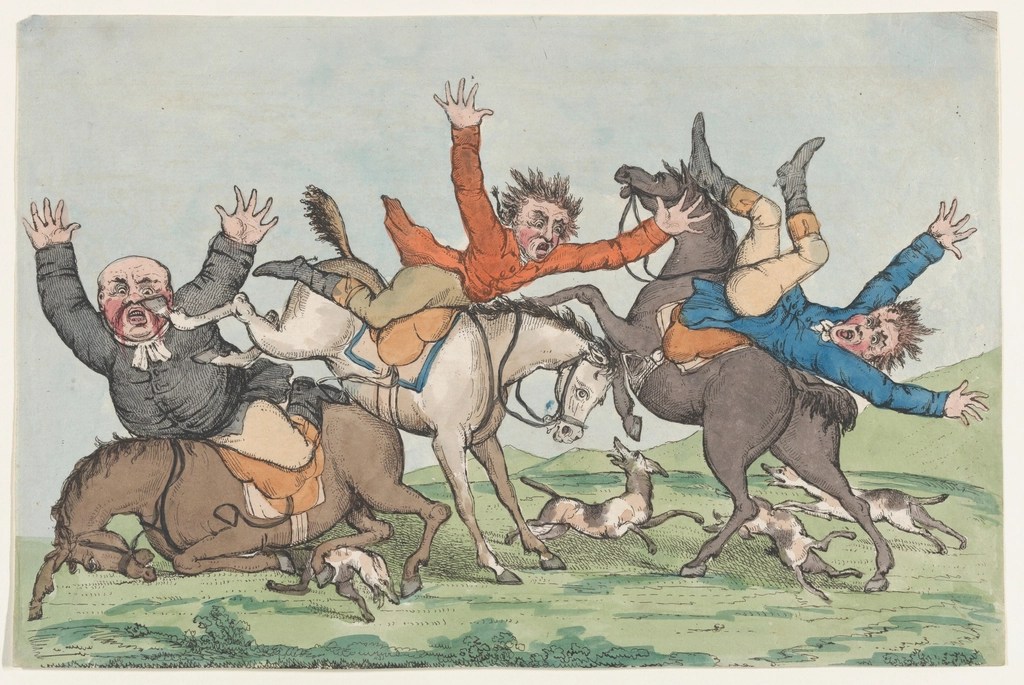
Three Riders Fall their Mounts by themet is licensed under CC-CC0 1.0

Intro:

Anything with the title, “How that Heals the World”, is likely to be read as a spiritual promissory note.

Taken in the context of this inquiry, however, no such positive promise is possible. And yet, the promissory phrase is intentional.

And although it will turn away the more discerning noses of potential readers, the title stands, because it is precisely this misdirection in the word “healing”, which creates the necessary bathos or humorous fall in expectations, which unlocks the meaning of the essay.

Or, rather, that expectation gets shattered during the course of all these essays; not broken down into the mirror opposite of “healing”, which would merely be a competing concept, such as “harming”. But it shatters my own bloated and self-important understanding of what it means to heal. And this turns the essay itself into a kind of medicine. (At least for me).


This Reversal of Expectations Requires a Good Soaking in Bathos

I use the word “bathos” even though it’s uncommon enough to require a definition. But a long definition will miss the Point. The Point needs to be sharpened into a singular sound.

Bathos: “an abrupt, often unintended, and ludicrous descent from a lofty, serious, or emotional tone to the commonplace or trivial. It functions as a form of unintentional anticlimax, frequently producing a comical or disappointing effect.” (Merriam Webster)

Bathos”:  The sound falls off the tongue as if from lofty literary heights; as if falling from a high horse, and landing with a hard “Baa” that knocks the wind out of the generous reader. And then the echoing thud of “Thosss” immediately follows; which further fades into the soft aftermath of that S stretching into white noise.

And then, the mildly concussed brain flashes with fragmentary allusions to the contradictory nature of this experience. In the one ear, there’s an allusion to the saying, “he sure took a bath on that deal”. In the other ear, I claim to experience the baptism of a new meaning, the splashing S sound washing away the various motes and beams of delusional expectation.

So, the word “healing” in the title was used bathetically, as an intentional misdirection. And also, as a mild reiteration of the more drenching bathos found in the essay posted last week, titled “Original Negative Geography….”

The humor of that essay (and the humorous point of all of them) is functional, not frivolous.

Because, the “solution” or “healing” here only amounts to giving up the search for an anti-dote beyond noticing the absurdity itself. Until this absurdity is met directly as a preposterous fact, we never give up the busy chase; and our brains trip over themselves from morning to night looking for an exit from its own chaotic search for an exit.

Or, as an old Zenn saying has it: It’s as if we’re “riding an ox in search of an ox.”  

Read More »

Empire Falls: Footnote to the Essay, “What Is Self-Knowledge?”

“A bitter wind blows through the country
A hard rain falls on the sea
If terror comes without a warning
There must be something we don’t see
What fire begets this fire?
Like torches thrown into the straw
If no one asks, then no one answers
That’s how every empire falls” — John Prine (“That’s How Every Empire Falls”)

Maybe the scientific revolution (for all its magnificent insights and newfound capacities) re-imagined the human being as a kind of inanimate billiard ball bouncing mechanically along a chain of meaningless cause and effect.

This was the only Grand Narrative that science could offer the individual. A brief, inexplicable eruption from total non-animacy, which ends in non-animacy yet again.

This revolution freed the individual from the biting dogmas of religion, but left the individual feeling like a surplus ball bearing bouncing around in some inexplicable clockwork; which had the effect of leaving the non-scientist (the new lay person) desperate to find purchase in the open-ended abyss of an isolated “me,” which was all that remained in the absence of religion and monarchy (and NO, this is not a lament). But as a result, perhaps the 18th and 19th century citizen (or at least European or American citizen) colonized the world in its need to distract itself from the absence of meaningful identity that the sudden withdrawal of old certainties provoked.

I mean, the 19th century “American” mind was optimistic, because it was experiencing the “singularity” of a logarithmic upswing in personal and national power in the rising tide of colonialism, thanks to genocide and slavery.

As the empire collapses, the urge to regress towards that “old time” faith in kings and gods and tribes grows more desperate, and less euphoric. Hence, there’s a desire to return to the familiar hellscape of genocide and enslavement so as to give those who feel this way a boost of self-esteem.

So, perhaps the “rugged individual”, and the “self-made man” of an eager 19th century America became the resume-building, careerist, self-branding, cynical and self-obsessed tweeting global consumer of today. We’ve all been colonized.

Read More »

A Ramble on How Too Much Identity and Too Little Self-Knowledge Contributes to our Collective Suicide: Preface to the Essay, “What Is Self-Knowledge?”  

Seen from Mars, it’s as if human beings as a whole don’t care if they themselves survive (or if other species are allowed to live).

Is this mass suicide?

An indifference to our own collective fate is spreading, even among people who are still devoted to their families. The indifference is justified as a form of realism. If we’re heading towards destruction then realism, they say, is accepting our fate (knowing all living things eventually die anyways).

Indifference to life and death itself is being conflated with realism.

And death as a natural completion of a life-cycle is being conflated with a premature murder/suicide of one another and millions of other species.

This isn’t a realistic or mature regard for life and death, but the very attitude of a person who has resigned themselves to giving up on a complete life and committing suicide before maturation. This “realism” is the suicidal impulse itself.

After all, what are the direct means by which we are prematurely killing ourselves? We’re denying the effects of climate change, indulging in fascism and allowing AI to gain total possession of our minds, and suck the marrow out of life itself, to name just three.

These are the self-destructive behaviors of an immature species, an adolescent species, who has set fire to the house, locked itself in its virtual room, and then climbed into bed to watch a movie with the dog. And when a brother bursts into the room, shouting “fire!”, the adolescent mocks him for his overzealous concern, saying, “calm down and be realistic: we’re all going to die eventually anyways.”

Denial, indulgence and apathy are the justifications for what’s happening, not the mature acceptance of life and death. There is a reason why we make a distinction between murder and natural causes.

I believe it is realistic to say that we are killing ourselves and murdering one another.

But it’s not realistic to accept this situation as inevitable.

Therefore, I’d like to suggest that it’s this lack of self-knowledge, this refusal to self-reflect, learn, change and die naturally to who we are, which is the problem. Suicide and murder are not the acceptance of death, but its denial. We would rather be consumed in a fire we started than give up the illusions of ourselves and allow who we thought we were to die naturally.

Read More »

The Real Revolution Hasn’t Started Yet

Photo by William Warby on Pexels.com

“…something that wants to rise and shake itself free” (William Carlos Williams)


I had a fairly disconcerting experience when I was a 9th grade spectator at our school’s varsity basketball game. It was a rural school, Kindergarten through 12th in the same building. Maybe 30 kids per grade, so we knew pretty much everyone, or so I thought. But as I was watching the game, one of the players, maybe two years old than myself, a member of our church, our mothers were friends, became instantly unrecognizable.

I lost the flow of the game and became hypnotically focused on this one person. It’s probably a widespread phenomenon. It’s what some call “wordnesia.” Except in this case, it’s not the word that looks suddenly mispelled or inexplicable or weird, but a human being. Someone I knew on the periphery.

And even if it’s common, I want to magnify the moment, because there’s something almost pleasantly psychedelic about the experience, and also significant in some way that otherwise I ignore.

At any rate, I had this Wordnesia experience of a person when I was in 9th grade. I tried to juggle the knowledge of his “familiarity” with his sudden alien strangeness. His bearing no longer conformed to anyone recognizable. But I was also noticing him for the first time. Noticing the discrepancy between the mask of confidence he was trying to wear (the identity he was trying to present), my interpretation of his projected identity, and the unfamiliar reality of himself, which I’d never noticed until that moment.

And the alien feeling spread to the entire gymnasium. My hometown crowd, all familiar faces, looked like they were all struggling with masks. It was as if the known character of each person was peeling from their bodies, revealing a routine pretense, which was their public persona, which also revealed something of the real human being struggling with fear and doubt.

I don’t know if that’s how I would have interpreted at the time. But I’m doing so now, because I recollect a feeling of dislocation, and alien strangement in myself, when I looked around the gym. It was like a contagious form of wordnesia, or so I feared.

In the disjointed chaos of the moment (and I think it was a close game, so the energy of the crowd was high-strung, I started to notice the chaos of myself more than anything else, because the isolation turned me inwards, where I found nothing but a bundle of herky jerky movements that I vaguely but not gladly recognized as myself.

I tried to snap out of this alternate reality, but it stuck around for a long half-hour and then perhaps a milder version never fully dissipated the rest of my life. At any rate, thereafter I became even more self-conscious, more herky-jerky, and felt more like a fraud who didn’t know how to stop being a fraud.

But at the same time – and this is far more important – the effect was not one of haughty disdain for myself or others, but an unprecedented feeling of sorrow for the real human beings I’d never noticed before. Beneath the smiles and cheers they looked sad or tired.

This self-ennobling observation can’t be fully corroborated. But I do (I insist) feeling oddly sad in the midst of this somewhat pleasant natural high.

Sheer forgetfulness may have been the accidental drug, but it did seem to open a glimpse into more subtle realities simmering beneath the surface presentation; beneath the scripts that often trap us into being people we weren’t meant to be. Where familiarity once was, now bewildered human forms could be discerned. The vague outline of a soul writhing in a spider’s web or a cocoon, depending on whether they would emerge or not.

Read More »

Aphorisms, V.3

Photo by Yashasvi Nagda on Pexels.com
  • As the environmental situation shifts, the skills and intelligence we need also shift, forcing us to lose capacities in one direction while developing them in another. So, every new skill reaches a point of diminishing returns. Every medicine becomes a poison. *
  • There is no evolution without death. For those who change, the old form dies. *
  • Evolution isn’t impressed by big brains, if those brains aren’t capable of changing direction (which requires death). *
  • We like to think that we’re the ultimate generalists, able to adapt to any environment because of our technological gifts. But specialization is a sneaky tendency. The technologies that helped us become generalists reach a point of diminishing returns and begin to narrow our attention spans with too much passive absorption, and by corralling our intelligence (our awareness and behavior) along the predictable ruts of algorithms. *
  • Our genetics are recapitulated holograms of the primordial soup, which can germinate in any form when the immaterial lightning of insight alchemically strikes the fertile ground of matter. *
  • Every shift in shape from Tetrapod to whale could be described as earthly insights, leaps in orders of being.*
  • From a communal point of view, evolution is not competitive or comparative, but measured by whether the whole (or holon) is thriving or declining. *
  • We don’t see the relevance of earth and other species anymore, except as playthings or scenic backdrops to our diversions. We’ve become the only relevant thing, which is a loneliness that never existed in previous cultures. A meaninglessness too, because we have divorced ourselves from the undiscovered portions of who we are, which are rooted in the mystery of our surroundings. We slide along the empirical surface of the world, blind to the immaterial forces, which give shape to that empirical world. *
Read More »