
Insight as the Deletion of Positive Knowledge and How that Heals the World

[This was published in “Dissident Voice”.]

I’m not sharing “knowledge”. In fact, none of my essays communicate knowledge in the typical sense. I’m sharing encounters with absences of knowledge. It starts with the recognition of the categorical illusion of positive or conclusive knowledge — not the illusion of all knowledge, but the illusion of ever being able to know anything in a final form.

Science itself was built on this categorical realization that its theories do not lead to conclusive knowledge. However, even science seems to have lost sight of this initiating insight.

Or, as I said in an earlier essay: “This is what bothers me about the debate between evolution and creationism. Creationists criticize science as “mere theory.” And science usually stupidly responds by touting all the “facts” backing up evolution. It rarely says, “you’re damn right it’s “only” theory. Theory is what makes science great. We don’t settle on a dogma, on a literal interpretation, on a fixed position. We allow our perceptions to change with discovery. And we don’t believe in a final explanation because actuality exceeds every formulation. We can always learn more.”

The closer we look at knowledge itself, the more contextual and temporary it starts to look, built upon assumptions that are more faith-based or creative than solid. Just like an atom — the closer we look at solid form the more it turns to mostly emptiness and occasional energetic flashes of insight from the void.

New evidence is constantly calling everything into question. What we end up with are provisional structures of thought (or stories or theories), but no final answers. No such thing as Positive knowledge exists. It’s one of the many fairy tales we have swallowed, and it has led our culture towards disaster, as I’ve been discussing in all of these essays.

Most people think we already question things too much. But we’re only questioning specific portions of knowledge. We’re not questioning knowledge categorically. Schools, for instance, never helped students learn to examine the creative or downright fictional assumptions that underlie conclusive knowledge itself.

As I said in another essay, “It’s the rare school…which leaves a student without an allegiance to some fixed position. Most schools teach only a short-term open-mindedness in order to gain, in the end, conclusive confidence in what is “real.” Few schools help students discover a more ineffable confidence in uncertainty, in remaining alert to where conclusions diverge from reality.”

Read More »

The Title of the Previous Essay

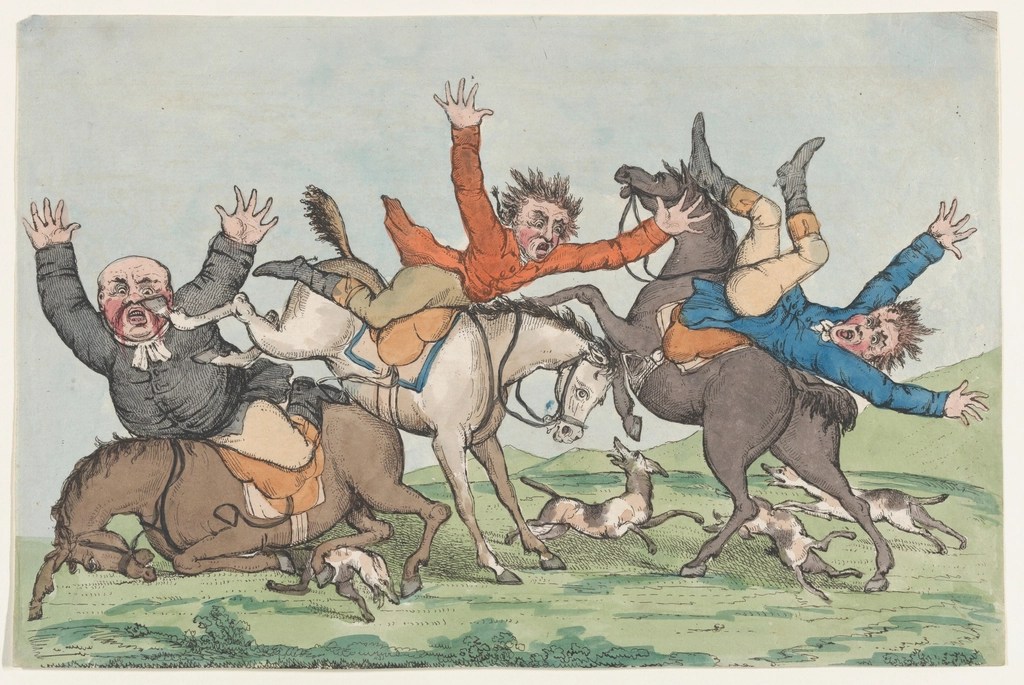
Three Riders Fall their Mounts by themet is licensed under CC-CC0 1.0

Intro:

Anything with the title, “How that Heals the World”, is likely to be read as a spiritual promissory note.

Taken in the context of this inquiry, however, no such positive promise is possible. And yet, the promissory phrase is intentional.

And although it will turn away the more discerning noses of potential readers, the title stands, because it is precisely this misdirection in the word “healing”, which creates the necessary bathos or humorous fall in expectations, which unlocks the meaning of the essay.

Or, rather, that expectation gets shattered during the course of all these essays; not broken down into the mirror opposite of “healing”, which would merely be a competing concept, such as “harming”. But it shatters my own bloated and self-important understanding of what it means to heal. And this turns the essay itself into a kind of medicine. (At least for me).


This Reversal of Expectations Requires a Good Soaking in Bathos

I use the word “bathos” even though it’s uncommon enough to require a definition. But a long definition will miss the Point. The Point needs to be sharpened into a singular sound.

Bathos: “an abrupt, often unintended, and ludicrous descent from a lofty, serious, or emotional tone to the commonplace or trivial. It functions as a form of unintentional anticlimax, frequently producing a comical or disappointing effect.” (Merriam Webster)

Bathos”:  The sound falls off the tongue as if from lofty literary heights; as if falling from a high horse, and landing with a hard “Baa” that knocks the wind out of the generous reader. And then the echoing thud of “Thosss” immediately follows; which further fades into the soft aftermath of that S stretching into white noise.

And then, the mildly concussed brain flashes with fragmentary allusions to the contradictory nature of this experience. In the one ear, there’s an allusion to the saying, “he sure took a bath on that deal”. In the other ear, I claim to experience the baptism of a new meaning, the splashing S sound washing away the various motes and beams of delusional expectation.

So, the word “healing” in the title was used bathetically, as an intentional misdirection. And also, as a mild reiteration of the more drenching bathos found in the essay posted last week, titled “Original Negative Geography….”

The humor of that essay (and the humorous point of all of them) is functional, not frivolous.

Because, the “solution” or “healing” here only amounts to giving up the search for an anti-dote beyond noticing the absurdity itself. Until this absurdity is met directly as a preposterous fact, we never give up the busy chase; and our brains trip over themselves from morning to night looking for an exit from its own chaotic search for an exit.

Or, as an old Zenn saying has it: It’s as if we’re “riding an ox in search of an ox.”  

Read More »