“The Future Determines the Past”

Photo by Pixabay on Pexels.com

I’ve vaguely heard in passing the phrase, “the future determines the past.” I believe it came from Youtube titles referencing something from the theoretical edge of physics. But on Youtube, the phrase sometimes serves as esoteric click-bait, producing the mild effect of psychedelic incense, as if it were a wisdom too lofty for daily life.

“Esoteric” essentially means knowledge reserved for a select few. So, it’s a snobby concept. In reality (let’s call it), the “esoteric” is usually just a framework wider than the familiar, until it becomes familiar.

There’s nothing esoteric about the phrase, “the future determines the past.”

This is merely the reverse side of a more familiar illusion of “time.” The past determines the future as much as the future determines the past. Because both past and future are illusory, and both lose their meaning in a timeless awareness, which can’t even be called “the present” (because even “the present moment” is only an illusion of time passing).

So, while it’s easy and familiar to imagine that our actions in the fleeting present (which immediately becomes the past) determine our situation in the future (which means the past determines the future), it’s also possible to see that the future (a later “present moment”) redefines the significance of past events.

For instance, if I’m behaving like a miserable, selfish idiot and someone comes up to me and says, “you’re behaving like a selfish, miserable jerk!” what is the significance of this encounter?

Well, if I go on to live a life brooding with rage at that person, and drink myself into an even more miserable state of selfishness, then the encounter will be significant only as an excuse for becoming even more miserable.

But if I go on to live a life brooding with rage at that person and then wake up one morning and realize that he or she was right, and sober up and face myself squarely, changing my life, then that encounter is significant as a turning point.

What I do in the so-called “future” therefore determines the past.

And this is true at every moment, because there is no real past, present or future, but only an open-ended timelessness that includes all three as abstract derivations.
Jackal

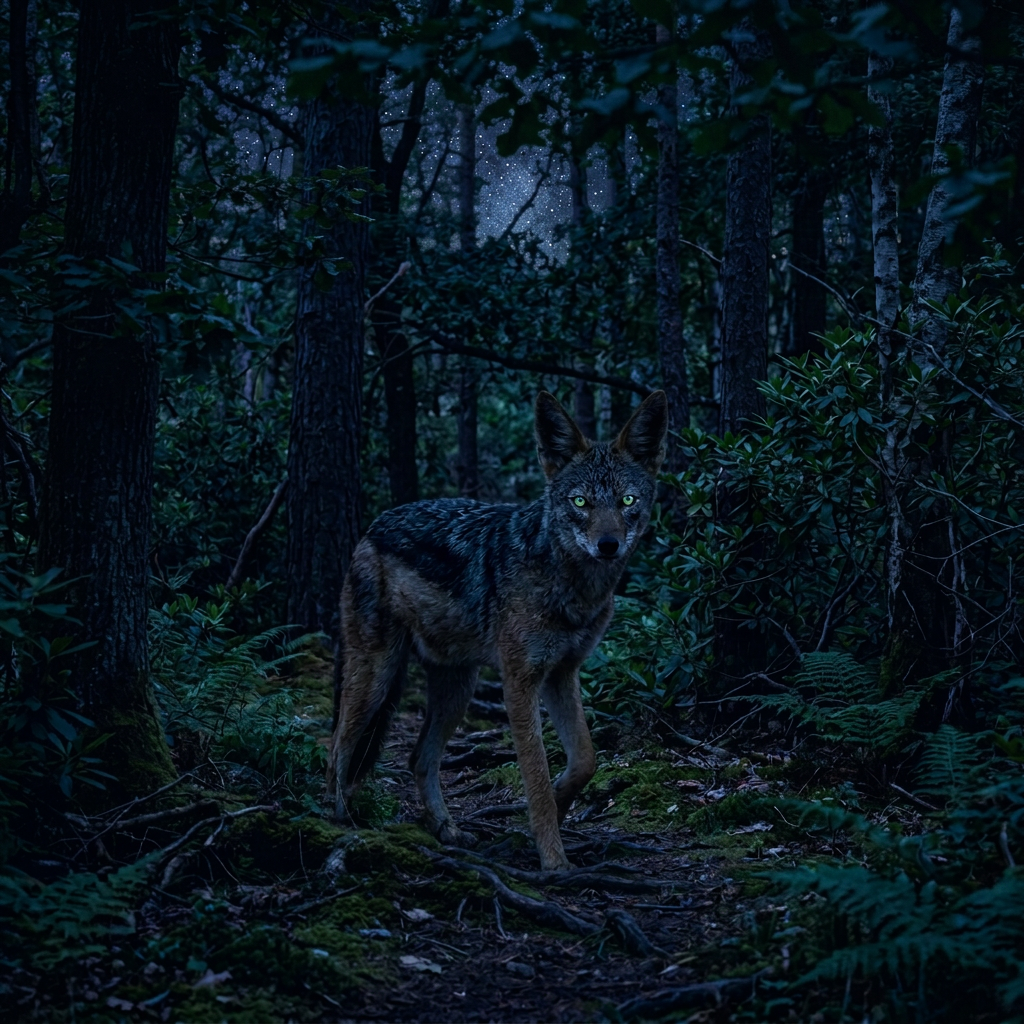
Jackal standing in dry grassland beneath a colorful dusk sky


[Part of a longer story titled “Jump“].

O Partha (Arjuna), happy are the Kshatriyas who gain such a battle that comes of its own accord, opening for them the doors to heaven.) — Chapter 2, Verse 32, Bhagavad Gita

He slept poorly and awoke early in anticipation of the mission that night. Then he threw up several times. It was a familiar dread, pre-jump jitters. Not just performance anxiety, or the fear of death, nor the heavy regret of knowing he placed himself in this extreme, and insane predicament voluntarily, nor the envy he feels at breakfast, seeing the carefree jocularity of the ground crew, and the meteorologists, who would never directly enter battle, let alone fly to the roof of the atmosphere itself, and leap into almost pure, frozen space, a half-assed astronaut, a momentary falling spacewalker, until the double-bag static line finishes unfolding, and holds him in a tug-of-war between the canopy pulling up, and the heavy load of his equipment, pulling down.

And then of course, what follows.

But something else was weighing him down now, and had been for quite some time, slowing his every step, as if he were sinking in sand. And it was preventing the boost of adrenaline he’d soon need.

A few hours prior to rigging up, he was hanging out with his “stick” (his paratrooper team) and they were ribbing each other and shooting the shit. Their last moments of relaxation.

But he could never banter very well. He sat on the floor with his back against a door-jam, enjoying the mild grinding pain of the spine against the edge of the jam.

This was his first serious combat jump, a HAHO deep into enemy territory to take out a relay post, and then bushwack back to safe ground, in what’s called an overland exfiltration. In about an hour, they’d start the elaborate procedures and checks and rechecks that took up the better part of 3 hours, prior and during the flight, which was going to be a long one.

Then they’d ride the canopy for a long way this time, about 30 miles, to a drop zone (DZ) in a narrow clearing in the fairly dense coastal forests and then make their way to their objective.

And only then would the real work begin.

Read More »

Jump

For Walter Cybulski, exceptional poet and humorist bar none

[The Introduction will make this story a little clearer, maybe]

His Father’s Circus

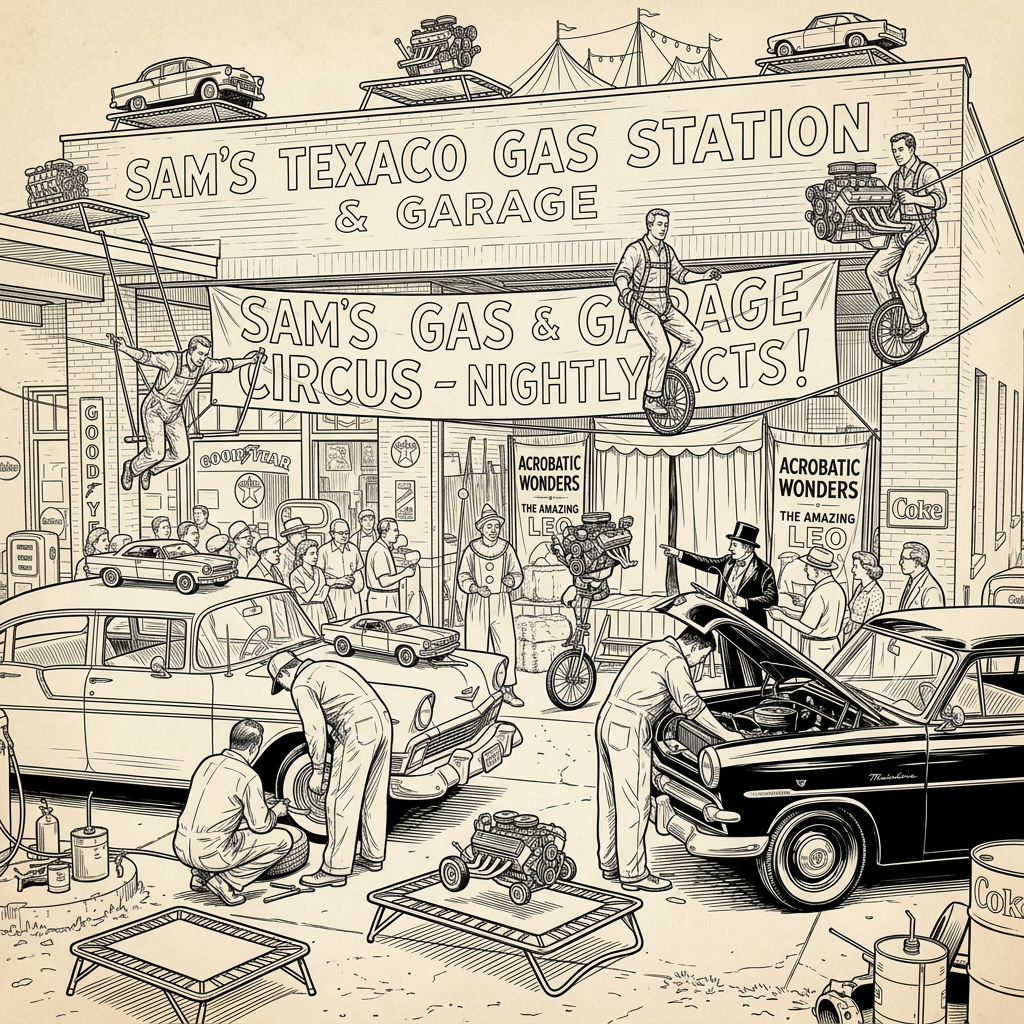
1950s gas station with circus act, spectators, mechanics, and classic cars

As a very young boy, his father ran a gas station. He was a mechanic and always carried a gigantic wrench, that was nearly 3 feet long and twice as heavy.

And when he wasn’t working on cars or trucks or busses or tanks, he would swing his wrench, and throw it high in the air and catch it, like a heavy metal drum major. And people would drive long distances just to have him fill up their tanks with gas, so they could watch him perform. And he would do somersaults out to the tanks and backflips all the way back to his office. And when he wasn’t working on cars or tanks or trucks, and the lines at the gas tanks had thinned, he’d finally close shop for the day and wander into the bar across the street and ham it up with his friends.

And the small boy would tag along, at first attached to his mother’s bosom, then to her hand, and finally alone, behind his dad, just large enough to be hoisted on the bar stool by a rough hand, and then given a little boost, and finally able to climb the bar stool by himself and drink coca-cola dribbled over huge tankards of ice, chewing the ice, absent-mindedly, while his father laughed and whistled and wagered fortunes on how many pushups he could do in an hour, or whether he could withstand a sledge hammer to his stomach.

Once, a dancing bear happened to be in the bar, and challenged his father to an arm-wrestling match, and the bear won two out of three, but never came back to challenge anyone again.

When the boy was 8 years old, he quit school to become a soda jerk, and got a job next door to his father’s garage. And over the years, as the garage business grew, all the other businesses in town grew by proximity, and profits skyrocketed all around. You could hear the sonic boom for miles.

Read More »

Introduction to the story “Jump”

“Can we rely on Jane Austen’s picture of landowning England with baronets and landscaped grounds when all she knew was a clergyman’s parlor? And Bleak House, that fantastic romance within a fantastic London, can we call it a study of London a hundred years ago? Certainly not. … The truth is that great novels are great fairy tales…” (Vladimir Nabokov, “Lectures on Literature”, page 2)

First, this is a strange story. It combines tall tale, fairy tale, absurdly narrow-lensed realism, realism itself, surrealism and mysticism (in that order).

Hitching a ride to this story would mean climbing aboard a vehicle with a real Mack Truck cab, 18 oversized cartoon tires and a trailer made of wispy dreams. It might not engender confidence in the driver of this tale.

So, here’s some help in finding an order behind the chaos.

One of the more simplistic questions this story asks is: “What would happen if a paratrooper became “enlightened” (let’s call it that) while falling into a war zone?”

But more completely, it’s the story of a person’s life told in vignettes, and short stories that “jump” from one stage to another, from childhood to deathbed. And each vignette is composed in a style characteristic of the character’s point of view at that moment.

So, for instance, the first one’s in the style of a tall tale, for the boy saw his father as a kind of Giant, as many kids tend to do.

The details of these tellings are nevertheless significant. The events we recall from earlier times are always a little tall in the telling, stretching real experiences into lopsided renderings that might as well be called fairy tales.

Read More »