Cliff Diving: The Dangerous Leap into Suspension and Proprioceptive Flight

Photo by Francesco Ungaro on Pexels.com

I’m forced to decipher the order that is slowly unfolding on its own. That is, this isn’t really an inquiry through words or logic of a thinking mind, but a way for words and logic to catch up with a wider perspective than a thinking mind can know.

It’s as if something non-rational is trying to recalibrate the rational mind so that it doesn’t block access to a larger perception.

And I’m not sure of my role as a speaker entirely. The speaker seems to be necessary in some way, but it’s not central to what is happening. Currently it seems to function mostly as a filter, to help organize certain features of reality into a workable personal relationship to the world.

But this worked-out relationship to the world – not only this sense of Self, but also everything this form of Self demands, such as power, prestige, and economic and national systems to promote all that – is leading to self-destruction.

The culture keeps looking for new ways to improve the filtering function of the Speaker or Self (which is to say, improve the moral quality of this fictional approach to the world); and we also keep looking for ways to improve the economic and national systems designed to promote the function of the Speaker or Self (which is to say, we keep looking for social solutions to this psychic and spiritual crossroads).

In other words, we keep employing one of two main ways to handle the approaching apocalypse: 1) Try to improve one’s Self; and 2) try to improve the culture that promotes the Self.

Read More »


… And Now I don’t

Photo by Gelatin on Pexels.com

I made a big and interesting mistake in trying to ascertain who you are in the essay “I See You Now.” Even the title sounded threatening. But this is what Negative Geography was built to handle — a place where I can stare back at my own footprints in the subtle mud of language and decipher where I go wrong.

And some of these mistakes reveal ancient confusions, ancient in that they are not entirely personal mistakes, but self-injurious reactions to transgenerational traumas as Mate tends to describe it, stretching back through human history beyond reckoning.

From one angle, this is the kind of mistake that our parents wisely warned us against — staring too long into the image reflected in the water, because we’ll drown in confusion.

However, I’m no longer susceptible to this fear. I think it’s because I already drowned a long time ago and now I’m beginning to crawl back to the shore like some kind of primordial shape, picture a mud puppy if you need to.

The first surface mistake was in devaluing the deeper personal and impersonal relationships I have with many of you. You aren’t some abstract conception of an Other; you are not merely mined for your value and then discarded, which is what I described. But the image I hold of the person listening is mysterious to me still, as if I’m picturing a mind that is still forming; but one that is partially revealing itself in many of you; and sometimes even in brief exchanges with strangers on a bus; with everyone who carries that charge of honesty that can change a life; and all this feeds the image of a wider mind that is listening, a real mind, in flesh and blood. And I made the mistake of accidentally discounting the fact that this potential is visible in real people reading, and is not abstract and disembodied.

So this led to the the second surface mistake — a failure to acknowledge how important these ongoing dialogues with you are in everything I write.

The underlying error, however, is solipsism. But solipsism is not merely a fancy way of describing a self-centered outlook.

Read More »

Technical Note on Why the Last Essay Isn’t Really About Writing

Maybe what I’m really after in speaking of an imaginary “you” and “Me” is a rapport with these persistent thoughts of self and other, these imaginary beings that occupy center stage in life. I’m not interested in being a writer, it’s not my career. But in looking at the dishonesty of thought honestly I’m dealing with a communal mess. And part of the resolution of a communal mess will necessarily involve communication of this sort.

Writing provides the opportunity for an elongated span of attention on these matters.  But it’s not the only way to approach all this. So it’s not about writing, it’s about the communal movement of thought. In any communicative case (speaking, fighting, using sign language, doing math) the same issue looms that I was trying to contend with — what to do about the self-image that insists on acting like a middle-man at all times, even poking its ugly little head between two embracing lovers more often than not in the form of anxieties and worries. This spoiled brat of thought has to be the center of attention and is constantly driven by insecurities, because it is by nature a deception, a projection posing as a reality.

So the question tends to be, how do I look at thought honestly knowing full well that a fictitious “I” or “me” will inevitably intrude on the scene demanding to play a central role?

There are a million ways to handle this and all have been tried in these essays, with varying effects. The one is to do what is being done in this paragraph, which is to refuse to use personal language and speak from the third person’s perch.

Read More »

The Need for Comedy and Illusion

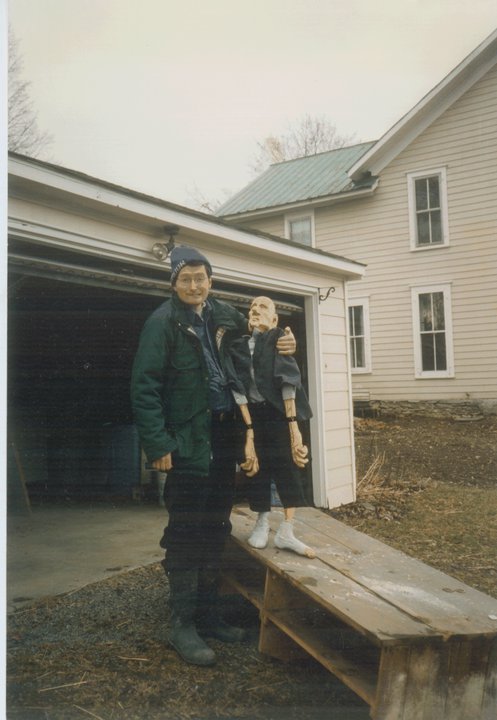
Vladimir and the author.


The problem with essays is that they tempt the writer to speak from a podium of sorts, as if he or she (let’s say he, because I’m talking about myself obviously), as if he were Walter Cronkite, the last representative of the True Believers in solid facts at the center of life, fading out to extremes of fantasy on the left and right.

But that’s not a valid picture of honesty, because there is no solid center if I am learning. The center is precisely the place where suspension and uncertainty live. Nothing is known; all is shifting perspective.

But in saying this I end up sounding like I’m standing at a podium again, and the hypocrisy this generates is fascinating, if nothing else.

Essays generally leave a stench of dishonesty no matter how honest they try to be. I think there’s another way to write essays, and that’s what I’m exploring.

I wish I could ask the reader to bear with me while I say this next sentence, because this statement is just a door to a larger room, but here it is: I’m not really interested in helping anyone. That’s not why I write. I write because I enjoy tracking down and confronting my own dishonesties.

What I am, at best, is honest about my own dishonesties. And I DO think that facing dishonesty is a good thing for the culture, because the culture is not facing its dishonesties, and I’m pretty sure that this will shortly be the cause of our extinction. But even if I feel this way, that’s not my motive.

I think it’s the other way around: I don’t think I can have a motive if I’m honest. I think I can only have a motive to be dishonest. Honesty is merely being without duplicity. There’s no effort involved if there’s no duplicity. So honesty is an empty condition, negated of all efforts, which are in fact efforts to hide from myself. So honesty is incredibly lazy, a slacker of sorts. There’s nothing moral about it. I do nothing and I’m honest. If I do something about it, then I’m squirming, looking for an advantage, an improvement, anything but the truth.

Read More »

A Return to Animism

The glen that thinks

Is it too small a story to say I do things independently, as if I were an outside agent? Is it more reasonable to say that it’s the environment that thinks through me and through every tree, bird, person or breath of wind, each an energetic and idiosyncratic manifestation of earthly intelligence?

This body becomes an aspect of its surroundings the moment the assertion of my differences ceases. if I’m not constantly thinking about myself, I dissolve into the world itself.

It requires a story to create a sense of independence. Relax for a moment and I disappear. But disappear only as something alienated from earth and others.

You could tell the story that the woods “inspire Me”. But that’s a story that misses something large. Inspiration IS seeing that tree’s connection and inseparability from intelligence. Intelligence arises between you and me, between trees and me too, and the little stream below where I sit carries the voice of my own intelligence.

This may sound fanciful, but it’s a more practical vision, a more factual one. Less dependent on an imaginary being who somehow “sits in” this body, who carries the name “I”, a little director I used to call “Zingryo” as a kid, sitting on a throne behind the eyes. He is “me”, and when he thinks about himself he is thinking about an Other of sorts, as if this Self he is thinking about were somehow still outside him, always one step removed, as Beckett observed.

Read More »

Why Am I Writing?

Photo by Ann H on Pexels.com

I don’t write because I know something. I write because I don’t. This is the narrative of someone who isn’t fully developed and never will be, and who sees things partially.

Writing occurs when a growing tangle of questions (or contradictions between my everyday life and a wider, less self-defensive perspective) becomes uncomfortable, much like a hairball in a cat. So I’m forced to disgorge this tangle in the form of yet another story or essay.

However, it’s not as if there’s a Right answer to anything and all undeveloped perspectives are simply sophomoric. Every definitive conclusion to my questions and contradictions would remain sophomoric (I remind myself), because there is no positive answer, only negative observations (of what is not true).

But this absence of certainties doesn’t imply the absence of honesty. At any stage of development, at any consistent depth of perception, I’m honest to the degree allowed by that particular depth. At a certain depth, the honesty may be only verbal. At another it may be more behavioral (trying to live up to moral codes and such). Or at still another it might be self-lucidity, the ability to recognize the persistent failure to live up to codes, and the kindness inherent in not trying to be perfect anymore, which is an honesty that exceeds morality. They’re all forms of honesty, but some reach deeper.

Read More »

The Delusions of Me, Myself and AI: On the Origins of Our Crises

Photo by Ru00fcveyda on Pexels.com

This appeared on Dissident Voice.

“Do I need to justify what most call philosophy? Aren’t all these social and political issues building into huge cumulonimbuses that demand a less solely reflective response? But look, a thunderstorm has its origins in the vibrations of individual atoms. And as an atom of this society, I need to examine myself, because whatever is driving me (and you) is driving that developing storm.”

“In other words, what is the role of individual perception in all these less abstract issues of immigration, governmental control, war, and the dangers of AI?”

“Well, I bristle at the word “abstract.” I’m saying that the storm has a concrete origin in the atom of my personality. There’s a dynamic there that translates into society. My personality is a twisted wreck of inauthenticity —  defensive denials, and bald declarations of pig-headed belief in anything and everything. I leap from one conclusion to another, rarely questioning any of them. Rarely learning.”

“Are you saying that society is a cumulative stupidity?”

“I think so. But on the “atomic” level it’s only me and you getting caught on what we think and usually staying that way the rest of our lives. It’s not just stupidity, but a stubbornly self-enforced stupidity, which is beguilingly odd. There’s a clarifying thrill in this, like being trapped in a small cell my whole life and suddenly discovering that there are doors everywhere in the cell that I’ve simply refused to open. Every resistance in myself is a door I refuse to open.”Read More »

Extinction and Responsibility: Why Climate Disaster Might Heal Us Even As it Kills Us

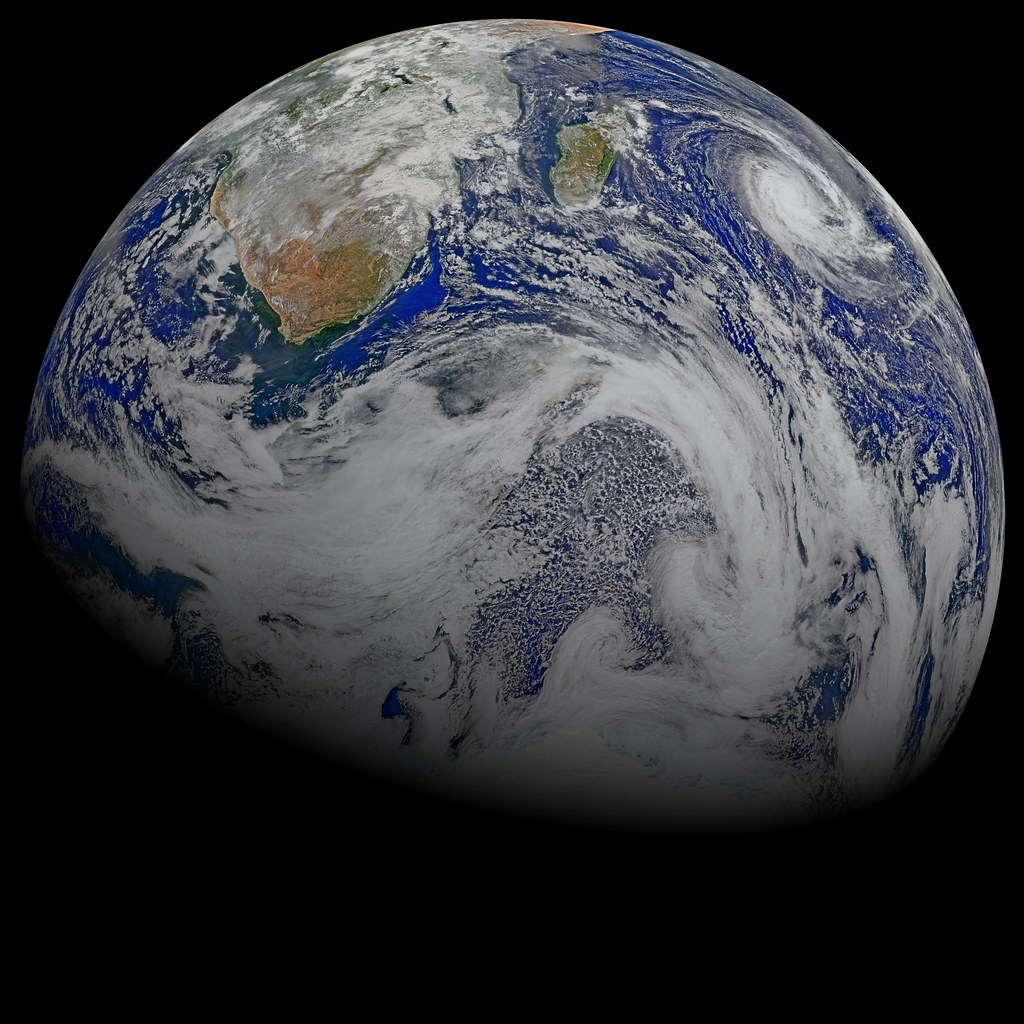
A Sky View of Earth From Suomi NPP by NASA Goddard Photo and Video is licensed under CC-BY 2.0

This appeared on Counterpunch.

Alice O’keeffe: “Even if we can’t escape its consequences, it is not too late to escape the mindset that brought us here.”

If climate disaster has left us with no future do we still feel responsible to the earth that outlives us? Or do we say “who cares?”

If we say “who cares?” then our sense of responsibility was never anything more than a moral rule, a business deal of sorts, where we agreed to behave honorably as long as we were allowed to project our egos into future generations. But I think real empathy for a world without us is still possible, and I think it matters in some way that can’t be calculated on a strictly transactional basis.

The possibility of near-term extinction is new, but the underlying dilemma this presents is as old as the Big Bang, or older. Death is death. It comes to the individual as surely as it comes to the species, the planet, and the exploding universe itself. What’s different now is only this onrushing inability to avoid facing this fact. And I think this is a good thing, because it forces a confrontation with the many reductive delusions that have limited our creative participation in the world, which is our responsibility to something more than ourselves. The chief among these limitations has been a strict and too literal image of who we are, an identity that keeps us trapped in a solipsistic circle.

Read More »

The Radical Derelict: Giving Up the Work Ethic for Peace

by thegetty is licensed under CC-CC0 1.0

This appeared on Counterpunch and Dissidentvoice.

The same relentless energy driving a toddler in its Terrible Twos still drives that voice in my head. However, when I see a toddler, I know I’m in the presence of a genius, albeit a naïve one. It’s not the size of the intellect, but the velocity of learning that describes its intelligence. I, on the other hand, tend to move in well-worn circles, constrained by prejudice and vested interest. I’ve learned to “circle the wagons”, so to speak, around particular conclusions.

Essentially, I’m what happens when a toddler’s unstoppable urge to learn gets diverted into supporting a predatory status quo. Open-ended learning gets replaced by a narrowing framework of instruction as the driving force; and a dawning sense of some innate order or intelligence in the world gets short-circuited by dependence on authority and by conformity to the culture’s creeds and isms.Read More »