I wonder if bad eyesight is caused by a disinclination to see the look on other people’s faces. We blur sight and retreat to senses which are less susceptible to duplicitous signals. So, the eyes atrophy or wear out with misuse.
When I take off my glasses, I end up listening more closely. Then the Other listens more closely too. And all they can see in my own blissfully blurred face is a good-natured ignoramus, which tends to awaken a spirit of charity, if not downright pity. Thus, we both become transfigured so long as at least one of us remains blurry.
The centrality of myself remains stubbornly pre-Galilean. *
What I “know” of another person is only my story of the story they tell about themselves.
Our personalities are merely characters in imaginary dramas. When the drama shifts, the personality shifts. If the drama ends, “we” end. Hence, we cling to dramas.
The imaginary voice is speaking to an imaginary person. The “I” and the “self” that are being addressed are both part of the imaginary performance.
Yes, it’s an inquiry into myself, but it’s not about “me”, as in my personal history or problems. It’s about the common momentum of thought that runs “me.”
If we make this conscious distinction between thought and being, then we are able to move in and out of the shapes imposed on perception by thought and language. This allows us to remain somewhat aloof from who we think we are.
Whatever we are, we’re not found in passing thoughts. They are merely the traces of our passing.
I learn from everything that goes wrong, and everything is always going wrong. *
I don’t write because I know something. I write because I don’t. *
But it’s not like I’m trying to do something. It’s more like something else is trying to do something and “I” keep getting in the way. And all this tripping over myself to avoid what it wants looks like “effort.” It’s a seductive pretense.
Writing happens when effort fails.
The only light the “I” produces is the light of its own combustive friction. This friction is produced by trying to avoid the revealing light of awareness. This friction is the cause of Hellfire. Hellfire is the light of heaven burning away.
Self-discovery is the discovery of nothing.
Self-discovery is the exploration of the cosmos, because the discovery of my absence is the discovery of everything else. But we turn our backs on this larger Being merely because it disturbs the small image of who we thought we were.
Writing is neither a means to an end, nor an end in itself. There is a third possibility. Writing is merely what happens when I’m learning. It’s a necessary corollary of the process, but neither a means nor an end.
If a necessary corollary to something larger is repressed, then the larger thing also can’t form. But we still can’t focus on the corollary as a means towards the larger thing.
I say things after I already know them. I know things silently prior to speaking. I speak in order to hold the surface image steady against a barrage of anomalous information.
The morning shadows are a memory of night. They seem to long for the dissipating darkness. Reluctantly, they retreat, until they are cowering under our feet by midday; and then by late afternoon, leaning once more towards the returning dark.
How can a timeless “now” squeeze between these ceaseless shadows?
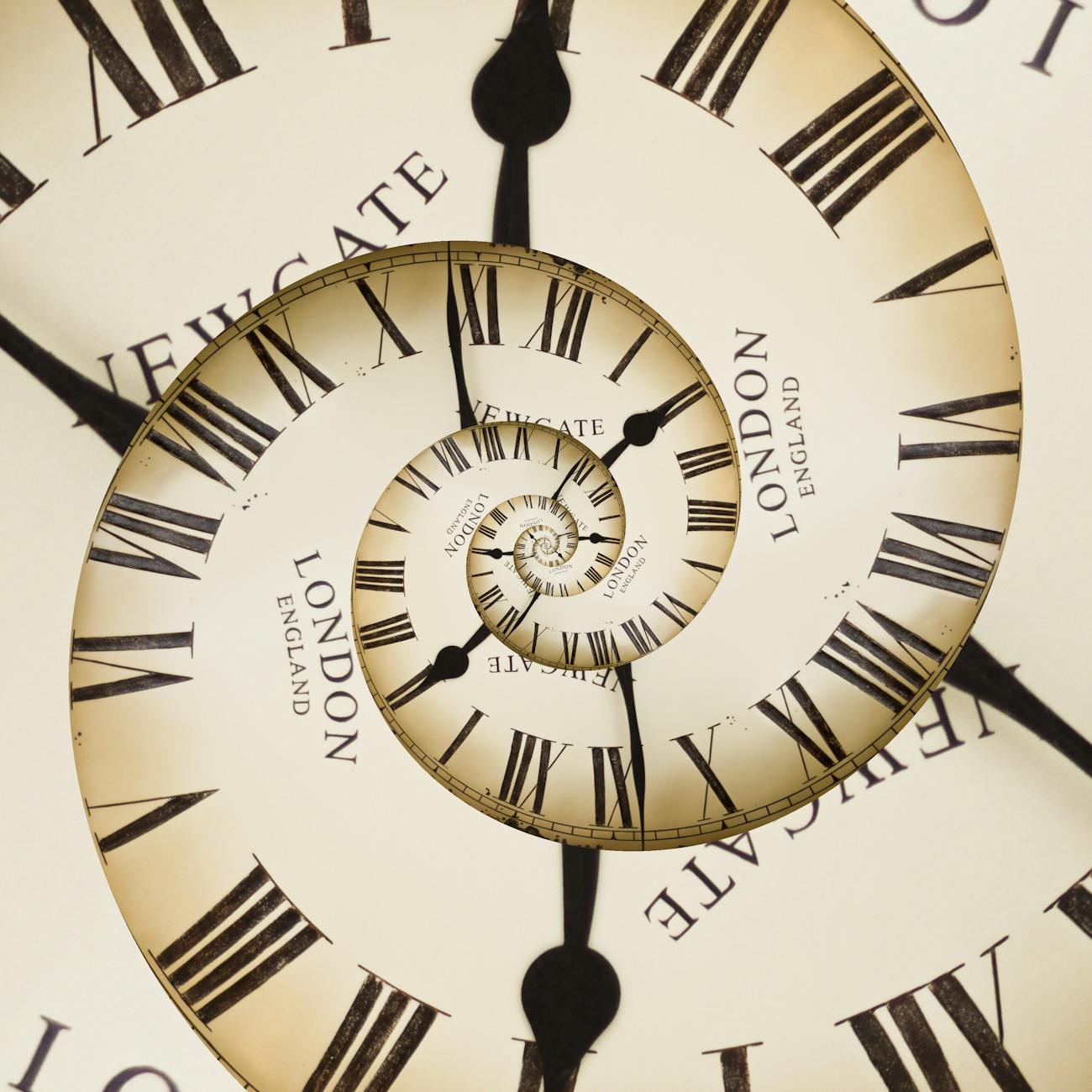
The clock, too, is ceaseless. There is no space on the clock face to mark a “now”.
Maybe the clock is only a map of a timeless territory.
Or, perhaps the clock is a spinning prism through which the mystery of time and timelessness can be seen in different slants of light and shadow.
But even a full circumference of 24 hours will not resolve this mystery. Because everywhere I look, I see only the limitations of human perception, not the limitations of reality itself. So, I can’t “know” time, only these slanted perceptions.
Perhaps time can’t be known because there’s no replication possible. Look, this golden-hued sunrise doesn’t hold quite the same golden hue as yesterday’s. Every morning, the clouds change, branches and leaves have fallen, breaking the light a little differently. And my sensitivities change also.
So far, the earth has experienced about 1,658,195,000,000 mornings, and every one of them was different. Maybe the clock never completes a perfect circle, but spirals beyond measure.
Maybe the techno-futurists are wrong, and we’ll never travel to a previous time, or live forever, because something always dies, no matter what. We will always leave someone behind, or some part of us. Or, we’d return knowing what we didn’t then; which would make it something new; not the past at all.
Our desire to escape the anxieties of time leads us unwittingly towards an inanimate repetition of a deathless world; a perfectly circular and repetitive mechanism; an escape from the spiral of renewal, which requires dying to the past and future, as Krishnamurti pointed out so clearly.
Look, already, the early morning hints of spring have vanished under a wintry sky. I have never known a morning like this.
I’m writing the persons who will replace us. At present we can only see the magnetic flash of someone in utero; that potential, which is more communal than personal. Some fetus audacious enough to see through its own charades.
I’m writing because this is the performance of a new way of being, this is how it begins to take shape. It’s you and I facing our shame, not I alone.
We don’t give birth to a new being by ourselves. This is an alchemical experiment, a shamanic dance. The eyes dance the words, and this ceremony creates someone capable of seeing the Self as a construct of self-deception. A way of being rises from the ashes of who we thought we were.
Imagine the courage it takes to not fool yourself.
Even the imagination of this person can’t be sustained without deception. The effort to do so creates a positive ideal, which is a desire for transcendence, and that desire is opposed to being seen as a fool. It doesn’t want to see how it fools itself. It hides from reality and never acknowledges that it does so.
This is the origins of our political situation also. The system is running from reality as fast as it can, right into the arms of a narcistic dictator.Read More »
Time to summarize where the series on freedom has gone up till now.
The only concern of these essays is the restoration of the earth’s health.
But how can something as pathetic as an essay contribute to the healing of the earth? The same way any other action performed whole-heartedly contributes, the same way any white blood cell encountering a virus contributes to the healing of the whole population: By realizing and metabolizing the world’s poisons as they circulate within this holograph of the whole, called me. By being an example of healing, by facing my diseased self honestly, allowing the old patterns of identification to die, as they should have died thousands of years ago, before the disease suppurated.
Honesty is the painful act of healing. It’s also the most rebellious act one can undertake in a deceitful world.
This isn’t about learning to play the violin while the world burns. None of these essays are about personal advancement or personal adjustments to a world in its death throes. Those concerns make me sick. I mean “sick” as an accurate metaphor, because the world’s sickness is rooted in a frame of mind that is selfish and short-sighted. We are heading towards extinction from too much personal concern.
People talk about lucid dreaming. Just once I’d like to be lucid when I’m awake.
I arose from blessed oblivion again this morning. It’s a shared oblivion that encompasses the origins of the universe itself. We share our beds with galaxies and comets in utero. The oblivion at the core of sleep isn’t the oblivion of lifelessness, nor is it a rejection of earthly existence, but a reunion with the primordial egg of undeceived Being at the heart of earthly life.
Every night we get the chance to recapitulate the origins of the world and awaken with a Big and creative Bang, which is not will, which is not choice, but a spontaneous eruption of something unprecedented in who we are. After all, we can’t choose what exceeds our comprehension.
I love the insistently hinting dreams of early morning. The timeless oblivion of the depths crashing on the shores of waking life, bending the scraps of memory so that they seem like messages in a bottle, warning me of the sleepwalking illusions of “being awake”.
There is a moment in the passage between fluid sleep and the seemingly solid ground of waking when you are neither. In that suspended space (an eternal space that only appears fleeting when you leave) you realize that the dreams of night were not real after all. And when you turn that same cleansed look towards shore, and peer through all the repetitive dramas of waking life, you see that they are no more solid than the dreams of night.Read More »
Last night I dreamt I was a Germanic medicine man, warrior kicking Roman ass in the Teutoburger Wald (my tribe’s version of the Little Bighorn). Dying in agony I was annoyed to discover that my wife was not tending my wounds, but merely nudging me in the ribs so I’d stop moaning in my sleep.
Despite my battlefield injuries, despite lying face-down in the swampy woods screaming in pain, I was not relieved to find myself back in this cold, bureaucratic, technological culture, although word processing is a nice addition. [See footnote on racial identity and the development of eco-fascism].
We’re all born mid-highway, spewing gas out the tailpipe, decimating forests for school projects, eating animals penned in concentration camps, privileged or lacking privilege, praying to the local deity, before we have a moment to reflect, through no choice of our own.
I just appeared here as a newborn in this historical timeline like a Chomsky Martian, and was quickly covered in all these decals and rooting for the team I got saddled with, no matter how often they lose.Read More »
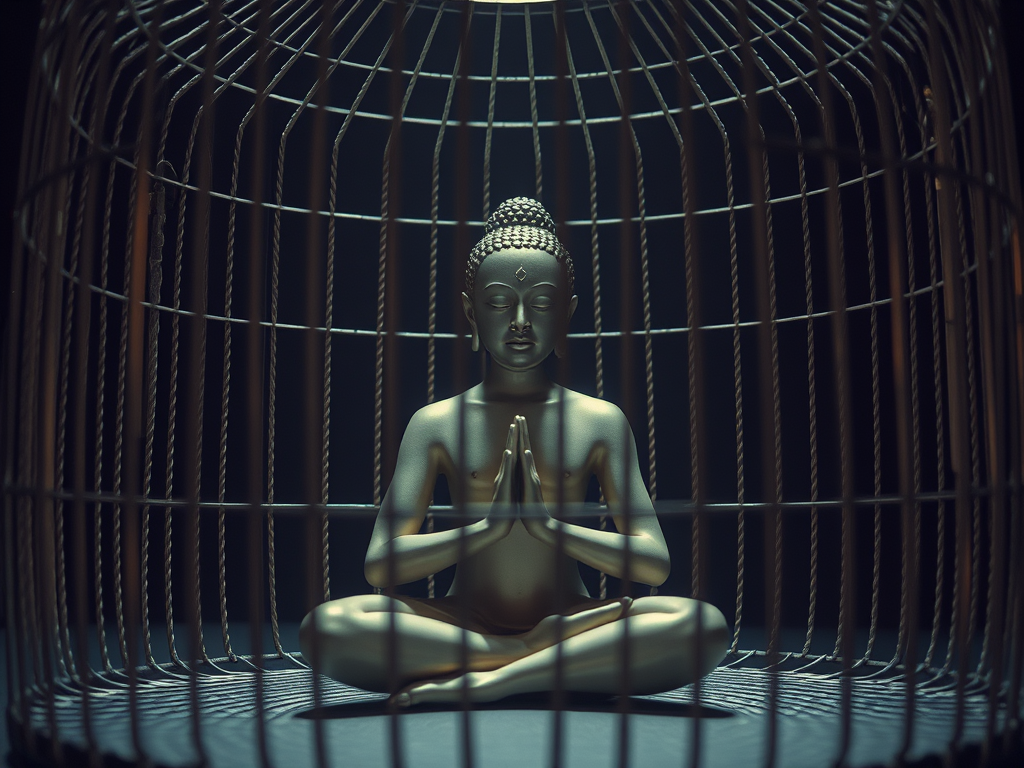
I can’t remain too long in any consistent first person, otherwise you’ll end up believing that I’m really me, and then I’ll be pinned inanimately to the page and unable to shape-shift as any living creature must if it hopes to avoid the tarpits.
Consider Me the ringmaster for what follows. I am part of the performance, just another circus freak, not the kind of Self you’d bring home to meet your mother.
Let’s dare to suggest I’m not even a living thing so much as a material swelling of words, thoughts, ideas, pictures, emotions, the chaotic surface waves left by the spirit of life as it hovered over the keyboard for a moment before passing on to better things. After all, the screen or page you’re reading is not itself alive. Nor is this picture of “me” that hovers over the page momentarily.
Or say instead that this picture of “Me” is a mnemonic shell that formed where life once placed its fleeting and immaterial finger. I am the fossil of something more lively that passed this way.
Or maybe I’m the detritus of memory, a junk-encrusted tumbleweed of ideas of myself, a messy and clanging assemblage of cans and can’t-do’s, recoils, crossed-wires and lost marbles. This would explain why I’m such a noisy sonofabitch.Read More »
The following hypothesis won’t be correct, but only at best insightful. From where I stumble through life, no human knowledge will ever be free of distortion, because we can’t pin down the nature of a morphing and multi-dimensional infinity. Therefore, I don’t want to construct a stable theory of reality. I’m offering a playful metaphysics instead, a suggestive cartoon (cartoonish in comparison to the dynamic world), a caricature that exaggerates certain features of reality that more conventional stories and theories have tended to downplay by exaggerating other features.
Metaphysical trips such as this are only built for the short haul. My exaggerated intention is to remove a dogmatic beam from the field of perception. Call it a cultural floater that is blinding us to wider potentials. What I’m doing feels practical, not academic.
Also, I’d like the reader to realize that these essays are not rationally planned. At this point in the essay I’m only pursuing a metaphor that now and then crystallized over the past few months. So I write my way deeper into this vague sense of a vaster formulation hiding in the fog of my own ignorance. I want you to know this, because this is an exploratory journey into the wilderness of ignorance, and I want you to ride along as it unfolds, not as a spectator reading a conclusive script.
Anything and everything, depending on how one sees it, is a marvel or a hindrance, an all or a nothing, a path or a problem (Fernando Pessoa)
Preface: I think the essay “Optimistic Despair” does a better job in this direction. But they do approach the same topic a little differently. It might be helpful to understand that I’m talking about problem solving in general, but also specifically how problem-solving relates to our entanglement in Thought, which is a problem that many people don’t even recognize as a problem.
————-
Why are problems sometimes interesting and sometimes frustrating?
I think if we’re too focused on obtaining a solution, a way past a problem, then the persistence of the problem can lead to despair and frustration. But if the problem itself is interesting, if its persistence is seen as the unfoldment of a mystery, then the problem is something we’re enjoying and we’re not merely trying to get rid of the problem.
When it comes to the “problem of Literalism” — which is the problem of thought, of being confused by our projections, as humanity has tended to be — the “solution” to the problem of Literalism is so rare that it either gets dismissed outright as an impossibility, or it tends to get labeled as “enlightenment” or “grace” or some other pedestaled conjecture, which are various forms of escape from the problem itself.
Most reasonable people will try to avoid tackling a problem that almost nobody in history has resolved, such as Literalism. From this personal angle, their hope of resolution is squashed immediately by realizing that almost nobody has ever solved this problem of thought, so why should they? Who are they to imagine that the solution is within reach? To avoid embarrassing delusions of grandeur and inevitable failure a seemingly humbler response would be to ignore the problem.
But this reaction is premised on the desire to get past the problem, rather than enjoy the problem.
But reasonable people don’t enjoy the problem. If they can’t get past it, they don’t want to consider it.
The problem is, we can’t enjoy a problem if we don’t recognize a possibility of resolution. But if we focus too much on resolving a problem, then we’re trying to get past the problem too ambitiously, which means we don’t enjoy the problem, which means the problem never resolves!
So most reasonable people get stuck between these two poles, hoisted on a double-bind that not only blocks any further interest but also wears them out.Read More »
Let me clarify the last essay, I think we can emerge from this trap of thought in time for the earth to heal. I do believe it, for what it’s worth. I’m not saying this as a spur to change, but as an observation of the nature of the problem itself. It’s not unresolvable.
We can change because the problem driving the world to the brink of collapse is a runaway imagination, thought that has no sense of itself as a creative fiction, which means we get fooled by all the red herrings that this imagination produces. Not just the usual evils such as status, power, money, but also suckered by all the well-intentioned solutions that are invented to counteract these evils.
However, we aren’t even coming close to realizing what this change demands from us. This is not the usual crisis we’re facing.
Every previous crisis in human history could be surmounted by applying our extraordinary capacity for imagination. This time we can’t.
Any species that develops this far in this direction would face the same dilemma. It’s a dangerous new power and we haven’t learned to use it in proper measure.
These dangers weren’t obvious over the vast course of human history. Population pressures weren’t enough to incite the imagination into hyperdrive. But as these pressures grew, more complicated products of the imagination appeared, such as agriculture, cities, governments, writing, and on and on. Products of the imagination became increasingly complicated, causing new problems faster than the imagination could be used to solve them. [Note, I have somewhat changed my mind on the inevitability of this problem, see comment below and “Notes on Closed and Open Views of Evolution”].
Essentially we entered into a predator/prey developmental relationship with our own imagination, inventing new forms to solve the problems caused by unforeseen complications arising in previous forms. And this has led to a logarithmic increase in products of the imagination and in the kinds of problems we face.
So up to this point we could say that we’ve only faced problems that the imagination was capable of solving, albeit by kicking the can of ever more complicated problems farther down the road. We are keeping one step ahead of a shadow that keeps growing larger and more menacing.
But now that road has shortened to a dead end. There is no room to kick the can anymore.
In other words, we’re beginning to realize that this two edged sword of imaginative development has grown into such a large sword that it’s going to kill us on the next swing.
Some don’t realize the implications of this development yet. They either fail to see the double-edged quality of so-called progress, concentrating only on the promises and not the perils of every new development of the imagination; or they can’t wrap their heads around the fact that this is not a problem like previous problems. They can’t see that we’re engaged in a logarithmic growth in products of the imagination, and that this has become a momentum that imprisons us. Technology is a steroid in this development, but not the real problem. The problem isn’t merely that we work for machines now, and not vice versa. The underlying reason why we’re susceptible to this enslavement is because we were already trapped within the products of our imagination.