[This appeared in the May issue of Pari Perspectives]
6am: Long Shadows
The morning shadows are a memory of night. They seem to long for the dissipating darkness. Reluctantly, they retreat, until they are cowering under our feet by midday; and then by late afternoon, leaning once more towards the returning dark.
How can a timeless “now” squeeze between these ceaseless shadows?
The clock, too, is ceaseless. There is no space on the clock face to mark a “now”.
Maybe the clock is only a map of a timeless territory.
Or, perhaps the clock is a spinning prism through which the mystery of time and timelessness can be seen in different slants of light and shadow.
But even a full circumference of 24 hours will not resolve this mystery. Because everywhere I look, I see only the limitations of human perception, not the limitations of reality itself. So, I can’t “know” time, only these slanted perceptions.
Perhaps time can’t be known because there’s no replication possible. Look, this golden-hued sunrise doesn’t hold quite the same golden hue as yesterday’s. Every morning, the clouds change, branches and leaves have fallen, breaking the light a little differently. And my sensitivities change also.
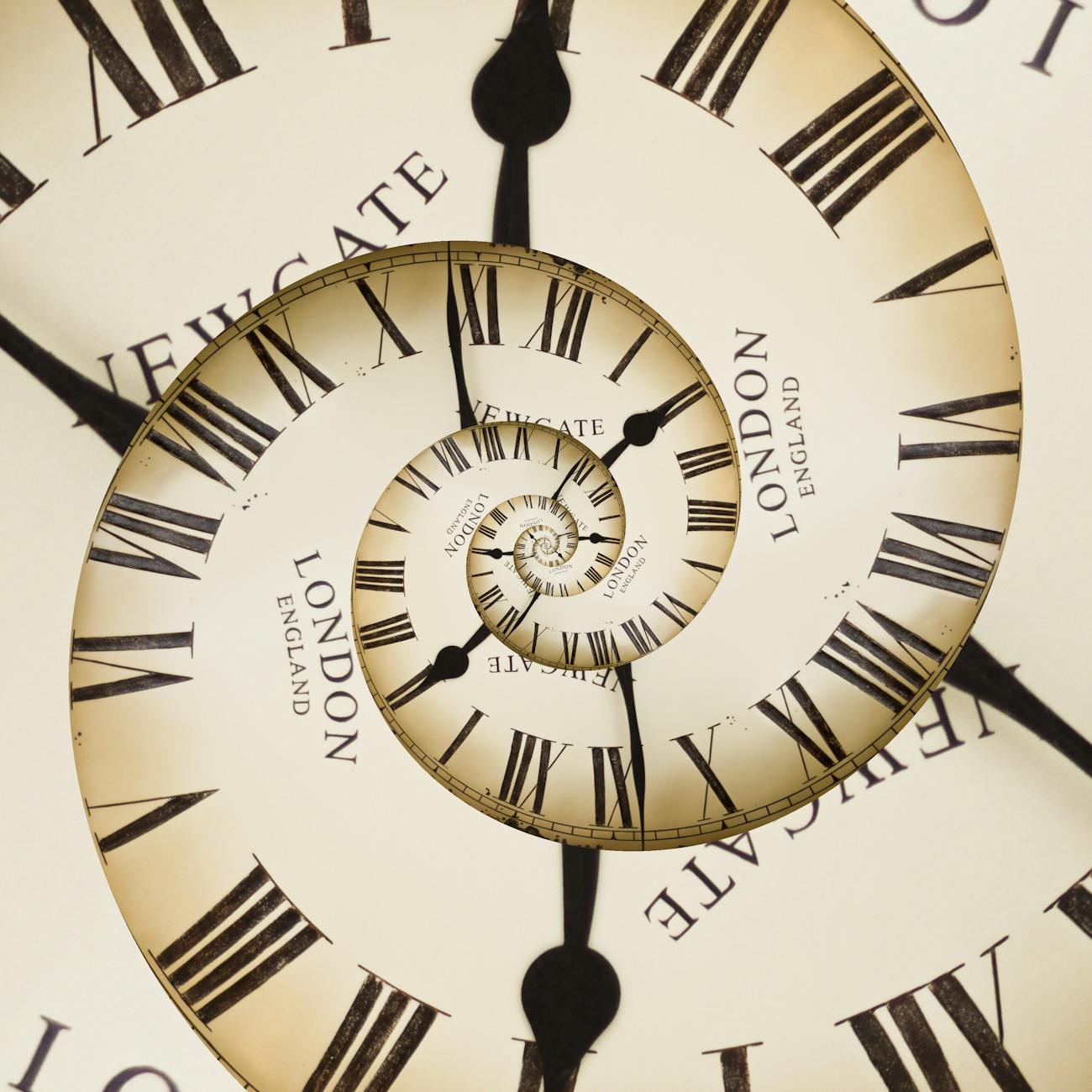
So far, the earth has experienced about 1,658,195,000,000 mornings, and every one of them was different. Maybe the clock never completes a perfect circle, but spirals beyond measure.
Maybe the techno-futurists are wrong, and we’ll never travel to a previous time, or live forever, because something always dies, no matter what. We will always leave someone behind, or some part of us. Or, we’d return knowing what we didn’t then; which would make it something new; not the past at all.
Our desire to escape the anxieties of time leads us unwittingly towards an inanimate repetition of a deathless world; a perfectly circular and repetitive mechanism; an escape from the spiral of renewal, which requires dying to the past and future, as Krishnamurti pointed out so clearly.
Look, already, the early morning hints of spring have vanished under a wintry sky. I have never known a morning like this.
Contradictions and Paradoxes at Noon
The midday light tends towards contradictory perceptions. It is the moment when the shadows stop shrinking and begin growing. So, we can see in an alternating light.
In one light, death may define time itself, by articulating a lifespan. But in another light, death extinguishes the shadows of past and future in a renewal that is timeless.
The first is a measurement of mechanical time, which acknowledges only a fleeting present. Death here comes only at the end of a period of time.
The second is a psychological urge to delay the challenges of the present, thereby inventing the past and future as a refuge – what David Bohm and Krishnamurti distinguished as “psychological time.” Here it is the death of the past and future — the death of time itself – which reveals a timeless present.
If this lands like an argument between the two, it’s a contradiction. But if the differences are intriguing, it’s a paradox that hints at a wider vantage point.
At noon, the illusions of mechanical and psychological time entangle us in two contradictory visions of the present tense.
After all, the midday shadows of past and future are at their lowest ebb. So, it’s a time of day when we’re typically too busy to notice the past that drives us and the future that obsesses us. This tends towards the sneaky illusion of already being present and fully awake. It’s easy to believe we’re living consciously in the present even if we’re only drifting between the shortened shadows of reflection and fantasy, which is only an ignorance of psychological time.
When I was in college, I recall a friend saying he was going to spend “the next 10 minutes at lunch enjoying the here and now.” I recall insisting that his intention was absurd. I told him that the goal itself set time in motion. I told him that placing a duration on the “here and now” is like placing freedom in a cage. And then I spent the next ten minutes begrudging him his tranquility.
What annoyed me was the oblique recognition of my own hypocrisy in thinking I knew what the “here and now” was all about, even while turning the issue over and over again — an obsession with the immediate past I was less capable of escaping than he.
This is the illusion of being present.
But our confusion can also result in the illusion of being trapped in the past and future.
After all, the shadows at midday may be easy to overlook, but they also never reach a resting point, which means that a perfectly shadowless “Now” can seem almost theoretical at this hour, like the invention of Zero.
Thinner than a pancake, “now” can’t even stick around long enough to taste itself. How oppressive this vision of “the present”, wedged between two towering giants.
3 Illusions: The Past, Present and Future
By 3pm, the second illusion dominates the busy day. Nobody seems to “have time” to be present. The past and future — reviewing and planning — predominate.
Nevertheless, some find ways to momentarily break the illusion of psychological time. Mountain climbers, for instance, pin themselves to cliffs in order to shut down the past and future, widening the moment by way of a state of emergency.
Call it an experiment with emergence. They force a confrontation with necessity, which can’t even suffer the small delay of being named, “the present.” Here there is no time for the idea of time. It would forestall a more densely rich awareness of our surroundings, which the emergency requires.
Hanging in suspension, the “future”, the “past” and the “present” all become equally fictitious.
This absence of time is an absence of anything that delays what is happening. Here we’re not getting dragged into the constant dramas of the panicking voice, impatient to escape the moment.
Hanging in suspension, we discover an intelligence in the absence of thought, which was both too impatient to notice nuance, and too slow to change tracks.
And in this absence, there is a rich density of experience that seems to slow the clock. The whitewashed walls of cliché over which our minds raced without reflection, dissolve to reveal subtle distinctions — crevices in our assumptions — that catch our attention and reveal realities we hadn’t noticed.
It’s a commonality bordering on the trite, but an intense experience can seem to stretch indefinitely. Ask the survivors of bear attacks, or military battles; or those who have “dreamed” entire lifetimes within the span of a 20-minute near-death experience.
In these emergencies, it may be only thought’s impatient inventions of time that have slowed down. And we have moved into a field of intelligence that is perpendicular to the slow plodding of mechanical time.
n this dimension, there’s an immediacy of intelligence that can move past the old sticking points without the need for words. And this immediacy is faster than light, which slows the clock in the same way Einstein suggested.
But in moving beyond the illusions of the clock, we’re not rejecting its creative genius as metaphor.
Look, every point on the clock is a turning point!
The great genius of the clock didn’t lie in its mechanics, but in its practical reduction of the world into numerical segmentations. Had we but played with this metaphor as a known fiction, it would have served us now and then, and not driven us like slaves.
But we thought the clock was real. It became an egregore that rose up to threaten us with deadlines.
The fiction of the clock doesn’t make it a lie, so long as we’re not duped by it. We can say Yes to this invention, and still avoid the conceit of technologists, who are too beguiled by the power of their illusions.
Now we can use words like “now” and “actuality” and “3pm” as helpful fictions, and obtain a fleeting foreknowledge of a timelessness these words can’t reach.
If Time is the fourth dimension, then at 3pm we have perceived a fifth dimension, a way to glimpse something beyond the illusions of time.
A 6th Sense
Twilight feels more real than the clearest deadlines.
Some claim that we are constantly occupied with the past and future because we are wary of repeating mistakes.
But if life is that dangerous, then why don’t we share the attentive qualities of a mountain climber? Why is our everyday attention dangerously deflected into focusing on what has already happened, or what might happen?
Why are we escaping the unmolested moment by retreating into a vacuous fiction of time? How did the absence of distraction end up feeling like a danger?
At dusk, my shadow blends with the dark, and I sense my own death in this. The moment my shadow dissolves into the dark, there is no past or future for me. If time ceases to be compulsively re-inflated moment by moment, I disappear. I am the central illusion of time.
Maybe a sixth dimension of time emerges in knowing how to die. It appears when we extend our recognition of time’s fictional nature to include me; this self that insists even now that it’s not a fiction.
And in this absence of psychological time, we feel the presence of the past (to emphasize Sheldrake’s phrase). Not the past as a separate reality; but the past as an embodied component of the present.
What we lose is a Self that is stranded in time. In its place, there appears a connectivity to the larger world that is paradoxically denser than matter itself. Look, all of history is condensed into our atoms, bones and brains. And uncountable stars gave their lives to make this carbon or this one unnamable moment.
This connectivity is love. It requires no travel time, because everyone and everything is already within us.
And we can also obtain glimpses of destiny, the presence of the future. But this presence resembles the open-ended creativity of a spontaneous jazz musician, who can strum the subtle chords of this unprecedented moment, and hear something of the song in its completion.
Or, like an athlete who can feel the flow of the game, and respond as if they knew what was going to happen; a telepathic perception of the densely packed potential in every moment; a knowledge of implications.
This is a form of time travel after all. But there is no pre-existing future or past into which it travels.
Nothing is waiting for us in some finished form, as the “long-termists” proclaim. This future is fuzzy, and requires the lightning strikes of unprecedented insight to mutate this present form into something we can’t entirely anticipate.
At 6pm, I can only obtain these precognitive visions of a sixth sense. They are moments when dimensions perpendicular to time open and close as small anomalies in the persistent illusion of me.
At twilight, we seem to pause at the brink of a larger turning point, a more extensive mutation.
Nein!
At 9pm, clouds deepen the darkness.
This sense of self seems stubbornly pre-Galilean. Despite the earth’s demotion from the center of the galaxy, the “I” still clings to its own centrality.
Something has changed, no doubt. While traveling these spiraling orbits of time, the vacuous core of myself has been exposed and weakened. Occasionally, I seem to evaporate as a fiction in the face of something timeless and unnamable, which supersedes who I think I am.
But there must be a “Kuiper Belt” at the outer boundary of this self-centric system – a boundary between time and timelessness, which I can’t cross.
Because I return from these hiatuses mistaking the memory of these events for “my own.”
This is why the self always wants to name the timeless source. It wants to transfer its identity to this greater centrality, and thereby continue its illusion of evolution.
But the source remains unnamable. Like Gandalf, it commands that the egregore of self “Shall Not Pass!”
The biggest paradox of the day is the paradox of evolution. Yes, the spiraling clock is a depiction of evolution itself. But as Krishnamurti pointed out, the person we hold most dear at the center of this spiraling clockwork cannot evolve. That person must die before the new hour can ring.
Midnight
The sky has cleared, and the Milky Way looks no more distant than low clouds.
Science informs us that the stars are no more real than home movies; merely re-runs of the deep past. And a similar delay occurs in our perceptions of one another. There’s a material speed limit. Our brains can only process the biased past tense of one another.
There is despair in such single-minded knowledge; our age seems oppressed by it; aware only of this isolation in time and space. We’ve been reduced to single points of data; food for prowling algorithms.
In this solipsism there’s no hope of global harmony. And in secret loneliness, some return to old surrogates of a savagely imposed unity, such as Fascism.
This is true in my own country, which is trying to time travel to a past greatness, where all traces of genocide, slavery and imperialism have been whitewashed away. We are trying to delay the death of a fictional image from the past.
This time-obsessed resistance to death is mainly a western phenomenon, which indigenous cultures did not share as often or as radically. Algonquin people used the term “Wetico”, or “mind-virus” to describe it. And the great writer Leslie Marmon Silko (of Laguna Pueblo descent) described this as a “witchery”, for which her book, “Ceremony” was itself a healing ceremony.
This sickness is the real cause of the climate crisis. We are heated molecules rising in emotion.
Of course, these scientific measurements of our separation in time and space are valid. But they are only the reflections of a single pane of the prism of time; an insightful fiction that has become a single-minded illusion of “the whole truth.”
Just before midnight I fell into an extended dream on the verge of sleep. It will seem Utopian to a culture swept up in violent land-grabs, invasions and genocide. But it’s not a practical proposal. It’s a test of reflexes.
Will a cynical despair automatically reject the possibility of a society that knows how to live without conflict? Does our cynicism betray a fear of losing an illusion of identity tied to historical dramas?
But it’s not a futuristic Utopia. It’s only a glimpse of the maturity we have largely lost. It only requires holding our points of view – even ourselves — in suspension, as insightful fictions.
The Haudenosaunee could be our inspiration; the way they talked around an issue from all sides, transforming contradiction into paradox, until they obtained consensus without coercion.
From this conception, the embryonic society would grow without borders. It would retain only the governance necessary to carry out practical tasks. Nobody would drape these practicalities in a flag. The known fictions of our identities would short-circuit the rush to war.
Our cultures would form as a reflection of the land itself, and no less colorful with nuance. And these races and religions would constantly mix, merge, hybridize, bloom and die. Nobody would prevent the necessary migration of populations; and there would be nobody forcing anyone to leave their homes. We’d allow ourselves to be absorbed by new myths, and new rituals.
We would allow ourselves to constantly die and be reborn. This requires a psychological freedom from the past. And it would paradoxically recognize the presence of the past and the presence of the future in everything; and that everything we lose in the passage of mechanical time contributes eternally to what is new.
The conditions for growth are only the realization that all knowledge of time and self are fictions. But these fictions are also not illusions. These are the paradoxes that serve as the womb of a new society that is forming now, not in the future.
We can’t fight or flee our way past these endless anxieties of time. We can’t “get there” from here. The here has to change.
We can only turn perpendicular to the momentum of escape and notice what is already happening. Timelessness is the ending of an escape from escape itself. This alone breaks the link in time’s chains.
Then the metaphors of our death multiply. Then this “Kuiper Belt”; this persistently hungry ghost in the machine of time raging against its approaching deadline; this chain-link cocoon protecting an egregore of Self (a fiction that doesn’t know it’s a fiction; a time-inflating motor in the clock); this whole “system of thought” (Bohm), dies.
And after centuries of Wetiko, the real human being, beyond all brand names and borders, emerges from its dormancy and unfolds as a portion of earth’s own destiny.
“Death is the mother of beauty”, wrote Wallace Stevens.
But all we are doing in dying is letting an inanimate shell of thought fall away, which we had mistaken for the mystery of ourselves.
Midnight is the death and rebirth of the day. Now the chthonic tonic of dreams cleanses the brain of yesterday. And our lost confidence in who we thought we were has become a creedless faith in what lies beyond our grasp.
 Negative Geography
I am amazed that you can put this down coherently. This is tough stuff to walk through. I can see it happening in conversation/discourse… but writing it down, and making it digestible, is quite an undertaking! Mighty impressive. Thank you for sharing this.
LikeLiked by 2 people
Thanks for reading!
LikeLike
[…] The centrality of myself remains stubbornly pre-Galilean. * […]
LikeLike
[…] Maybe the clock is only a map of a timeless territory. * […]
LikeLike