Solipsism

Photo by Marlon Schmeiski on Pexels.com

“Jackal” provided a way to describe a solipsistic trap I fell into when I was 13. I had to let a “character” who is not me embody it for himself.

I don’t want to make this about a supposedly real “me” and draw all that attention into this false face, this red herring (this personal story.) I don’t want to take this drama of myself too seriously. It’s just a story, one of billions.

I mean, I didn’t suffer more than you. Much less, than most. Except in this one chapel of Hell. I think we’re all in some portion of Hell, as far as I can tell. But my understanding of hell is that it’s a mirage of deceptive thoughts obscuring an inconceivable and (therefore) sacred mystery, which exceeds the goody two shoes moralities of every imaginary heaven.

But any report exposing the delusional landscapes of hell is (from my point of view) helpful to everyone else who is stranded there.

We’re differently the same, I suppose. Not isolated at least. Not from totally separate worlds, for the world gave birth to all of us. But we embody nuanced vantage points of that undefinable unity. We obtain a creedless faith in what exceeds us. Our own ignorance is a palpable proof, in that sense, of our own sacred source, stretching into infinity.

But this somewhat overwrought and somewhat peculiar behavior (writing) is the only way I found to extricate this ganglion of thoughts from this peculiar spot in hell. Or, you could say, the only way to get my head out of my ass was to write. It’s not for everybody. Other people have other methods applicable to other locations in hell. The shape of their own escape from hell is their own requirement.

But that’s why I’m writing about it. I can’t help it. It’s what the slow unfoldment of sanity requires of me.

And, until now, I’ve been hesitant to attempt anything that comes this close to the actual terror itself. When I was 13, I briefly tried to describe the solipsistic predicament to my mother and older siblings. But I could feel them dissolving into distance as I spoke, because their own empathy prevented them from confronting such an unreachable (and ludicrous sounding) pain in someone they cared for.

But it was also partially that I myself withdrew from them, because I could not want anyone (especially them) to feel a horror of that sort. So, all I could feel in trying to reach for help, was a widening cavern in our relationship.

And what good would it do them or me? It would only ruin them too. It was impossible to want anyone to feel such terrorizing isolation. And I couldn’t make sense of it anyways.

But now, I have an incentive to share it more vividly, because the trap is sprung. I got through the terror part of it (like you did, or you probably wouldn’t be reading). And we can see from our different perches that this solipsistic problem — which can be dismissed easily as an absurdly selfish perspective — is also the secret terror underlying the whole human culture, at least as seen from a certain slant of light. But that slant (like all honest slants) provides valid information. This information goes unnoticed in other slants of light (which have their own peculiar channels of information, and so on and so forth, ad infinitum).

This implies that we’re learning to see past the need to compete, because you I and everybody else (when we’re not lying to ourselves) add unique vantage points to the human vantage point as a whole. An honest person (even if only honest at this moment) is inevitably idiosyncratically weird and insightful, as far as I can tell. And whatever they do will carry that stamp of a genuinely authentic and good human being, who is inevitably — helplessly — helpful. That’s all that anything of quality really amounts to, a virtue-spreading action.

Skills are less profound than a genuine human being in action, whatever that happens to be, even if it’s only writing.

After all, this isn’t actually showbusiness. This isn’t about writing. Or making something that others should admire and applaud. You can keep your thumbs to yourself. It’s about facing my own (our own) pretense (from a certain slant), which is my Self as a mere drama, not as something real. Every self-image is unreal in that sense. We’re weirder and more unique than these static, repetitive habitual dramas of ourselves, these surrogates of reality, these strawmen, these avatars, these Egregores, whom we mistake for ourselves, these original Bots gone rogue, these false fronts. These identities are confinements of whatever it is we really are.

And this is the very half-insight I half-glimpsed as a kid but couldn’t understand until now. It scared the shit out of me.

Yes, in fact, I am not real just like I feared (and no longer fear). The others I picture (you all, for instance) are also unreal. I’m sorry to break the news. All these beliefs about myself are not the reality of myself, nor of you. There are no ultimate boundaries to our existence that allow real definitions to form. And we merge with one another if thought isn’t imagining itself in isolation. Without that thought we merge. And this means no summaries of us can stand as anything but transient (and therefore useful and helpful) fictions.

Therefore, being “unreal” is freedom from any finality of form, or any known limits, with their dull routines of perception. We exceed these small certainties of self. Our roots are inseparable from the whole mystery of the universe itself.

Read More »
What the Jackal Said: Duty to What? Loyalty to Whom?

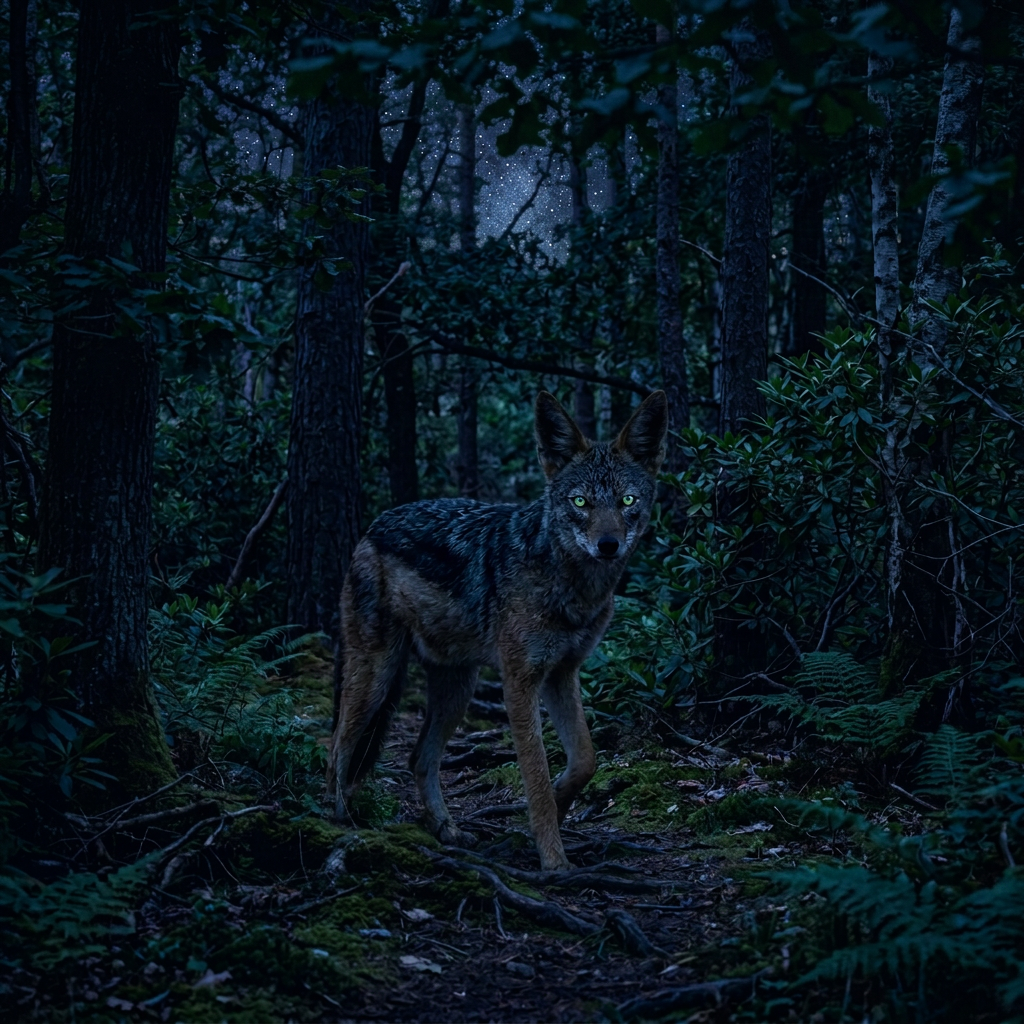
Jackal standing in dry grassland beneath a colorful dusk sky


I’d like to rummage around in the entrails of the story “The Jackal“, because what the Jackal in the story “says” is my own turning point, and one which I’ve not yet managed to complete. Any comments on this perspective would be helpful. I’ll leave it here in case it collects some thoughts.

Here is what the jackal in the forest said to the soldier:

He knows now that there are also are demonic forces in the world, but they are weak by themselves, and can only build on what we start. They take sustenance from our energy of resistance, which is always a resistance to a broader perspective, or a truth that undermines a sanctuary of self-enclosed illusion. He notices that every time he speaks to himself in his head – every thought – creates an artificial division in his consciousness, a kind of militarized border within him, which makes an enemy of his own rejected wisdom.

And demonic forces, weak though they are, encourage the formation of stronger and stronger borders within us, strengthening resistance by the perpetual whisper of what might happen, of what needs to be done, or who we need to become – compulsions that are unconscious panic.

And yet, the demonic forces are so weak they can only barely emit a whisper of memory, or a glimpse of imaginary danger. And then we supply the added energy and build the solid structures according to a demonic plan. Eventually, we are even convinced to give these demons a solid form of their own, by lending them our own bodies and dissolving into the whispering minds of the demons themselves.

And he recognizes the whole military chain of command, the whole enflamed world, its systems of government, its economics, even its institutionalized charities, its schooling, the way we make our living, the roads and housing we build, so much of it has been heedlessly and ravenously built by demonic plan, driven by the stolen, hypnotized energy of human beings, who have mistaken themselves for the reflections of their own small demons. These forces have possessed the world through a whisper campaign, which has no power in itself.

But they have whispered for countless generations that we are inherently evil and that nothing can change. And it is this small-minded message which has blinded us to ourselves. They have made a tapestry of small arguments in our minds, which wrap us into confusing patterns of argument and counter-argument. But it is a tapestry of illusion.

Despite its success, it remains utterly powerless to stop any single human being from doing what it could. Anyone, anyone at all – not special people, not geniuses, not experts, but anyone — who sees the illusion as an illusion, and recognizes the weakness of evil, and its ludicrous plans for the world, dissolves this illusion.

A human rebellion from this ancient enslavement to hell amounts to nothing more than walking away from every hand that clutches at your sleeve with appeals to honor, duty and decency. And you will see the fear and suffering, anger and panic in the eyes of the human souls bedeviled into trying to keep you chained.

But these are the last fragmenting strands in the tapestry of illusion. Because it’s the devil’s decency we are preserving, the devil’s duty and honor we are promoting. You feel the devil’s cries of pain and fear that he is losing you. And the poor, betrayed souls of human beings possessed by these demonic values will accuse YOU of betrayal.

Ignore them, ignore them for the sake of life itself, no matter what happens. You can’t save anyone. But in saving yourself, you’re not saving a separate human being. It’s humanity itself that awakens in you. It’s the dissolution of who you thought you were. And your example – though ridiculed and condemned – sends shock waves through the whole ocean of being. It is the only way to save the prisoners themselves. Walk away from prison for their own good, not yours. They won’t thank you, but you are breaking a chain around their necks, which they don’t see.

Leave, and bear the ignominy of desertion. There is no compromise with the devil. Betray this world fully, or humanity itself will remain trapped in hell. Only the dissolved individual, the anonymous human being, can free the world. They will not be known, even to themselves. But they will be an unprecedented agent of rebellion.

Jackal

Jackal standing in dry grassland beneath a colorful dusk sky


[Part of a longer story titled “Jump“].

O Partha (Arjuna), happy are the Kshatriyas who gain such a battle that comes of its own accord, opening for them the doors to heaven.) — Chapter 2, Verse 32, Bhagavad Gita

He slept poorly and awoke early in anticipation of the mission that night. Then he threw up several times. It was a familiar dread, pre-jump jitters. Not just performance anxiety, or the fear of death, nor the heavy regret of knowing he placed himself in this extreme, and insane predicament voluntarily, nor the envy he feels at breakfast, seeing the carefree jocularity of the ground crew, and the meteorologists, who would never directly enter battle, let alone fly to the roof of the atmosphere itself, and leap into almost pure, frozen space, a half-assed astronaut, a momentary falling spacewalker, until the double-bag static line finishes unfolding, and holds him in a tug-of-war between the canopy pulling up, and the heavy load of his equipment, pulling down.

And then of course, what follows.

But something else was weighing him down now, and had been for quite some time, slowing his every step, as if he were sinking in sand. And it was preventing the boost of adrenaline he’d soon need.

A few hours prior to rigging up, he was hanging out with his “stick” (his paratrooper team) and they were ribbing each other and shooting the shit. Their last moments of relaxation.

But he could never banter very well. He sat on the floor with his back against a door-jam, enjoying the mild grinding pain of the spine against the edge of the jam.

This was his first serious combat jump, a HAHO deep into enemy territory to take out a relay post, and then bushwack back to safe ground, in what’s called an overland exfiltration. In about an hour, they’d start the elaborate procedures and checks and rechecks that took up the better part of 3 hours, prior and during the flight, which was going to be a long one.

Then they’d ride the canopy for a long way this time, about 30 miles, to a drop zone (DZ) in a narrow clearing in the fairly dense coastal forests and then make their way to their objective.

And only then would the real work begin.

Read More »

Jump

For Walter Cybulski, exceptional poet and humorist bar none

[The Introduction will make this story a little clearer, maybe]

His Father’s Circus

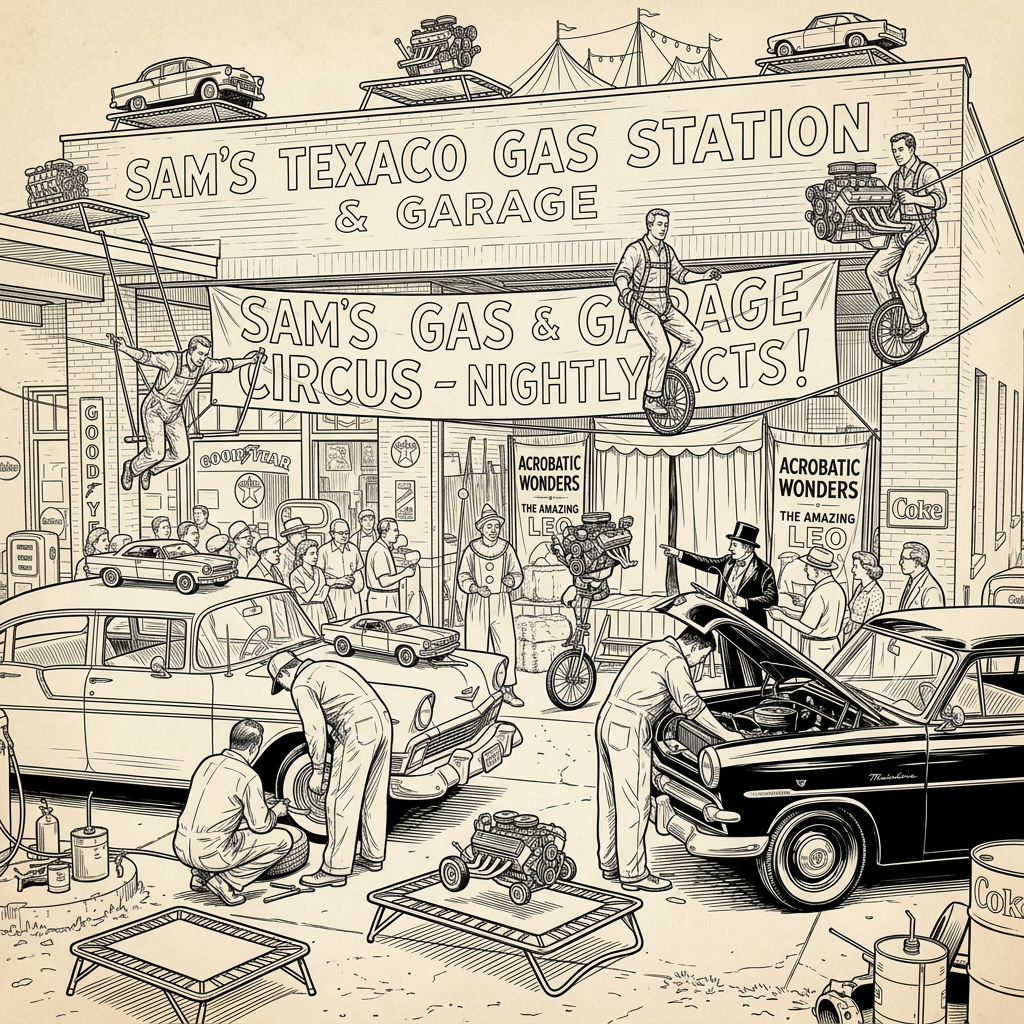
1950s gas station with circus act, spectators, mechanics, and classic cars

As a very young boy, his father ran a gas station. He was a mechanic and always carried a gigantic wrench, that was nearly 3 feet long and twice as heavy.

And when he wasn’t working on cars or trucks or busses or tanks, he would swing his wrench, and throw it high in the air and catch it, like a heavy metal drum major. And people would drive long distances just to have him fill up their tanks with gas, so they could watch him perform. And he would do somersaults out to the tanks and backflips all the way back to his office. And when he wasn’t working on cars or tanks or trucks, and the lines at the gas tanks had thinned, he’d finally close shop for the day and wander into the bar across the street and ham it up with his friends.

And the small boy would tag along, at first attached to his mother’s bosom, then to her hand, and finally alone, behind his dad, just large enough to be hoisted on the bar stool by a rough hand, and then given a little boost, and finally able to climb the bar stool by himself and drink coca-cola dribbled over huge tankards of ice, chewing the ice, absent-mindedly, while his father laughed and whistled and wagered fortunes on how many pushups he could do in an hour, or whether he could withstand a sledge hammer to his stomach.

Once, a dancing bear happened to be in the bar, and challenged his father to an arm-wrestling match, and the bear won two out of three, but never came back to challenge anyone again.

When the boy was 8 years old, he quit school to become a soda jerk, and got a job next door to his father’s garage. And over the years, as the garage business grew, all the other businesses in town grew by proximity, and profits skyrocketed all around. You could hear the sonic boom for miles.

Read More »

The Two-Edged Sword of Thought and Action; On the Nature of Humor and Sorrow

Recently, my wife and I drove past a house way out in the country, where 8 chickens were held in a cage that would be small for one. This was just after learning that the killings in Gaza were continuing under the radar; and Trump had just bombed another 20 fishermen for no reason. And Ms. Good had been murdered.

Our efforts to save the chickens became a surrogate attempt to put an end to all that pain and sorrow. In other words, it was futile. We could do nothing but contemplate a midnight raid, which would have caused the poor, ignorant woman in the shack to lose her mind. Because in some strange way she loved the chickens, or thought she did, and had raised them from eggs, she said. And there was nothing the sheriff or the animal welfare department could do under current laws; and we had no place to bring the chickens even if we stole them.

And after contemplating the possibility of losing my mind over an issue that was so small in comparison to what is happening in the broader world, I had to accept the pain. I had to admit that there is no possibility of separating the pain of life from the love of life. And that we live in a world that must always teeter between hell and heaven. And that we have to find a way to move through this border land without sinking into pits of despair or indulging in a transcendence too high for our tears to reach the earth.

Read More »