Jump

For Walter Cybulski, exceptional poet and humorist bar none

“Arjuna said: How shall I strike my grandfather, my guru, and all other relatives, who are worthy of my respect, with arrows in battle, O Krishna?” — Bhagavad gita

[The Introduction will make this story a little clearer, maybe]

His Father’s Circus
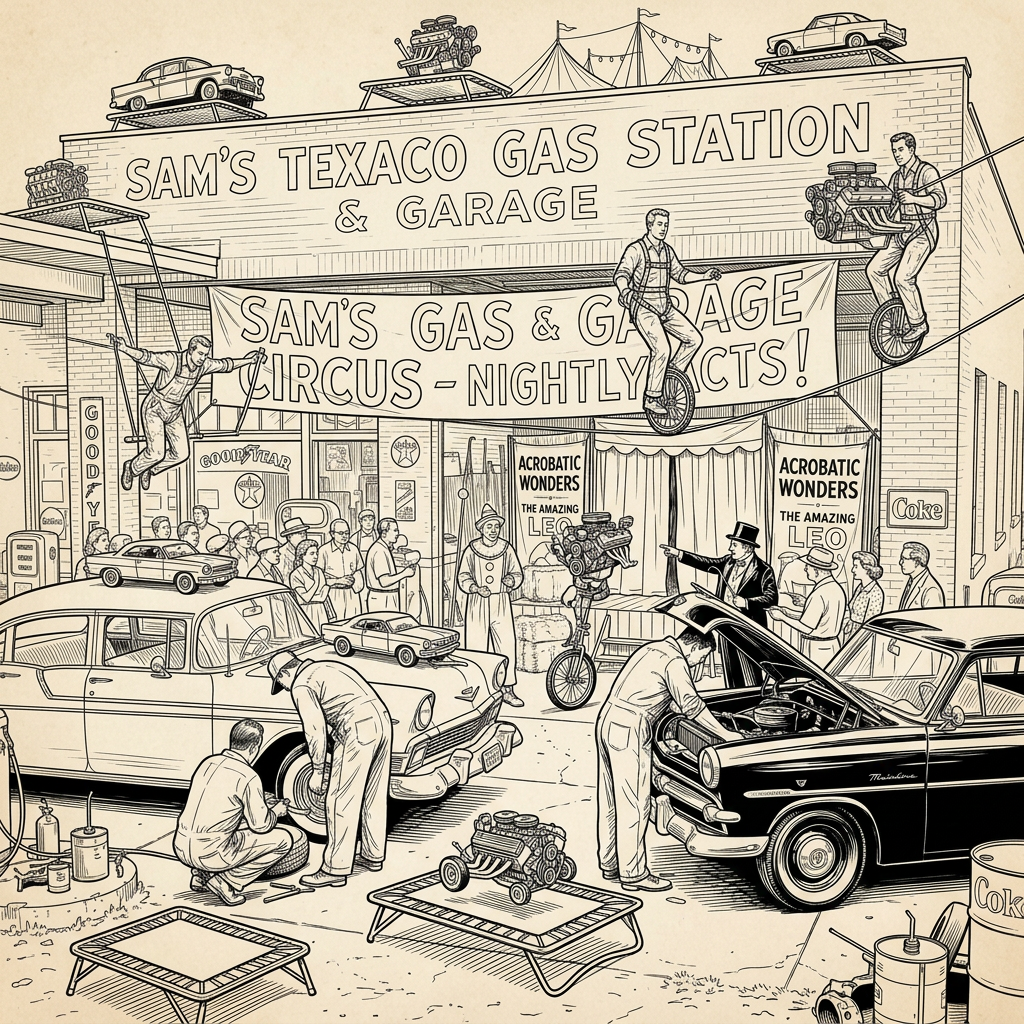
1950s gas station with circus act, spectators, mechanics, and classic cars

As a very young boy, his father ran a gas station. He was a mechanic and always carried a gigantic wrench, that was nearly 3 feet long and twice as heavy.

And when he wasn’t working on cars or trucks or busses or tanks, he would swing his wrench, and throw it high in the air and catch it, like a heavy metal drum major. And people would drive long distances just to have him fill up their tanks with gas, so they could watch him perform. And he would do somersaults out to the tanks and backflips all the way back to his office. And when he wasn’t working on cars or tanks or trucks, and the lines at the gas tanks had thinned, he’d finally close shop for the day and wander into the bar across the street and ham it up with his friends.

And the small boy would tag along, at first attached to his mother’s bosom, then to her hand, and finally alone, behind his dad, just large enough to be hoisted on the bar stool by a rough hand, and then given a little boost, and finally able to climb the bar stool by himself and drink coca-cola dribbled over huge tankards of ice, chewing the ice, absent-mindedly, while his father laughed and whistled and wagered fortunes on how many pushups he could do in an hour, or whether he could withstand a sledge hammer to his stomach.

Once, a dancing bear happened to be in the bar, and challenged his father to an arm-wrestling match, and the bear won two out of three, but never came back to challenge anyone again.

When the boy was 8 years old, he quit school to become a soda jerk, and got a job next door to his father’s garage. And over the years, as the garage business grew, all the other businesses in town grew by proximity, and profits skyrocketed all around. You could hear the sonic boom for miles.

Read More »

Introduction to the story “Jump”

“Can we rely on Jane Austen’s picture of landowning England with baronets and landscaped grounds when all she knew was a clergyman’s parlor? And Bleak House, that fantastic romance within a fantastic London, can we call it a study of London a hundred years ago? Certainly not. … The truth is that great novels are great fairy tales…” (Vladimir Nabokov, “Lectures on Literature”, page 2)

First, this is a strange (war) story. It combines tall tale, fairy tale, absurdly narrow-lensed realism, realism itself (the war segment), surrealism and mysticism (in that order).

Hitching a ride to this story would mean climbing aboard a vehicle with a real Mack Truck cab, 18 oversized cartoon tires and a trailer made of wispy dreams. It might not engender confidence in the driver of this tale.

So, here’s some help in finding an order behind the chaos.

One of the more simplistic questions this story asks is: “What would happen if a paratrooper became “enlightened” (let’s call it that) while falling into a war zone?”

But more completely, it’s the story of a person’s life told in vignettes, and short stories that “jump” from one stage to another, from childhood to deathbed. And each vignette is composed in a style characteristic of the character’s point of view at that moment.

So, for instance, the first one’s in the style of a tall tale, for the boy saw his father as a kind of Giant, as many kids tend to do.

The details of these tellings are nevertheless significant. The events we recall from earlier times are always a little tall in the telling, stretching real experiences into lopsided renderings that might as well be called fairy tales.

Read More »