
Jackal

[This is a section from the longer story “Jump”, posted yesterday. It’s a war story; maybe an oblique rethinking of the story of Arjuna on the Battlefield, dealing with the meaning of duty and selflessness and illusion. Not that it was rationally planned as a story with that intent. But it intertwined with those issues, while also metabolizing the writer’s own demons regarding the nature of reality and illusion, which had seriously bothered him as a teenager].

Jackal standing in dry grassland beneath a colorful dusk sky

The boy slept poorly and awoke early in anticipation of the mission that night. Then he threw up several times. It was a familiar dread, pre-jump jitters. Not just performance anxiety, or the fear of death, nor the heavy regret of knowing he placed himself in this extreme, and insane predicament voluntarily, nor the envy he feels at breakfast, seeing the carefree jocularity of the ground crew, and the meteorologists, who would never directly enter battle, let alone fly to the roof of the atmosphere itself, and leap into almost pure, frozen space, a half-assed astronaut, a momentary falling spacewalker, until the double-bag static line finishes unfolding, and holds him in a tug-of-war between the canopy pulling up, and the heavy load of his equipment, pulling down.

And then of course, what follows.

But something else was weighing him down now, and had been for quite some time, slowing his every step, as if he were sinking in sand. And it was preventing the boost of adrenaline he’d soon need.

A few hours prior to rigging up, he was hanging out with his “stick” (his paratrooper team) and they were ribbing each other and shooting the shit. Their last moments of relaxation.

But he could never banter very well. He sat on the floor with his back against a door-jam, enjoying the mild grinding pain of the spine against the edge of the jam.

This was his first serious combat jump, a HAHO deep into enemy territory to take out a relay post, and then bushwack back to safe ground, in what’s called an overland exfiltration. In about an hour, they’d start the elaborate procedures and checks and rechecks that took up the better part of 3 hours, prior and during the flight, which was going to be a long one.

Then they’d ride the canopy for a long way this time, about 30 miles, to a drop zone (DZ) in a narrow clearing in the fairly dense coastal forests and then make their way to their objective.

And only then would the real work begin.

Read More »
Jump

For Walter Cybulski, exceptional poet and humorist bar none

“Arjuna said: How shall I strike my grandfather, my guru, and all other relatives, who are worthy of my respect, with arrows in battle, O Krishna?” — Bhagavad gita

[The Introduction will make this story a little clearer, maybe]

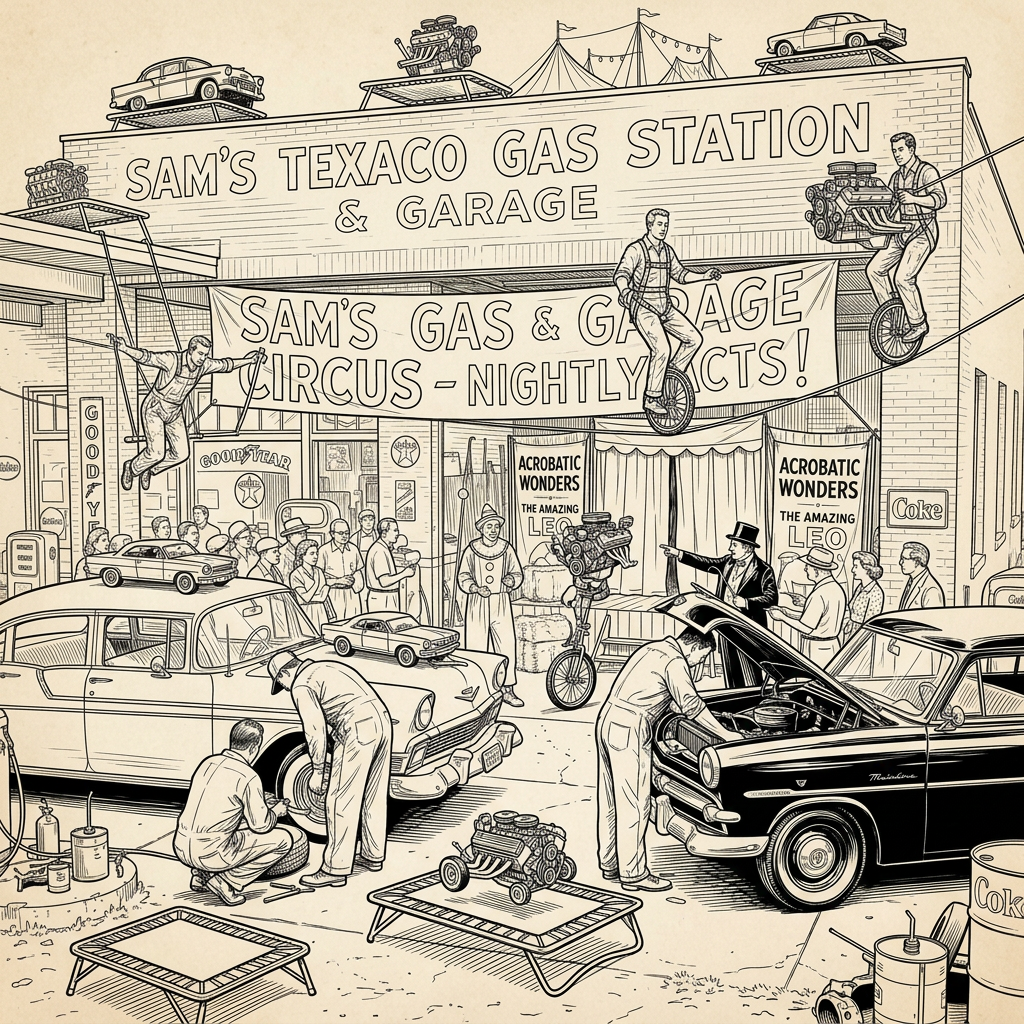
His Father’s Circus

1950s gas station with circus act, spectators, mechanics, and classic cars

As a very young boy, his father ran a gas station. He was a mechanic and always carried a gigantic wrench, that was nearly 3 feet long and twice as heavy.

And when he wasn’t working on cars or trucks or busses or tanks, he would swing his wrench, and throw it high in the air and catch it, like a heavy metal drum major. And people would drive long distances just to have him fill up their tanks with gas, so they could watch him perform. And he would do somersaults out to the tanks and backflips all the way back to his office. And when he wasn’t working on cars or tanks or trucks, and the lines at the gas tanks had thinned, he’d finally close shop for the day and wander into the bar across the street and ham it up with his friends.

And the small boy would tag along, at first attached to his mother’s bosom, then to her hand, and finally alone, behind his dad, just large enough to be hoisted on the bar stool by a rough hand, and then given a little boost, and finally able to climb the bar stool by himself and drink coca-cola dribbled over huge tankards of ice, chewing the ice, absent-mindedly, while his father laughed and whistled and wagered fortunes on how many pushups he could do in an hour, or whether he could withstand a sledge hammer to his stomach.

Once, a dancing bear happened to be in the bar, and challenged his father to an arm-wrestling match, and the bear won two out of three, but never came back to challenge anyone again.

When the boy was 8 years old, he quit school to become a soda jerk, and got a job next door to his father’s garage. And over the years, as the garage business grew, all the other businesses in town grew by proximity, and profits skyrocketed all around. You could hear the sonic boom for miles.

Read More »

A Non-Dogmatic Structure of Thinking

The Buddha Gate

I wanted to write because I needed to bring some order to the swirling fog of my own experience. Not a belief system that pins thought down too tightly, but a lattice of sorts it can safely grow, so it knows its place and doesn’t keep sprawling chaotically like Kudzu over every aspect of life, drowning out the world in this relentless voice, which is perpetual self-deception.

It’s not easy to look for the source of this restlessness. It’s easier to find a job or some other way of occupying our thoughts at a safe level of magnification. It’s easier to focus on the practical necessities of navigating this crazy highway of life, a perpetual state of semi-emergency that becomes routine, but a tenuous routine that can’t afford to be interrupted by larger questions about the underlying infrastructure of belief we’re riding upon. Accept the crazy beliefs, the nationalism, the war-state, the cut-throat economic system, the values and goals this emergency approach to life forces on us — accept all that at face value and call our subjugation to this mad system of thought “a practical approach.”

(By the way, some people like to say that they’re not philosophers. Still, we’re all running on vast infrastructures of metaphysics unconsciously, in the same way that anyone driving on an interstate is unconsciously following the infrastructure of road-building ideas. We may not consciously reflect on why we’re heading in this or that direction as we exit onto overpasses and circular entrances to a highway, but our lives are following patterns of an infrastructure of belief nevertheless. So we may not be capable of understanding the descriptions of these philosophies, but they’re still under-girding the way we live).

The restlessness is the same for me, but the practical approach wasn’t helpful. And leaving behind the highway metaphor, the practical approach constructs a solid floor to everyday life, and all the restless energy of a constantly swirling brain gets kept in the crawlspace. Then it becomes a taboo or “simply uninteresting and pointless” to look beneath the floorboards at one’s own churning mind. And this is a clever tactic if all you want from life is the kind of happiness that remains circumscribed by a repressed turmoil. And what goes missing in life isn’t missed, because nobody misses what they don’t notice.

But still they compensate themselves for everything that gets left out by making an art out of the minutiae of life, appreciating the “little things” as you would admire a knick-knack shelf, but always remembering that what’s important are the practical necessities of maintaining this bubble of unconscious repression wherein happiness can reign. In fact, the rule is, don’t indulge in any larger questions, which tend to pry open the floor boards and release all sorts of religious and political demons that ruin dinner parties. 

Now and then, of course, a few pressing questions and confusions nevertheless erupt from the floorboards and circle the brain in repetitive patterns all night like giant mosquitos. And until a distraction is found (a way to nail the boards down again), the person is forced to see themselves as powerless victims of these escaped thoughts. And this reinforces the conviction that our own turmoil is something external to us, a fact of nature that can’t change. That’s one of the strongest nails keeping the flooring in place: we’re helpless victims of our own brains, so ignore the brain and just focus on this nice little space we’ve created.

If any readers have made it this far then they also probably can’t ignore the racket from beneath the flooring any more than I can. The pursuit of happiness begins to feel like a shallow sitcom, devoid of all real adventure and danger. 

So you and I (the nervous ones essentially) couldn’t follow their lead and rest comfortably while the floor kept popping and creaking all day. Every belief that was designed to nail down those loose boards — whether it was religious or patriotic or careerist beliefs —  included the same taboo against questioning the framing, which made them feel deceptive.Read More »