Cliff Diving: The Dangerous Leap into Suspension and Proprioceptive Flight

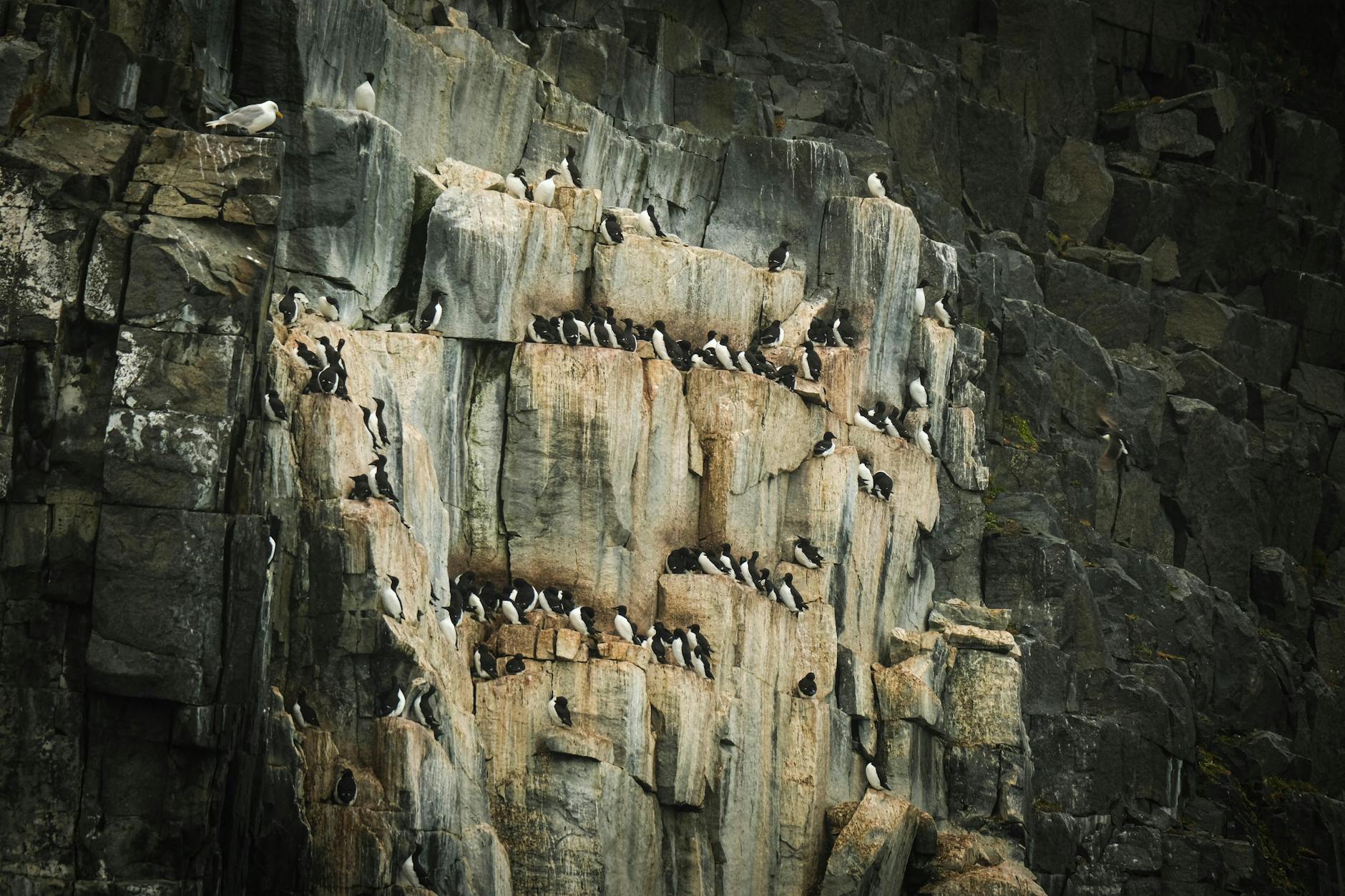
Photo by Francesco Ungaro on Pexels.com

I’m forced to decipher the order that is slowly unfolding on its own. That is, this isn’t really an inquiry through words or logic of a thinking mind, but a way for words and logic to catch up with a wider perspective than a thinking mind can know.

It’s as if something non-rational is trying to recalibrate the rational mind so that it doesn’t block access to a larger perception.

And I’m not sure of my role as a speaker entirely. The speaker seems to be necessary in some way, but it’s not central to what is happening. Currently it seems to function mostly as a filter, to help organize certain features of reality into a workable personal relationship to the world.

But this worked-out relationship to the world – not only this sense of Self, but also everything this form of Self demands, such as power, prestige, and economic and national systems to promote all that – is leading to self-destruction.

The culture keeps looking for new ways to improve the filtering function of the Speaker or Self (which is to say, improve the moral quality of this fictional approach to the world); and we also keep looking for ways to improve the economic and national systems designed to promote the function of the Speaker or Self (which is to say, we keep looking for social solutions to this psychic and spiritual crossroads).

In other words, we keep employing one of two main ways to handle the approaching apocalypse: 1) Try to improve one’s Self; and 2) try to improve the culture that promotes the Self.

Read More »

… And Now I don’t

Photo by Gelatin on Pexels.com

I made a big and interesting mistake in trying to ascertain who you are in the essay “I See You Now.” Even the title sounded threatening. But this is what Negative Geography was built to handle — a place where I can stare back at my own footprints in the subtle mud of language and decipher where I go wrong.

And some of these mistakes reveal ancient confusions, ancient in that they are not entirely personal mistakes, but self-injurious reactions to transgenerational traumas as Mate tends to describe it, stretching back through human history beyond reckoning.

From one angle, this is the kind of mistake that our parents wisely warned us against — staring too long into the image reflected in the water, because we’ll drown in confusion.

However, I’m no longer susceptible to this fear. I think it’s because I already drowned a long time ago and now I’m beginning to crawl back to the shore like some kind of primordial shape, picture a mud puppy if you need to.

The first surface mistake was in devaluing the deeper personal and impersonal relationships I have with many of you. You aren’t some abstract conception of an Other; you are not merely mined for your value and then discarded, which is what I described. But the image I hold of the person listening is mysterious to me still, as if I’m picturing a mind that is still forming; but one that is partially revealing itself in many of you; and sometimes even in brief exchanges with strangers on a bus; with everyone who carries that charge of honesty that can change a life; and all this feeds the image of a wider mind that is listening, a real mind, in flesh and blood. And I made the mistake of accidentally discounting the fact that this potential is visible in real people reading, and is not abstract and disembodied.

So this led to the the second surface mistake — a failure to acknowledge how important these ongoing dialogues with you are in everything I write.

The underlying error, however, is solipsism. But solipsism is not merely a fancy way of describing a self-centered outlook.

Read More »

Technical Note on Why the Last Essay Isn’t Really About Writing

Maybe what I’m really after in speaking of an imaginary “you” and “Me” is a rapport with these persistent thoughts of self and other, these imaginary beings that occupy center stage in life. I’m not interested in being a writer, it’s not my career. But in looking at the dishonesty of thought honestly I’m dealing with a communal mess. And part of the resolution of a communal mess will necessarily involve communication of this sort.

Writing provides the opportunity for an elongated span of attention on these matters.  But it’s not the only way to approach all this. So it’s not about writing, it’s about the communal movement of thought. In any communicative case (speaking, fighting, using sign language, doing math) the same issue looms that I was trying to contend with — what to do about the self-image that insists on acting like a middle-man at all times, even poking its ugly little head between two embracing lovers more often than not in the form of anxieties and worries. This spoiled brat of thought has to be the center of attention and is constantly driven by insecurities, because it is by nature a deception, a projection posing as a reality.

So the question tends to be, how do I look at thought honestly knowing full well that a fictitious “I” or “me” will inevitably intrude on the scene demanding to play a central role?

There are a million ways to handle this and all have been tried in these essays, with varying effects. The one is to do what is being done in this paragraph, which is to refuse to use personal language and speak from the third person’s perch.

Read More »

I See You Now

Photo by Juan Burgos on Pexels.com

Would you believe me if I said I don’t want to call attention to myself? It would seem impossible because I’m placing these private and somewhat personally unnerving words out there on Facebook, for one thing.

But personal attention makes me sick. And yet I couldn’t find you until I placed these things in some kind of public thoroughfare. I didn’t care if it was just a park bench. Someplace where you might happen along, allowing me to imagine you.

A park bench is almost perfect, but not quite believable enough, because I’m sure these words would be pecked to pieces by a passing pigeon or thrown up on by a drunk, before anyone real like you happened along.

And so I tried a publication like Counterpunch, fairly broad and relatively easy to access. But periodicals have a far too particular outlook, are too demanding in what they want from me. I’m not inclined to work at molding myself to anyone’s demands. I need a thoroughfare that is utterly open-ended and will not lead to any kind of fame, which would destroy my solitude or anonymity. But the thoroughfare still needs to be larger than a park bench in order to allow me to convincingly imagine you as a passing stranger with a mind as large as God’s.

Read More »

The Need for Comedy and Illusion

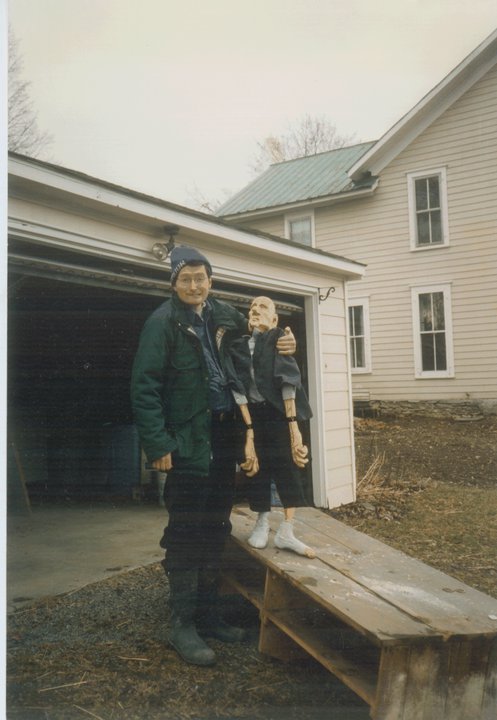
Vladimir and the author.


The problem with essays is that they tempt the writer to speak from a podium of sorts, as if he or she (let’s say he, because I’m talking about myself obviously), as if he were Walter Cronkite, the last representative of the True Believers in solid facts at the center of life, fading out to extremes of fantasy on the left and right.

But that’s not a valid picture of honesty, because there is no solid center if I am learning. The center is precisely the place where suspension and uncertainty live. Nothing is known; all is shifting perspective.

But in saying this I end up sounding like I’m standing at a podium again, and the hypocrisy this generates is fascinating, if nothing else.

Essays generally leave a stench of dishonesty no matter how honest they try to be. I think there’s another way to write essays, and that’s what I’m exploring.

I wish I could ask the reader to bear with me while I say this next sentence, because this statement is just a door to a larger room, but here it is: I’m not really interested in helping anyone. That’s not why I write. I write because I enjoy tracking down and confronting my own dishonesties.

What I am, at best, is honest about my own dishonesties. And I DO think that facing dishonesty is a good thing for the culture, because the culture is not facing its dishonesties, and I’m pretty sure that this will shortly be the cause of our extinction. But even if I feel this way, that’s not my motive.

I think it’s the other way around: I don’t think I can have a motive if I’m honest. I think I can only have a motive to be dishonest. Honesty is merely being without duplicity. There’s no effort involved if there’s no duplicity. So honesty is an empty condition, negated of all efforts, which are in fact efforts to hide from myself. So honesty is incredibly lazy, a slacker of sorts. There’s nothing moral about it. I do nothing and I’m honest. If I do something about it, then I’m squirming, looking for an advantage, an improvement, anything but the truth.

Read More »

Neo Animism

The glen that thinks

Is it too small a story to say I do things independently, as if I were an outside agent? Is it more reasonable to say that it’s the environment that thinks through me and through every tree, bird, person or breath of wind, each an energetic and idiosyncratic manifestation of earthly intelligence?

This body becomes an aspect of its surroundings the moment the assertion of my differences ceases. if I’m not constantly thinking about myself, I dissolve into the world itself.

It requires a story to create a sense of independence. Relax for a moment and I disappear. But disappear only as something alienated from earth and others.

You could tell the story that the woods “inspire Me”. But that’s a story that misses something large. Inspiration IS seeing that tree’s connection and inseparability from intelligence. Intelligence arises between you and me, between trees and me too, and the little stream below where I sit carries the voice of my own intelligence.

This may sound fanciful, but it’s a more practical vision, a more factual one. Less dependent on an imaginary being who somehow “sits in” this body, who carries the name “I”, a little director I used to call “Zingryo” as a kid, sitting on a throne behind the eyes. He is “me”, and when he thinks about himself he is thinking about an Other of sorts, as if this Self he is thinking about were somehow still outside him, always one step removed, as Beckett observed.

Read More »

Truth and Distortion

It’s impossible to comprehend anything without some distortion. Because in order to understand anything, I have to ignore and lose my comprehension of something else.

Try to avoid this, try to understand anything perfectly, and all you’ll do, dear imaginary reader, is distort your awareness by this great ambition, obtaining some glimmer of clarity at the expense of a singled-minded focus that causes pain in direct proportion to the pleasure it produced. That’s why Beckett said, “The tears of the world are a constant quantity. For each one who begins to weep somewhere else another stops. The same is true of the laugh.” 

So I can’t fall headlong into a particular story and take it as gospel, because there is always distortion. Focus is a distortion of the field of vision. Where there is focus there is a loss of wider attention.

And there is no way to obtain a perfectly wide field of attention because the universe will always be wider than these 6” brains can span.

So I can’t look at distortion as a problem that needs to be eliminated. It’s part of the process of thinking, that’s all. And it needs to be acknowledged and realized, because otherwise thought operates under the deluded assumption that it can solve everything eventually. And thought can’t solve the problems thought itself creates.

Read More »

A Minor Pop of Sound and Fury

Photo by Andrea Piacquadio on Pexels.com

I think we all come into this world like molten lava, with no settled opinions, shifting our gaze, shedding old forms of thought, constantly growing. I equate this molten lava with passion, and the fluidity of learning, and we still feel it in any question that burns, questions that interest us beyond any practical utility.

But we’ve also been born into a culture that systematically attempts to channel this molten energy into particular shapes and forms, where it cools and hardens into certainties and dogmas. This includes the hardened conviction that it’s necessary to quell the passions of children, and stabilize them into practical shapes that can help maintain the social system itself.

To me this looks like the work of the predator performing another of its “stupendous maneuvers” (Castaneda). Like some great wrestler, the human species is flipped 180 degrees on its back, where it submits to justifying the repression of its own young as a way of maintaining the inorganic life of the system itself. And so the social system stops being merely a tool for the promotion of human potential and becomes instead an end in itself, justifying the human sacrifice this requires.

This molten lava metaphor is supposed to represent the liveliness of the ever-growing human soul. But of course, the molten lava metaphor also suggests the dangerously destructive qualities of a human being, who can’t be corralled into working their fingers to the bone in support of this mechanical system of control we call our nation or our economic system.

Two dangers really: Repressed human energy will erupt volcanic rage. And human energy channeled into service to a system slowly degrades our intelligence.

Read More »

We Are Like Squid: The Gift of Shape-Shifting

Pexels.com

“He explained that [shamans] see infant human beings as strange, luminous balls of energy covered from the top to the bottom with a glowing coat, something like a plastic cover that is adjusted tightly over their cocoon of energy.

He said that glowing coat of awareness was what the predators consumed, and that when a human being reached adulthood, all that was left of that glowing coat of awareness was a narrow fringe that went from the ground to the top of the toes. That fringe permitted mankind to continue living, but only barely.

As if I were in a dream, I heard don Juan explaining that, to his knowledge, man was the only species that had the glowing coat of awareness outside that luminous cocoon.

Therefore, he became easy prey for an awareness of a different order; such as the heavy awareness of the predator. He then made the most damaging statement he had made so far. He said that this narrow fringe of awareness was the epicenter of self-reflection where man was irremediably caught. By playing on our self-reflection, which is the only point of awareness left to us, the predators create flares of awareness that they proceed to consume in a ruthless, predatory fashion.

They give us inane problems that force those flares of awareness to rise, and in this manner they keep us alive in order for them to be fed with the energetic flare of our pseudo-concerns.”

Carlos Castaneda — “Active Side of Infinity”


A prismatic perspective changes the nature of a conversation. When we realize that thought is not actual, but fictional, then answers, and the deceptions necessary to defend those answers, both go extinct. They become archaeological artefacts of a world that has ceased to exist.

We stop trying to compete to be right the moment we realize that nothing we say is right.

In fact, nothing we say is even Close to being Right, because what we Say about life and life itself are composed of utterly different substances.  The map can’t get closer to being the place itself, no matter how precise it tries to be. They are different substances entirely and never the twain shall meet.

But in this case, we’re making maps of a world that becomes more complex and profound as we learn. So beliefs are essentially out of date and primitive the moment they’re formed.

Out of date if they’re proposed as answers, that is. But they become more profound as metaphors – freer to experiment with angles and stories, because we’ve discarded the burden of being right. So we’re no longer being pressed into working towards a singular conclusion.

And then discussions stop being debates over who is right. We stop acting like prosecutors of one another. We stop trying to undermine an “opponent’s” point of view, because it would be self-limiting. So argument dies and questions become subtle requests for directions to the vantage points being discussed, because every new metaphor adds interest and color to everything.

Read More »

The Predator is Real: Learning to See Prismatically

By a prismatic perspective I mean realizing that nothing we think is actual. I think most humble human beings accept that their ideas are not perfect.

Now look at the same realization a little more intensely, that’s all.

What that means is I can only observe a small bandwidth of stimuli even at my best. And from what I Can see, I only remember a smaller fraction. And of those memories, I can only stitch together the few that make the most sense to me. So all I ever know are fictions.

That’s not what we usually think, but it’s the same thing as realizing that our ideas are only interpretations. Interpretations are fictions.

And they can be honest or dishonest fictions. But facts that aren’t the product of some interpretation are few and far between. And they’re usually negative, such as “the emperor has no clothes”. But in this case the negative discovery is that thought is not actual.

So ideas are only at best insightful, not literal.

Without the delusion of absolute truth there’s no motive to lie. Think about that. We lie when we’re trying to convince someone of an absolute truth, even if it’s only the absolute truth of Selfishness, the need to lie to protect my sense of Self. But if we see that nothing is conclusively true, including our sense of Self, but only at most a helpful way of distorting an otherwise ungraspable whole to make it meaningful, then there is no competition between points of view. They all add information, that’s all.

And if nothing can be taken literally, then thoughts become more creative, conjectural, metaphoric, prismatic.

Each word is like a different refraction of an unknowable actuality. Each word provides a slightly different slant or insight into qualities of the world.

So I could have called this a “metaphoric mentality” instead of a “primsmatic perspective.” The word “prism” emphasizes the ability to spin the issue around to get insights into different qualities. When I use the word metaphor, this emphasizes the suggestive nature of thought, the absence of Literalism. But neither of them are the actuality. They are merely different qualities that each metaphor reveals in what would otherwise be a mysterious, ungraspable whole.

So when thought stops trying to be actual, it becomes more creative, trying out different angles to discover wider potentials in the world. We shift from a narrowing search for answers to a widening, adventure-loving exploration, which can’t have an agenda because it doesn’t know what’s coming next. But in this spirited exploration of the world we begin to discover new powers, like the freedom from competition that this prismatic angle provides; the creativity it encourages.

Read More »