Kant described that “pathless land” (that “negative geography”) as a freedom to speak for oneself, trusting one’s own intelligence. And this implied that science at its best recognizes that its theories remain shadows on Plato’s cave. At its best science is attentive to deviations from what is believed to be real. And not in the way Karl Popper conceived of falsification, which is still reductive in its quest for a perfect theory. But rather, at its best science remains alert to what is “false in the true, and true in the false”, as Krishnamurti phrased it.
Creationists have an especially hard time with this. A mentality alert to anomalies in what is true and false doesn’t have a vested interest in defending its stories. The theories of science are not weak because they’re perpetually changing. They’re intended as provisional sketches of a universe wildly erring from anything we imagine. Or as the physicist Hans-Peter Dürr phrased it, “Science also speaks only in parables.”Read More »
I’ve been tremendously inspired of late by The Negative Psychologist — a doppelganger of Neg. Geo it seems. In every essay he finds a way to draw attention away from the conceptual level and back to what is actually happening in our heads (the function of thinking, as opposed to the abstract content of thought. Which is to say it tends towards “proprioception.”) Somehow he casually side-steps the trap of knowledge accumulation (of constructing an ego).
In his work I find countless heuristics in the form of amusingly critical observations. And his observations have a lovely sense of humor, a bemused detachment. “Ken and Barby Land”, for instance, makes me laugh. It describes that diabolically mundane work-a-day wold, the superficial world of constructs and images. This is from Gaining Perspective”, by The Negative Psychologist:
Such a mental condition might be called ‘Ken and Barbie land’, and another fitting image is that of the ‘Stepford Wives’. The scary thing is that, if we had our own way, we would probably opt for this as a full-time mode of being because it is so very ‘non-challenging’. We love not to be challenged. Easy is good! Easy is good! If you do not believe this, then just watch yourself for a day or two and see where your head is at for most of the time – are you in one of your various comfort zones (in the realm of the known), or are you somewhere new, somewhere challenging?
Pharsalia, or Civil War, is also the title of a poem by Lucan, written sometime around the time of Christ — about the civil war between Julius Caesar and the Roman Senate. “All wars are civil wars.” All empires mark our own triumph and defeat. The footprints of all these triumphs and defeats can be seen in the land, in Pharsalia itself.
What I see in Pharsalia is the terminal moraine of a ruinous glacier of hyper-rational thinking that came from Europe. That witchery (as Leslie Marmon Silko uses the word) — that non-sacred vision of reality — has reached its apex and is melting away. It leaves behind a flattened landscape of political and social thought, of spiritual ruin. It becomes evident in places like Pharsalia first.
It’s a place near where I grew up. There’s a melancholy power here. Subdued, ancient, hard, desolate, beautiful. In this beauty there are seeds of renewal that will remove every last trace of witchery from our system. But first one has to appreciate the desolation of the place.
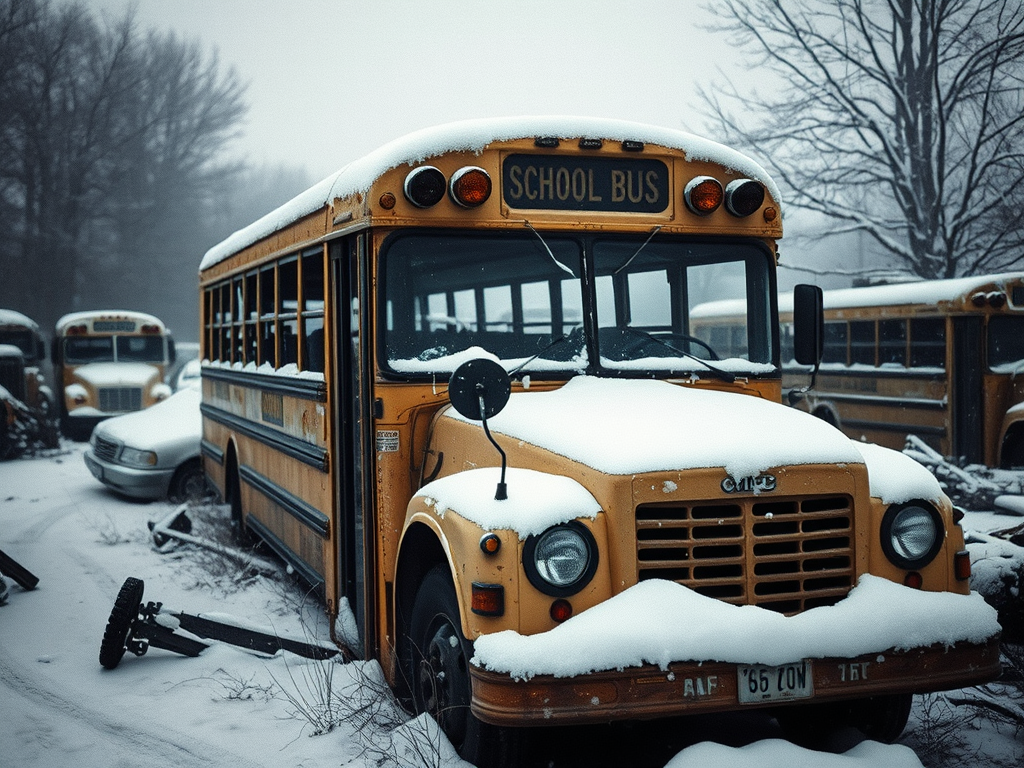
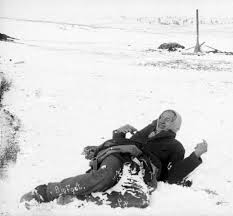
The Royal Elephant carcass of a bus lies mangled among legions of Fords and Chevrolets. From shrinking drifts broken doors and mirrors reach out like Chief Bigfoot in Death. All of Pharsalia melts again into the stone boot-prints of mile-heavy ice.
Here pool retreating forces. Their triumph and defeat merging and disappearing like ice in water, like elephant into earth.
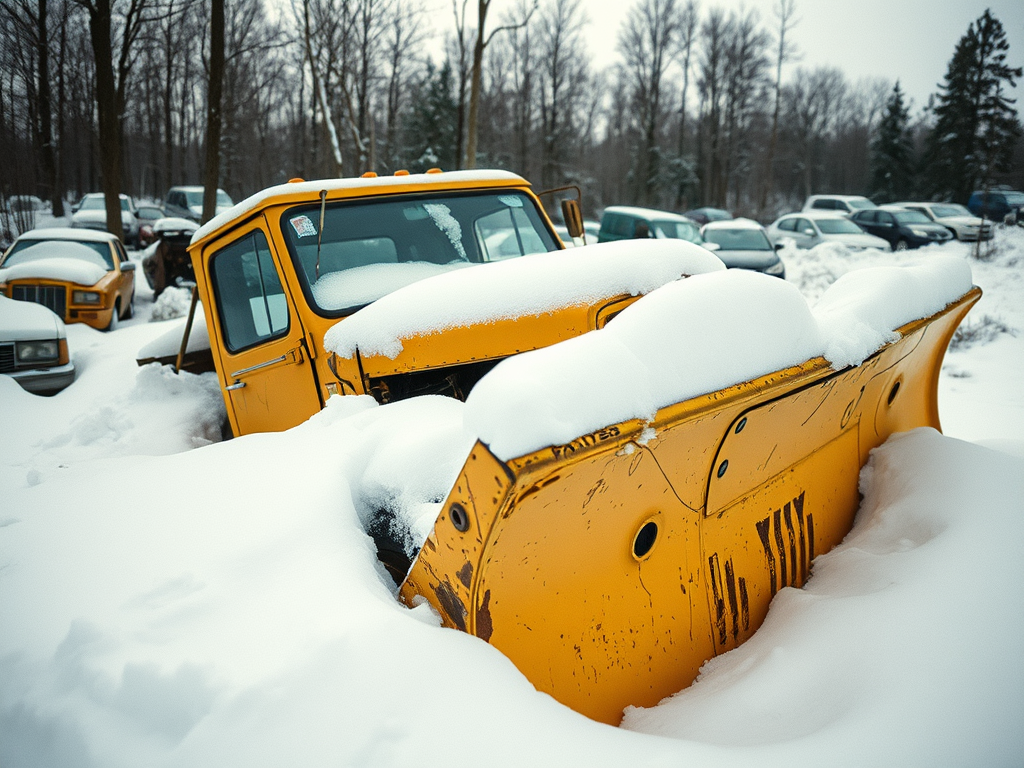
Where Oneida once held a feather dance, thanking Maples, now Chevys and great yellow plows, their wings rusted, lie buried in snow.
In a paintless church, old window frames lean against the sills, thick with flies, an inch deep, overhead broken cobwebs swing.
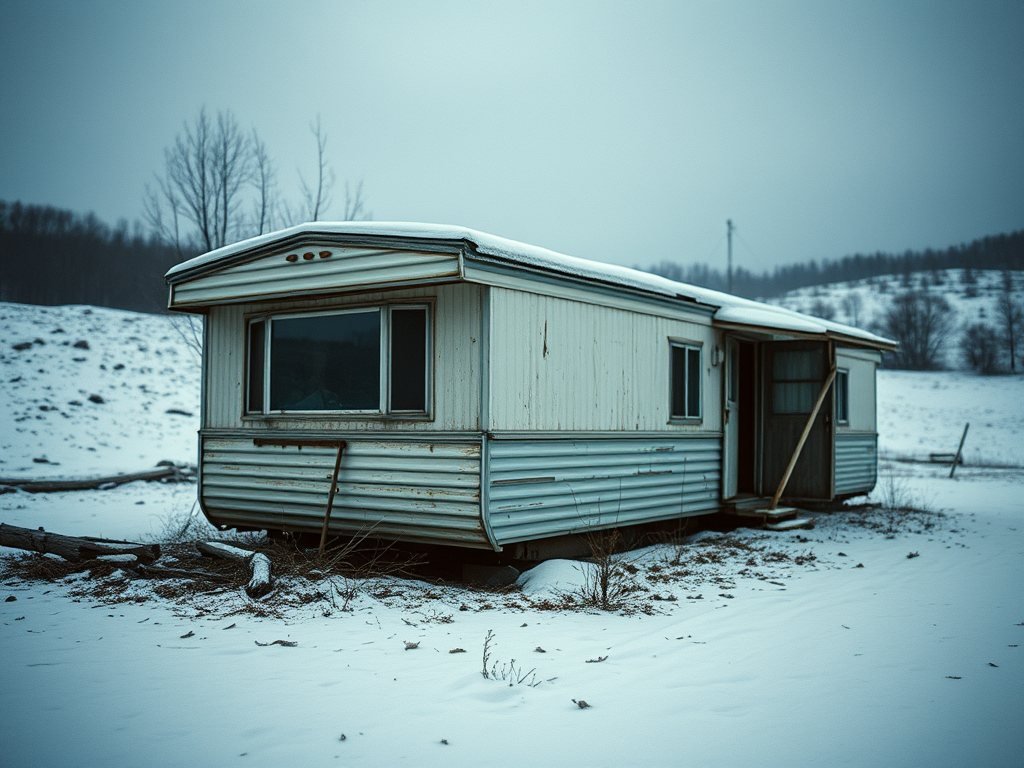
Here and there Erratic hunter/gatherers Slump on sofas in aluminum encampments piled along the highway like a terminal moraine
—
I used AI generated images in place of the actual photos I once used for the poem, much to my own disgust. But I’m not much of a picture taker and was using other people’s photos of the area, and then worried about copyright. So in the meantime I figure, poetry is imaginative. So if I supply imaginary photos and confess to that fact, then perhaps it’s not as unseemly as it still feels. Elsewhere in the essays I don’t have good things to say about AI. But we have to find a way of living in and around this potential monster of a technology. So until I take my own photos, (apart from the old photo of Chief Bigfoot, which is real), I’m leaving these suggestive AI photos. It’s ridiculous, but for now they stay. I’d prefer actual drawings to these things, but I can’t draw.

 Negative Geography