Technical Note on Why the Last Essay Isn’t Really About Writing

Maybe what I’m really after in speaking of an imaginary “you” and “Me” is a rapport with these persistent thoughts of self and other, these imaginary beings that occupy center stage in life. I’m not interested in being a writer, it’s not my career. But in looking at the dishonesty of thought honestly I’m dealing with a communal mess. And part of the resolution of a communal mess will necessarily involve communication of this sort.

Writing provides the opportunity for an elongated span of attention on these matters.  But it’s not the only way to approach all this. So it’s not about writing, it’s about the communal movement of thought. In any communicative case (speaking, fighting, using sign language, doing math) the same issue looms that I was trying to contend with — what to do about the self-image that insists on acting like a middle-man at all times, even poking its ugly little head between two embracing lovers more often than not in the form of anxieties and worries. This spoiled brat of thought has to be the center of attention and is constantly driven by insecurities, because it is by nature a deception, a projection posing as a reality.

So the question tends to be, how do I look at thought honestly knowing full well that a fictitious “I” or “me” will inevitably intrude on the scene demanding to play a central role?

There are a million ways to handle this and all have been tried in these essays, with varying effects. The one is to do what is being done in this paragraph, which is to refuse to use personal language and speak from the third person’s perch.

Read More »

I See You Now

Would you believe me if I said I don’t want to call attention to myself? It would seem impossible because I’m placing these private and somewhat personally unnerving words out there on Facebook, for one thing.

But personal attention makes me sick. And yet I couldn’t find you until I placed these things in some kind of public thoroughfare. I didn’t care if it was just a park bench. Someplace where you might happen along, allowing me to imagine you.

A park bench is almost perfect, but not quite believable enough, because I’m sure these words would be pecked to pieces by a passing pigeon or thrown up on by a drunk, before anyone real like you happened along.

And so I tried a publication like Counterpunch, fairly broad and relatively easy to access. But periodicals have a far too particular outlook, are too demanding in what they want from me. I’m not inclined to work at molding myself to anyone’s demands. I need a thoroughfare that is utterly open-ended and will not lead to any kind of fame, which would destroy my solitude or anonymity. But the thoroughfare still needs to be larger than a park bench in order to allow me to convincingly imagine you as a passing stranger with a mind as large as God’s.

Read More »

The Need for Comedy and Illusion

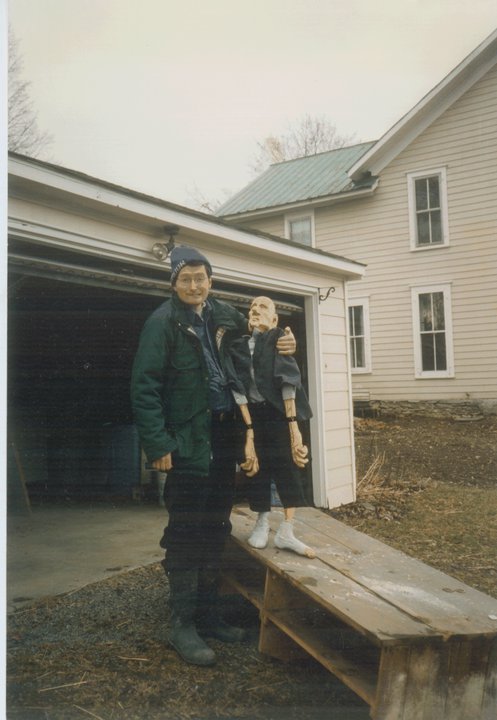
Vladimir and the author.


The problem with essays is that they tempt the writer to speak from a podium of sorts, as if he or she (let’s say he, because I’m talking about myself obviously), as if he were Walter Cronkite, the last representative of the True Believers in solid facts at the center of life, fading out to extremes of fantasy on the left and right.

But that’s not a valid picture of honesty, because there is no solid center if I am learning. The center is precisely the place where suspension and uncertainty live. Nothing is known; all is shifting perspective.

But in saying this I end up sounding like I’m standing at a podium again, and the hypocrisy this generates is fascinating, if nothing else.

Essays generally leave a stench of dishonesty no matter how honest they try to be. I think there’s another way to write essays, and that’s what I’m exploring.

I wish I could ask the reader to bear with me while I say this next sentence, because this statement is just a door to a larger room, but here it is: I’m not really interested in helping anyone. That’s not why I write. I write because I enjoy tracking down and confronting my own dishonesties.

What I am, at best, is honest about my own dishonesties. And I DO think that facing dishonesty is a good thing for the culture, because the culture is not facing its dishonesties, and I’m pretty sure that this will shortly be the cause of our extinction. But even if I feel this way, that’s not my motive.

I think it’s the other way around: I don’t think I can have a motive if I’m honest. I think I can only have a motive to be dishonest. Honesty is merely being without duplicity. There’s no effort involved if there’s no duplicity. So honesty is an empty condition, negated of all efforts, which are in fact efforts to hide from myself. So honesty is incredibly lazy, a slacker of sorts. There’s nothing moral about it. I do nothing and I’m honest. If I do something about it, then I’m squirming, looking for an advantage, an improvement, anything but the truth.

Read More »

Why Am I Writing?

I don’t write because I know something. I write because I don’t. This is the narrative of someone who isn’t fully developed and never will be, and who sees things partially.

Writing occurs when a growing tangle of questions (or contradictions between my everyday life and a wider, less self-defensive perspective) becomes uncomfortable, much like a hairball in a cat. So I’m forced to disgorge this tangle in the form of yet another story or essay.

However, it’s not as if there’s a Right answer to anything and all undeveloped perspectives are simply sophomoric. Every definitive conclusion to my questions and contradictions would remain sophomoric (I remind myself), because there is no positive answer, only negative observations (of what is not true).

But this absence of certainties doesn’t imply the absence of honesty. At any stage of development, at any consistent depth of perception, I’m honest to the degree allowed by that particular depth. At a certain depth, the honesty may be only verbal. At another it may be more behavioral (trying to live up to moral codes and such). Or at still another it might be self-lucidity, the ability to recognize the persistent failure to live up to codes, and the kindness inherent in not trying to be perfect anymore, which is an honesty that exceeds morality. They’re all forms of honesty, but some reach deeper.

Read More »

Alchemical Writing


Feeling the Bones

Sometimes I wonder why I can’t stop all this burrowing into the bones of thought (as I like to think I’m doing).

But that’s when I forget what I love. I love feeling those bones, the hidden, labyrinthine structures supporting our simplistic surface consciousness. And I love encountering my own shocking assumptions, the ones I didn’t even realize I had until I started fumbling around among those bones.Read More »

Limited Infinities

infinity-hatching-larger-infinities

The reader is being reimagined. While this is happening, I’ll shake my notebooks free of the rejected scraps of previous essays.

After that, maybe a new phase can begin. A phase in which writing plays second fiddle to something I can’t really name. I’m not a writer and I have no intention of being hitched to any writerly discipline.

The commitment to a discipline feels narrowing. An intentional commitment feels like I’m putting on blinders and being yoked to a practice that promises its own enticing infinity. An infinity within a narrowing frame.Read More »