As the environmental situation shifts, the skills and intelligence we need also shift, forcing us to lose capacities in one direction while developing them in another. So, every new skill reaches a point of diminishing returns. Every medicine becomes a poison. *
There is no evolution without death. For those who change, the old form dies. *
Evolution isn’t impressed by big brains, if those brains aren’t capable of changing direction (which requires death). *
We like to think that we’re the ultimate generalists, able to adapt to any environment because of our technological gifts. But specialization is a sneaky tendency. The technologies that helped us become generalists reach a point of diminishing returns and begin to narrow our attention spans with too much passive absorption, and by corralling our intelligence (our awareness and behavior) along the predictable ruts of algorithms. *
Our genetics are recapitulated holograms of the primordial soup, which can germinate in any form when the immaterial lightning of insight alchemically strikes the fertile ground of matter. *
Every shift in shape from Tetrapod to whale could be described as earthly insights, leaps in orders of being.*
From a communal point of view, evolution is not competitive or comparative, but measured by whether the whole (or holon) is thriving or declining. *
We don’t see the relevance of earth and other species anymore, except as playthings or scenic backdrops to our diversions. We’ve become the only relevant thing, which is a loneliness that never existed in previous cultures. A meaninglessness too, because we have divorced ourselves from the undiscovered portions of who we are, which are rooted in the mystery of our surroundings. We slide along the empirical surface of the world, blind to the immaterial forces, which give shape to that empirical world. *
The morning shadows are a memory of night. They seem to long for the dissipating darkness. Reluctantly, they retreat, until they are cowering under our feet by midday; and then by late afternoon, leaning once more towards the returning dark.
How can a timeless “now” squeeze between these ceaseless shadows?
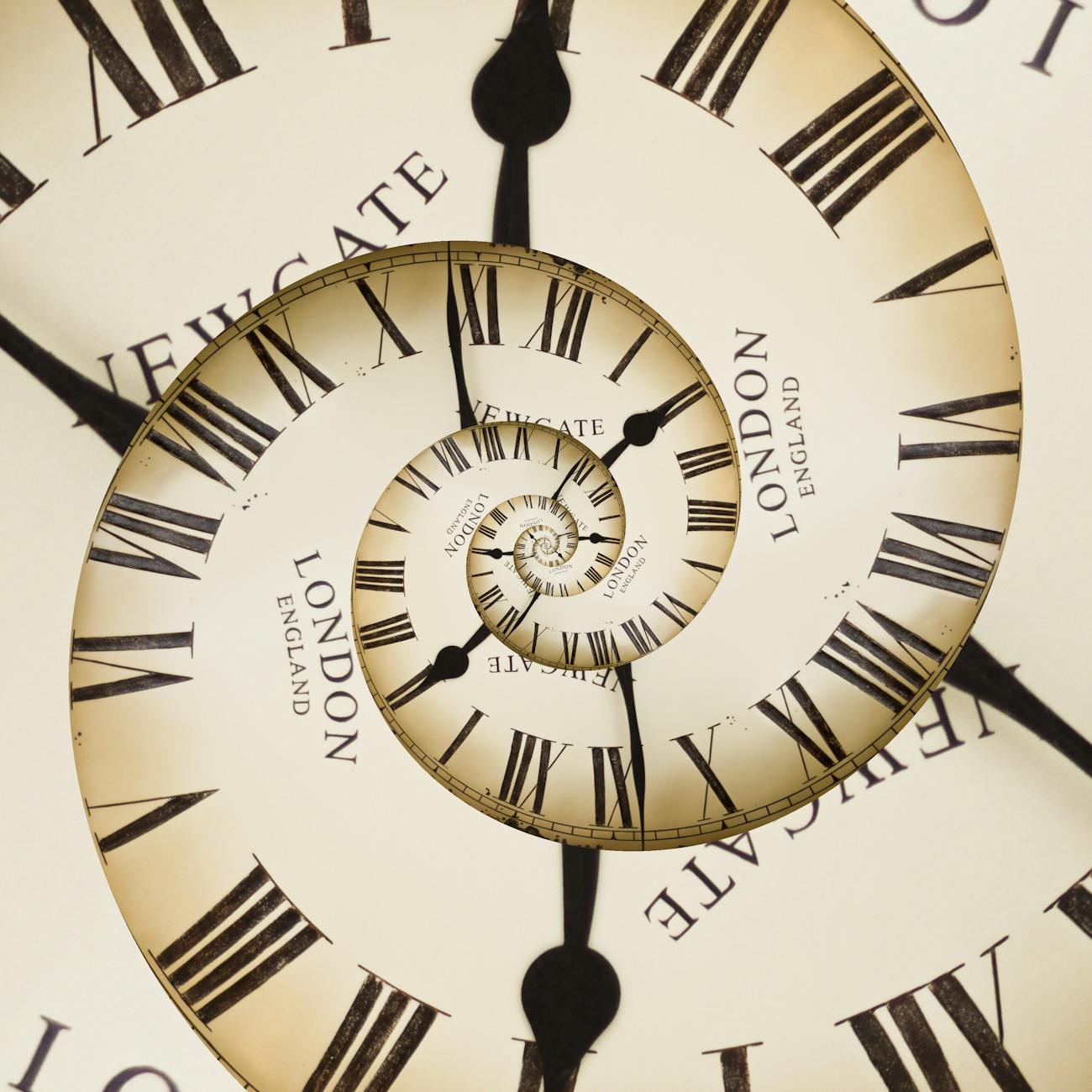
The clock, too, is ceaseless. There is no space on the clock face to mark a “now”.
Maybe the clock is only a map of a timeless territory.
Or, perhaps the clock is a spinning prism through which the mystery of time and timelessness can be seen in different slants of light and shadow.
But even a full circumference of 24 hours will not resolve this mystery. Because everywhere I look, I see only the limitations of human perception, not the limitations of reality itself. So, I can’t “know” time, only these slanted perceptions.
Perhaps time can’t be known because there’s no replication possible. Look, this golden-hued sunrise doesn’t hold quite the same golden hue as yesterday’s. Every morning, the clouds change, branches and leaves have fallen, breaking the light a little differently. And my sensitivities change also.
So far, the earth has experienced about 1,658,195,000,000 mornings, and every one of them was different. Maybe the clock never completes a perfect circle, but spirals beyond measure.
Maybe the techno-futurists are wrong, and we’ll never travel to a previous time, or live forever, because something always dies, no matter what. We will always leave someone behind, or some part of us. Or, we’d return knowing what we didn’t then; which would make it something new; not the past at all.
Our desire to escape the anxieties of time leads us unwittingly towards an inanimate repetition of a deathless world; a perfectly circular and repetitive mechanism; an escape from the spiral of renewal, which requires dying to the past and future, as Krishnamurti pointed out so clearly.
Look, already, the early morning hints of spring have vanished under a wintry sky. I have never known a morning like this.
“I think I could turn and live awhile with the animals… they are so placid and self-contained, I stand and look at them sometimes half the day long. They do not sweat and whine about their condition…. … … not one is demented with the mania of owning things, Not one kneels to another nor to his kind that lived thousands of years ago Not one is respectable or industrious over the whole earth” (Whitman, Leaves of Grass)
Love may be eternal, as the saying goes, but it’s also never more than a series of fleeting encounters. What we hold too long and too close becomes blurry, dissolves into fetish. The objects of our love slip our embraces sooner or later.
Or as the saying goes, what we love, we let go. Living things are constantly going. The animal body moves, it breathes, pumps, circulates and leaves only a trace that fades and disperses.
Even the atoms of our bodies are constantly being replaced.
The person we love is a dispersing form. Or, rather, a shape discernable in the gathering and dispersing of material.
I’m watching suspended motes of dust slowly circulating through the room. If this dust formed an intelligent pattern in passing, if the shape of a person could be discerned in the circulating motes, would this suggest a presence beyond the dust itself? Would we intuit the impression of a soul, because something more than matter alone is at work here? Something that gathers and disperses, an immaterial attractor revealed in the passing shape of matter?
But to attribute this “soul” to something utterly non-material and separate from the body does great harm to our understanding of earthly life. It devalues the biology as some “mere” candy wrapper that can be thrown away, almost disparagingly.
The beauty of these paradoxes lies in the cracks that suggest something more. For there is something soulful about an animal body, about the earth itself. And we are too quick to explain it all rationally, materially and mechanically, or leap into a transcendence that betrays our earthly mother.
Rather than inventing some compromise view, I prefer the suspended question, which sees the limits of both and offers no final answer, only a direction of learning. A vision of life that is more than material, and more than non-material. Nothing so black and white. Nor the compromise of gray. Somehow an embrace of both — a soul that shines as a body, a body that burns with soul. Read More »
People talk about lucid dreaming. Just once I’d like to be lucid when I’m awake.
I arose from blessed oblivion again this morning. It’s a shared oblivion that encompasses the origins of the universe itself. We share our beds with galaxies and comets in utero. The oblivion at the core of sleep isn’t the oblivion of lifelessness, nor is it a rejection of earthly existence, but a reunion with the primordial egg of undeceived Being at the heart of earthly life.
Every night we get the chance to recapitulate the origins of the world and awaken with a Big and creative Bang, which is not will, which is not choice, but a spontaneous eruption of something unprecedented in who we are. After all, we can’t choose what exceeds our comprehension.
I love the insistently hinting dreams of early morning. The timeless oblivion of the depths crashing on the shores of waking life, bending the scraps of memory so that they seem like messages in a bottle, warning me of the sleepwalking illusions of “being awake”.
There is a moment in the passage between fluid sleep and the seemingly solid ground of waking when you are neither. In that suspended space (an eternal space that only appears fleeting when you leave) you realize that the dreams of night were not real after all. And when you turn that same cleansed look towards shore, and peer through all the repetitive dramas of waking life, you see that they are no more solid than the dreams of night.Read More »
Eugene yawned. He dreaded another day of banging his head against the glass.
His friend Leslie, however, was eager to get started.
“Yesterday that precocious young fly Skip said he felt the glass in the upper pane softening a little. Let’s get cracking! Today’s the day, I can feel it.”
Eugene stretched his wings and nibbled on sun-dried bacteria. “I’ll be there in a minute.”
Most of the flies stuck between the storm window and the regular window were already banging away.
Eugene stretched his wing again.
His world measured approximately 64 inches by 26 inches by 5 inches. The majority of flies were banging on the glass facing the interior of the house, and not on the storm window to the outside. That’s because the curtains in the little shack were usually closed, which made the interior window into a weak mirror reflecting the trees and fields across the road. And that’s where they wanted to go.
And all memory of night, when they had banged away on the storm window facing the dark fields and trees, had by then faded into legend.
“Eugene thinks he can sit there all day and reap the benefits of our hard work!” a fly named Bixby complained, when he saw Eugene slowly crawling his way towards them.
“Yeh, but guys, how many generations of flies have been trying to get out of this window?” Eugene said, looking down again at the piles of corpses on the sill.
“Oh, listen to Mr doom and gloom!” Bixby said. “Legend has it that a fly named Boris flew out this very window and into those yonder trees!” Bixby shifted a wing to point at a shimmering mirage of a tree. “So how’d he do it? Not by moaning, but by banging that’s how.”Read More »
This is an honest fairy tale. But it’s not a true story, for who can know the fathomless truth of anyone? It’s about my sister, who died recently.
In this tale the child is led deeper into the enchanted forest. A bewitched forest.
And the more frightened she became the farther she fled into the foggy interior of the woods. There she made her stand, a brave and lonely thing, and built her refuge and her prison.
Or course, these enchanted forests are invisible to others. You can walk around in broad daylight and nobody would know you are lost. As the saying goes, you never see the forest for the trees.
So the child couldn’t tell anyone where she was. I’m here, she would cry. Can’t you hear me?Read More »