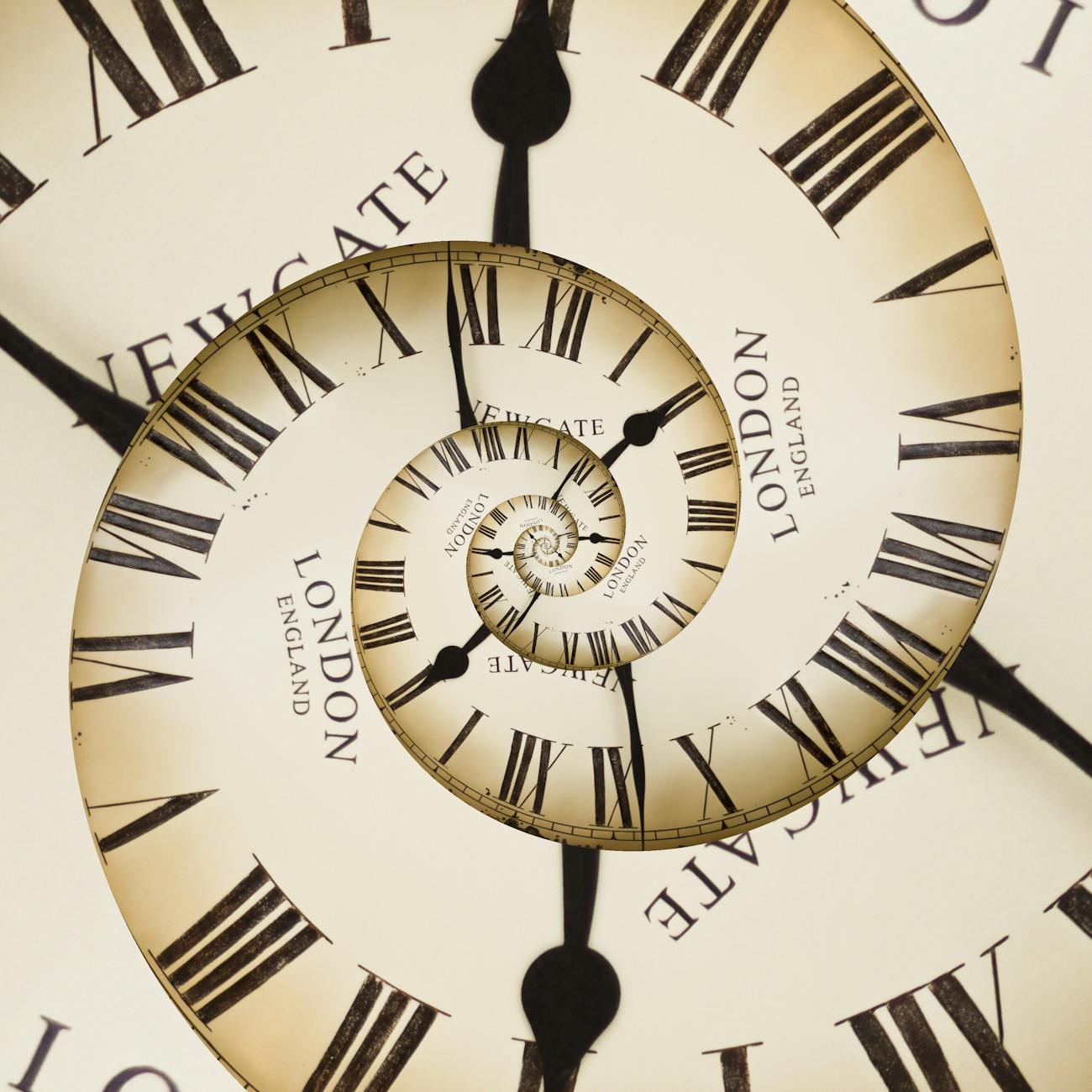
Time and Timelessness

Photo by Fritz Jaspers on Pexels.com

[This appeared in the May issue of Pari Perspectives]


6am: Long Shadows

The morning shadows are a memory of night. They seem to long for the dissipating darkness. Reluctantly, they retreat, until they are cowering under our feet by midday; and then by late afternoon, leaning once more towards the returning dark.

How can a timeless “now” squeeze between these ceaseless shadows?

The clock, too, is ceaseless. There is no space on the clock face to mark a “now”.

Maybe the clock is only a map of a timeless territory.

Or, perhaps the clock is a spinning prism through which the mystery of time and timelessness can be seen in different slants of light and shadow.

But even a full circumference of 24 hours will not resolve this mystery. Because everywhere I look, I see only the limitations of human perception, not the limitations of reality itself. So, I can’t “know” time, only these slanted perceptions.

Perhaps time can’t be known because there’s no replication possible. Look, this golden-hued sunrise doesn’t hold quite the same golden hue as yesterday’s. Every morning, the clouds change, branches and leaves have fallen, breaking the light a little differently. And my sensitivities change also.

So far, the earth has experienced about 1,658,195,000,000 mornings, and every one of them was different. Maybe the clock never completes a perfect circle, but spirals beyond measure.

Maybe the techno-futurists are wrong, and we’ll never travel to a previous time, or live forever, because something always dies, no matter what. We will always leave someone behind, or some part of us. Or, we’d return knowing what we didn’t then; which would make it something new; not the past at all.

Our desire to escape the anxieties of time leads us unwittingly towards an inanimate repetition of a deathless world; a perfectly circular and repetitive mechanism; an escape from the spiral of renewal, which requires dying to the past and future, as Krishnamurti pointed out so clearly.

Look, already, the early morning hints of spring have vanished under a wintry sky. I have never known a morning like this.

Read More »

The Whitewashed Corridors: An Allegory

Architecture Building” by Anonymous/ CC0 1.0

Remember when I found you in that long, white hallway? There were no obvious lights anywhere, but somehow everything seemed brightly lit, without any shadows.

The majority of the crowd in the hall was drifting past us in small groups, linked arm-in-arm — probably families and friends, or communities, or economic associations, moving at a fairly steady clip. A few loners were running and bumping into people. Lots of “excuse me’s” and “hey, look out’s” could be heard.

I asked you to stand to the side, because that woman to the left just about ran you over, remember? Of course, I was joking.

I introduced myself as a janitor. Not really part of the crowd. But I’d been working in that complex for as long as I could remember.

Perhaps I’m a spirit, because nobody seemed to notice me. I pushed my invisible broom up and down the various corridors, without paying much attention to the hubbub or what this place was all about.

But after what seemed like several thousand years of sweeping floors, I got a little bored. And I got a little curious about the nature of this complex or whatever it is. You were the only ghost like me I’d ever met. You seemed familiar to me. I saw you on the margins of the page, not quite sure why you were here. I told you to join the club. I said, I think it’s time for me to lay down my broom and start exploring this place a little more. I asked you to join me.

So, we picked out somebody at random to see where he was going. Let’s not bother with describing him, other than to say, he walked alone (which was somewhat rare), early middle-aged, somewhat stooped and nervous, constantly checking his watch. Oh, and he was carrying a backpack that looked fairly heavy. That should suffice, we’re not building a character study. We only wanted to find out where everyone was heading.

Now and then we’d pass someone moving in the opposite direction, almost always mumbling feverishly to themselves. Everyone would try to get out of their way. They had bad hair, which seemed to make people nervous.

It was a non-descript hallway, as I said, except for signs that appeared at every turn, or T, or four corners. The first one we passed said, “just around the corner!” But usually, the signs were more specific.

For instance, sometimes the crowd would move slower. Especially if we came to a juncture. The first one I recall was a four corners – left, right or straight. Our man stopped to consider his options.

The sign to the left read, “This way to Profit”, and a portion of the crowd in business attire — using their briefcases as shields to push through the traffic jam — went scampering off in that direction, talking into their cell phones nonstop. 

But we couldn’t see anything different in that direction. It looked like the same white, featureless hall. And we saw another sign at the end of the corridor, but it wasn’t possible to make it out clearly.

To the right, the sign said, “This way to Life Everlasting!” And a portion of the crowd started heading in that direction, walking arm in arm with their children. And others walked alone with their heads bent in solemn procession. And yet that corridor also looked exactly the same as the others. And the man we were following went straight. We thought, maybe we should have picked somebody more interesting. But that wasn’t the point of the trip.

Read More »

Lucid Waking

Dreaming youth by Ernst Barlach
Dreaming youth by Ernst Barlach by Los Angeles County Museum of Art is licensed under CC-CC0 1.0

People talk about lucid dreaming. Just once I’d like to be lucid when I’m awake.

I arose from blessed oblivion again this morning. It’s a shared oblivion that encompasses the origins of the universe itself. We share our beds with galaxies and comets in utero. The oblivion at the core of sleep isn’t the oblivion of lifelessness, nor is it a rejection of earthly existence, but a reunion with the primordial egg of undeceived Being at the heart of earthly life.

Every night we get the chance to recapitulate the origins of the world and awaken with a Big and creative Bang, which is not will, which is not choice, but a spontaneous eruption of something unprecedented in who we are. After all, we can’t choose what exceeds our comprehension.

I love the insistently hinting dreams of early morning. The timeless oblivion of the depths crashing on the shores of waking life, bending the scraps of memory so that they seem like messages in a bottle, warning me of the sleepwalking illusions of “being awake”.

There is a moment in the passage between fluid sleep and the seemingly solid ground of waking when you are neither.  In that suspended space (an eternal space that only appears fleeting when you leave) you realize that the dreams of night were not real after all. And when you turn that same cleansed look towards shore, and peer through all the repetitive dramas of waking life, you see that they are no more solid than the dreams of night.Read More »

… And Now I don’t

I made a big and interesting mistake in trying to ascertain who you are in the essay “I See You Now.” Even the title sounded threatening. But this is what Negative Geography was built to handle — a place where I can stare back at my own footprints in the subtle mud of language and decipher where I go wrong.

And some of these mistakes reveal ancient confusions, ancient in that they are not entirely personal mistakes, but self-injurious reactions to transgenerational traumas as Mate tends to describe it, stretching back through human history beyond reckoning.

From one angle, this is the kind of mistake that our parents wisely warned us against — staring too long into the image reflected in the water, because we’ll drown in confusion.

However, I’m no longer susceptible to this fear. I think it’s because I already drowned a long time ago and now I’m beginning to crawl back to the shore like some kind of primordial shape, picture a mud puppy if you need to.

The first surface mistake was in devaluing the deeper personal and impersonal relationships I have with many of you. You aren’t some abstract conception of an Other; you are not merely mined for your value and then discarded, which is what I described. But the image I hold of the person listening is mysterious to me still, as if I’m picturing a mind that is still forming; but one that is partially revealing itself in many of you; and sometimes even in brief exchanges with strangers on a bus; with everyone who carries that charge of honesty that can change a life; and all this feeds the image of a wider mind that is listening, a real mind, in flesh and blood. And I made the mistake of accidentally discounting the fact that this potential is visible in real people reading, and is not abstract and disembodied.

So this led to the the second surface mistake — a failure to acknowledge how important these ongoing dialogues with you are in everything I write.

The underlying error, however, is solipsism. But solipsism is not merely a fancy way of describing a self-centered outlook.

Read More »

I See You Now

Would you believe me if I said I don’t want to call attention to myself? It would seem impossible because I’m placing these private and somewhat personally unnerving words out there on Facebook, for one thing.

But personal attention makes me sick. And yet I couldn’t find you until I placed these things in some kind of public thoroughfare. I didn’t care if it was just a park bench. Someplace where you might happen along, allowing me to imagine you.

A park bench is almost perfect, but not quite believable enough, because I’m sure these words would be pecked to pieces by a passing pigeon or thrown up on by a drunk, before anyone real like you happened along.

And so I tried a publication like Counterpunch, fairly broad and relatively easy to access. But periodicals have a far too particular outlook, are too demanding in what they want from me. I’m not inclined to work at molding myself to anyone’s demands. I need a thoroughfare that is utterly open-ended and will not lead to any kind of fame, which would destroy my solitude or anonymity. But the thoroughfare still needs to be larger than a park bench in order to allow me to convincingly imagine you as a passing stranger with a mind as large as God’s.

Read More »

Why this Shit Matters: Notes on the Last Few Essays

Goofy as it might sound, I’ve been trying to do something for 40 years that is almost impossible. I’ve been grinding my teeth on this thing against all good advice, pouring all my energy into what probably looks like an obscure and meaningless (or maybe just confused and confusing) thing.

The Buddhists say that the truth can’t be spoken; that words are a distraction from what is real, because language is a virtual reality that convinces us that it’s not virtual. So language is essentially a delusion, which can never help us encounter what is real. Reality is found off the page, not on it.

And the same goes for thought and feeling and imagery. It’s all a kind of curtain that pretends to be showing something beyond the curtain, where in fact nothing at all is found. We make up everything.

Look, the Buddha knew his shit. And I’m not disputing what the Buddhists say above. In fact, it was my starting point, not as an idea or belief (because I’d never heard of Buddhism), but as a terror. If for some reason you suddenly learn that you’re trapped behind a film of language, feeling, thought and imagery and that everything you experience is imaginary, then there is no “getting off the page” into reality. It’s like being stuck in a hall of mirrors. It’s not a choice.Read More »