I can imagine that many of the claims I tend to make would annoy historians, among others.
I tend to say that knowledge isn’t a matter of fact or fiction, but of honest or dishonest fiction.
And I tend to say that a conclusion puts an end to learning.
Historians, reporters and police detectives (among others), however, are often diligent in sorting fact FROM fiction, and wouldn’t take kindly to any smudging of those distinctions. They also tend to work towards a conclusive determination of events. They might argue that the question, “did this happen or not?” demands a conclusive answer in order to learn anything substantial. So right away, both of my claims will seem outlandish from their perspectives.
I myself would argue that we need to retain a distinction between fact and fiction if the context (such as law) is premised on this distinction. We have to understand the definitions and frameworks of any foreign language. But I would argue that these linguistic distinctions are themselves fictional inventions. “Fact or fiction” ‘is a fictional way of sorting events.
After all, a fact (under microscopic examination) is by itself a meaningless dot of data in an infinite sea of data points. Facts only begin to make sense when they are strung together in a narrative. In other words, we can’t understand any fact without understanding the context, which is the story that defines the fact. I can’t think of a single fact that isn’t part of an explanatory narrative, like beads on a string.
Creativity is inseparable from the collection of facts. Read More »
People talk about lucid dreaming. Just once I’d like to be lucid when I’m awake.
I arose from blessed oblivion again this morning. It’s a shared oblivion that encompasses the origins of the universe itself. We share our beds with galaxies and comets in utero. The oblivion at the core of sleep isn’t the oblivion of lifelessness, nor is it a rejection of earthly existence, but a reunion with the primordial egg of undeceived Being at the heart of earthly life.
Every night we get the chance to recapitulate the origins of the world and awaken with a Big and creative Bang, which is not will, which is not choice, but a spontaneous eruption of something unprecedented in who we are. After all, we can’t choose what exceeds our comprehension.
I love the insistently hinting dreams of early morning. The timeless oblivion of the depths crashing on the shores of waking life, bending the scraps of memory so that they seem like messages in a bottle, warning me of the sleepwalking illusions of “being awake”.
There is a moment in the passage between fluid sleep and the seemingly solid ground of waking when you are neither. In that suspended space (an eternal space that only appears fleeting when you leave) you realize that the dreams of night were not real after all. And when you turn that same cleansed look towards shore, and peer through all the repetitive dramas of waking life, you see that they are no more solid than the dreams of night.Read More »
Last night I dreamt I was a Germanic medicine man, warrior kicking Roman ass in the Teutoburger Wald (my tribe’s version of the Little Bighorn). Dying in agony I was annoyed to discover that my wife was not tending my wounds, but merely nudging me in the ribs so I’d stop moaning in my sleep.
Despite my battlefield injuries, despite lying face-down in the swampy woods screaming in pain, I was not relieved to find myself back in this cold, bureaucratic, technological culture, although word processing is a nice addition. [See footnote on racial identity and the development of eco-fascism].
We’re all born mid-highway, spewing gas out the tailpipe, decimating forests for school projects, eating animals penned in concentration camps, privileged or lacking privilege, praying to the local deity, before we have a moment to reflect, through no choice of our own.
I just appeared here as a newborn in this historical timeline like a Chomsky Martian, and was quickly covered in all these decals and rooting for the team I got saddled with, no matter how often they lose.Read More »
I can’t remain too long in any consistent first person, otherwise you’ll end up believing that I’m really me, and then I’ll be pinned inanimately to the page and unable to shape-shift as any living creature must if it hopes to avoid the tarpits.
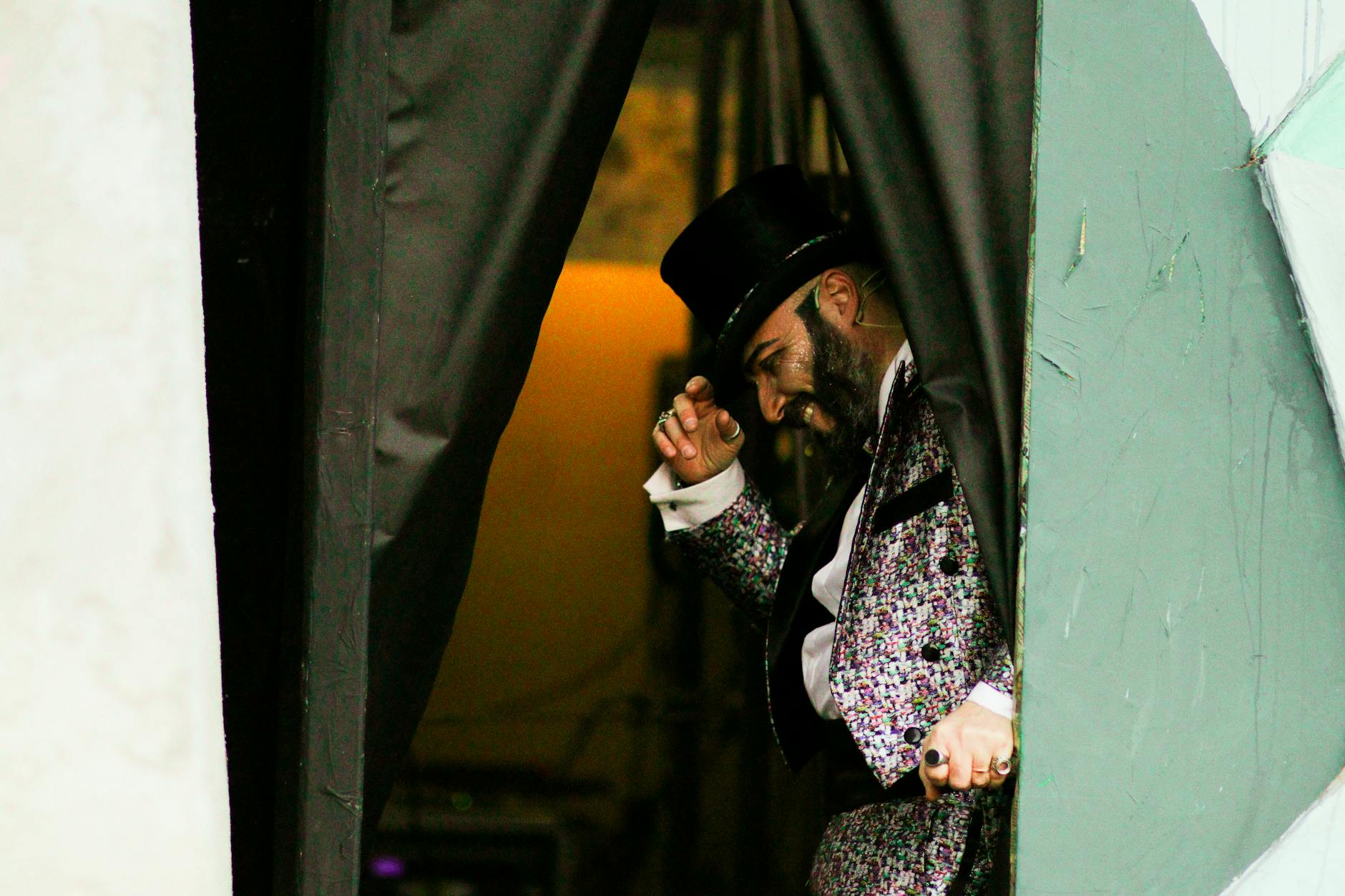
Consider Me the ringmaster for what follows. I am part of the performance, just another circus freak, not the kind of Self you’d bring home to meet your mother.
Let’s dare to suggest I’m not even a living thing so much as a material swelling of words, thoughts, ideas, pictures, emotions, the chaotic surface waves left by the spirit of life as it hovered over the keyboard for a moment before passing on to better things. After all, the screen or page you’re reading is not itself alive. Nor is this picture of “me” that hovers over the page momentarily.
Or say instead that this picture of “Me” is a mnemonic shell that formed where life once placed its fleeting and immaterial finger. I am the fossil of something more lively that passed this way.
Or maybe I’m the detritus of memory, a junk-encrusted tumbleweed of ideas of myself, a messy and clanging assemblage of cans and can’t-do’s, recoils, crossed-wires and lost marbles. This would explain why I’m such a noisy sonofabitch.Read More »
The following hypothesis won’t be correct, but only at best insightful. From where I stumble through life, no human knowledge will ever be free of distortion, because we can’t pin down the nature of a morphing and multi-dimensional infinity. Therefore, I don’t want to construct a stable theory of reality. I’m offering a playful metaphysics instead, a suggestive cartoon (cartoonish in comparison to the dynamic world), a caricature that exaggerates certain features of reality that more conventional stories and theories have tended to downplay by exaggerating other features.
Metaphysical trips such as this are only built for the short haul. My exaggerated intention is to remove a dogmatic beam from the field of perception. Call it a cultural floater that is blinding us to wider potentials. What I’m doing feels practical, not academic.
Also, I’d like the reader to realize that these essays are not rationally planned. At this point in the essay I’m only pursuing a metaphor that now and then crystallized over the past few months. So I write my way deeper into this vague sense of a vaster formulation hiding in the fog of my own ignorance. I want you to know this, because this is an exploratory journey into the wilderness of ignorance, and I want you to ride along as it unfolds, not as a spectator reading a conclusive script.
How do we restore the prismatic flow to human culture without forcing it, without imposing our will from the top down?
The personal lens has mainly become psychotic in this culture, blocking access to wider views. And if we learn to change without force on a narrow or personal level – without introducing this divisive top-down mentality when we’re alone — then there is no other obstacle to a communal and cosmic clarity.
So what I write about are the aspects of a new vision that are wavering for me personally. I’m nothing if not inconsistent. But I’m learning things from these wavering encounters with sanity, more specifically from these failures to retain sanity. Every failure reveals the nature of the madness. (One thing I learn is it’s not “my mind”. The system of thought is a shared system of tracks for trains of thought. So whatever I learn about this situation on a personal level is applicable to everyone else (and vice versa, what you learn)). And writing is one way for a span of attention to widen enough to discover the underlying system of switches (so to speak), which keep the personal trains of thought circling on a narrow gauge, falling for the delusion that they’re running on an isolated system of tracks. And this attention repairs or alters those switches, releasing this human energy from that self-centric circularity and allowing the human (shared) mind to rediscover a wider fluidity of movement between the narrow, the mid-range and the long views.
This is important: In this particular fiction I’m writing (and every essay is a fiction) the personal point of view represents no independent being. It’s a story from the microscopic point of view. Here, likewise, the communal lens is a story from the shared, communal point of view. And the cosmic lens is a little different (as I tried to show in Part IV, “What Is Radically New”). We need cosmic stories (myths and theories), but not as a primary point of access to the cosmic. The cosmic is mainly contacted by negation (by the realization that all of our myths and theories are cartoons of “something more” that can never be known in any conclusive sense). The cosmic lens can only be accessed when we’re in a non-Literal or metaphoric state of mind, whereby the Self is also felt as a cartoon depiction of something beyond the reach of knowledge. In other words, the Self here is not seen as an actual source of this life, but only as a cartoon representation of the whole from a microscopic perspective.
We Don’t Change by Trying to Change (there’s no top-down change)
We don’t change by trying to change. (The moment we have the urge to change ourselves, something already changed. And this urge arose in us spontaneously, without knowing how, without making a decision – the decision is the result of change, not the cause). The reason a “decision to change” sometimes seems to help arouse energy is because the “decision to change” is a kind of microscopic myth or creed that gives us an illusion of something we can trust as a crutch.
But the cosmic vision can’t replace the narrow vision or the mid-range vision. We need to move freely between all three vantage points in order to scan the world as honestly as possible. So it’s a nested hierarchy of perception, where the cosmic puts the narrower communal and personal vantage points in their proper place. Without this fluidity of perception, our limited stories lose that tether to reality and become deceitful to the point of self-destruction.
Refusing to see the world honestly is the quickest way to be killed.
For instance, we could call this a dangerous world or we could call this an evil world. Both would be fictions. But the first one is more consistent with life in a wilderness, and we’re always living at the edge of a wilderness, because life always exceeds the idea, because they are two different substances, and never the twain shall meet
As in any earthly wilderness, it’s best to approach the unknown as a danger, but not as an evil. If we were to live by the fiction that the woods are evil, then the animals we encounter would increasingly live up to that billing. This is how schizophrenia becomes so convincing. The world responds to our stories, whether they’re honest or deceptive stories. Even positive thinking is deceptive. What it produces is a false front, a positive deception. Even if we’re not technically schizophrenic, the same principle exists. An “evil” interpretation would corner the beings we encounter into living up to that billing – they’d sense our fear aggression and respond in kind, seeing us as a threat — or they’d simply refrain from helping the flailing and drowning world (Chomsky’s Martians, for instance) and let it drown.
But if we approach the wilderness as dangerous, but not evil, then we’ll be able to notice other non-aggressive qualities in our fellow animals, and learn to avoid provoking them. We might learn to become friends with some of them, as we did in befriending wolves and wild cats.
The world responds to our stories. The deceptive stories can be too rose-colored as well. If we approached the wilderness as a paradise of love, we’d blind ourselves to the dangerous potentials that are also there and not live long either.
The problem with the bullshit of “positive thinking” is that the naively rose-tinted glass-wearers end up eaten.
But – and this we don’t acknowledge enough — the same is true for the cynics, for the ash-tinted glass-wearers (who think positively still, but only in dark directions). We give the cynics far too much credit for a “worldly intelligence” they Do Not Possess. They also end up provoking a world that eats them. It’s the naïve Literalism, the ignorant certainties, the stupid belief in something called “non-fiction”, which is the deeper problem. The problem is a lost perceptual fluidity.
Somehow the breath-taking significance of this is lost on most of us most of the time. We don’t see the implications of what we’ve discovered here. This discovery of a prismatic capacity to see everything as honest fictions erases the need for conflict. And this relationship to fiction shows us how it’s possible to move through the world as blindly as Helen Keller, knowing nothing in a positive sense, tapping the canes of our metaphors and stories to obtain negative information (tap, there’s an obstruction, tap, there’s a limit to our metaphor, tap, change direction), and from that negative flow of information, we re-design our theories, stories, myths and metaphors, with no intention of finding conclusion, except perhaps in limited fields of inquiry, and even these may alter radically as more dots of data emerge, and this underlying uncertainty allows us to “keep going” deeper and deeper into this weird, miraculous and unfathomable world.
“…theory is largely a game of make-believe in which we pretend, just for the sake of argument, that there’s just one thing going on: essentially we reduce everything to a cartoon so as to be able to detect patterns that would be otherwise invisible… One must simplify the world to discover something new about it. The problem comes when, long after the discovery has been made, people continue to simplify” (The Dawn of Everything).
Is it possible to think outside these national and supra-national controlling bodies on a communal level, while also relating to the cosmos outside the boundaries of any religious doctrines and beliefs (which are reductive surrogates of a cosmic perspective)?
A non-dogmatic approach to the cosmic perspective is one of the main themes of the Negative Geography inquiry. But I’ll try to approach it somewhat differently here.
If we were asked to imagine a cosmic perspective many of us would probably feel cornered into selecting one or another Ism or scientific theory or any conclusive opinion, whether rose-colored or ash-tinted. Or we might use vague terms like I used — “the whole” or “the cosmos”. Anything we conceive would amount to a cartoonish summary of something that can’t be pictured as a whole, because in picturing the whole we pretend to stand outside this conception in order to grasp it. In its place we relate to a singular projection of our imagination, which is separate from the observer, therefore a fragmented vision, not a real experience of wholeness.
We can’t picture, grasp or describe a cosmic perspective. It becomes a matter of faith. But there is blind faith in ideas, constructs, conclusions, dogmas. And there is a kind of “activated” faith that is creedless, that is “proven” by default, by running into our own limits and realizing that there is always something larger and more profound in the world. We don’t know what it is, but there is a kind of clear-minded faith that develops in what exceeds us.
I mean, even a cynic who doesn’t believe in “the whole of life” is summarizing the whole of life as non-existent. That is, we’re all forced to account for the cosmic lens one way or another, whether we want to admit it or not. Some fill it in with wishful thinking or cynicism, and some with scientific theories.
But is the cosmic perspective activated by filling it with words and ideas? Doesn’t this reduce the cosmic vision to a narrower and more static form?
Or is the cosmic dimension precisely that area of life that can’t be filled, that is constantly overflowing every container we try to build. If so, then the cosmic lens is precisely that state of mind which remains open-ended and uncertain.
The cosmic view, in other words, can be felt as a relationship to this solid limit in our understanding. It’s a visionwider than the widest view, because it detects the limits of every positive attempt to frame it. So there’s no need for a positive cosmic creed, only this direct experience of “something more”, something constantly escaping our grids of understanding (which I’m calling Negative Knowledge).Read More »
Technology isn’t the problem by itself. Technological solutions are often necessary. But not as a primary focus. I can almost picture a sane (by no means Utopian) world, which steals an element from Amish culture – not a wholly luddite element, but the element in their culture that is considerate in its rate of adopting new technologies. Otherwise, technological development becomes an accelerating end in itself, which has a hypnotic and reductive effect on human consciousness (as noted in several essays).
But how could such a carefully considered approach to technology be organized?
It wouldn’t work as a top-down imposition, as it would for the Amish, who are pretty much stuck within a narrow system. Any top-down imposition of rules is a reductive strategy in itself, which bends eventually towards dictatorship. But profound shifts in social realities (such as our relationship to technology) would begin on a grassroots level, preceding the imposition of new laws. The Civil Rights era, for example, represented an alteration in the balance of attitudes towards white privilege, and this started to happen prior to any changes in law.
Let me ramble a while in this direction and see if we can return to this question.
Most grassroots social movements still feel compelled to beseech “authorities” for changes in top-down rules, still end up trying to persuade the kings and queens of commerce and government to give their permission for any grassroots shift that is already happening. Governments and titans of commerce yielded to the Civil Rights movement, for instance, because they felt the implicit threat to the whole system of power if they didn’t yield. Or they yielded to the grassroots movement of smoking grass, for instance, because they were lured there by the promise of controlling the revenue stream.
But beseeching these authoritative bodies also keeps us narrowly tied to the harness of commerce, and government, so that nothing significant in that sense ever changes. We earn a certain freedom of movement, yes, but still within the old reins (or reigns) – still trapped in systems of control (and machine intelligence is that system). Trying to live without a cell phone, for instance, is becoming almost impossible. Everything is being streamlined to assist the management of people on a grand scale, primarily it seems via apps on phones. (Not because the Bilderbergs have a broad vision they’re trying to enact, but precisely because they don’t have one, or have only a desacralized vision of manipulated self-interest, where a cosmic lens might once have been). At any rate, we’re still reined to the system, but hats off to those who are trying to build a community off-grid.Read More »
[Link to Part I, but you don’t need to read part I to understand this]
If I can look at my own history as a narrative with highs and lows, with periods of clarity and periods of confusion and frustration, then this also probably describes human history as well. Of course, this would contradict the typical historical narrative, which envisions nothing much happening in human development for almost all of our 200 or 300 thousand years, until the last few thousand years, when everything began to improve and become suddenly creative and “advanced”, thanks mostly to technology. This narrative ends up forcing us to look at earlier or less-technologically obsessed cultures as more primitive, and sometimes less intelligent or creative than we are now, as if our history was an escalator climb, and we’re standing quite a few floors above them now.
This picture of the past is a little too pat and conceited. It reminds me of the stages of human development envisioned by Ken Wilber and others (see “The Limits of Ken Wilber”). There’s insight in these stage development models, but the details seem to reflect patterns of development within a regressive culture. And this regression may tend to stretch individual development along lines of partial maturation. Slicing and dicing these stages of delay in our maturation is insightful, but when we begin to project these developmental patterns onto older cultures, I think we’re only repeating patterns of colonial conceit.
My inclination is to assume three fundamental stages of development, depicted in that old Zen saying – “first there is a mountain, then there is no mountain, then there is.” I understand this to mean, first we see the world without the lens of language, a pre-linguistic directness. Then language begins to form an interpretive gauze over the mental eye, which is insightful, practical, and necessary for functioning in the world. But the gauze also begins to obscure the “mountain”. It’s the elongation of this second stage that most of these stage development models are elaborating upon (insightfully, this is not a criticism, but a different angle to consider). At the furthest, stretched distortion of this stage, post-modern insights such as “everything is language” or “there is no ‘thing’, only ‘thought’” erupt. Here, reality itself begins to seem doubtful. A kind of derealization crisis takes place. They can see that there is no mountain without the idea of a “mountain”. But the eruption of a third stage, which is actually not so much a stage, as a gateway into a larger form of life, erupts when the post-modern insight is completed, and the insight that “everything is a story” no longer stops us from seeing the mountain again. Now we’re no longer blinkered by our necessary interpretations. We can cease interpreting the world from the outside (when interpretations are not needed), and no longer relate to the mountain like an alien visitor. Now we “know” the mountain, not merely as a practical idea (all the time), but as an unnamable portion of eternity, a portion of our own fathomless Being.Read More »









 Negative Geography