As the environmental situation shifts, the skills and intelligence we need also shift, forcing us to lose capacities in one direction while developing them in another. So, every new skill reaches a point of diminishing returns. Every medicine becomes a poison. *
There is no evolution without death. For those who change, the old form dies. *
Evolution isn’t impressed by big brains, if those brains aren’t capable of changing direction (which requires death). *
We like to think that we’re the ultimate generalists, able to adapt to any environment because of our technological gifts. But specialization is a sneaky tendency. The technologies that helped us become generalists reach a point of diminishing returns and begin to narrow our attention spans with too much passive absorption, and by corralling our intelligence (our awareness and behavior) along the predictable ruts of algorithms. *
Our genetics are recapitulated holograms of the primordial soup, which can germinate in any form when the immaterial lightning of insight alchemically strikes the fertile ground of matter. *
Every shift in shape from Tetrapod to whale could be described as earthly insights, leaps in orders of being.*
From a communal point of view, evolution is not competitive or comparative, but measured by whether the whole (or holon) is thriving or declining. *
We don’t see the relevance of earth and other species anymore, except as playthings or scenic backdrops to our diversions. We’ve become the only relevant thing, which is a loneliness that never existed in previous cultures. A meaninglessness too, because we have divorced ourselves from the undiscovered portions of who we are, which are rooted in the mystery of our surroundings. We slide along the empirical surface of the world, blind to the immaterial forces, which give shape to that empirical world. *
There was a spontaneous genius in the Big Bang, which reverberates in all the little bangs that open new worlds through “blown minds” or insight. *
The desire for a deathless state (an unending Heaven of one sort or another) is an unintentional desire for lifelessness, for a static and inanimate repetitiveness. *
Even if I can’t hear the deep bass of the elephant and the whale echoing across the Savannah or the ocean, I’ll hear their silence. And then I’ll know the real meaning of alienation and loneliness, guilt and sorrow. *
Panic is a dog chasing its tail. Funny if I can see the whole dog, and not so funny if I’m caught up in the chase.
The question, “what is real?” can only be answered with a sense of humor.
Most schools teach only a short-term open-mindedness in order to gain, in the end, conclusive confidence in what is “real.” But a conclusion closes the mind and ends learning. Few schools help students discover a more ineffable confidence in what always exceeds our conclusions.
Scientists might cringe, but electrical or nuclear power could be described as hidden forces charmed into being by the magical formulas of math. These invocations isolate attributes of an undifferentiated whole, giving these forces an independent existence and practical purpose they never had. *
The scientist can become bewitched into a materialist vision; the salesperson can end up thinking that everyone is selling something. We’re made gullible by any story conflated with fact. *
Error is how reality makes itself known. It’s a ceaseless trade wind of correction. Embracing this slant on error, theories no longer strain to be perfect. (A “perfect answer” would put an end to learning). Learning requires riding that current. So, stories flex and shift like sails, catching whispers of larger worlds. Now the wind exceeding the sail is beautiful. *
There’s no greater comic relief than recognizing one’s inner demons as fools on the level of Curly, Moe and Larry. *
What hasn’t changed is this phony sense of a divided consciousness, this feeling of being the better half of a Siamese twin; the other a dummy of a nincompoop dragging along beside me; a co-creation of my own desired destiny divided by the destiny friends and enemies consider more within my grasp. Probably this Siamese self is nothing more than my own recollected behavior sloughed off on an imaginary scapegoat.
Too often, the inner voice (the “I”) escapes into the delusion of being the better angel, who can look back at his dim-witted past from an improved distance. As if I were superior to my own immediate past. And these internal revolutions from dimwit to angel and back again occur in quick succession, like a dog chasing its tail. *
For no sooner do I act in the world then I become immediately annoyed by what I’ve done, rising in opposition to this now utterly deposed former incarnation who had been in his own day (of a moment or two ago) an equally enraged monster with regard to previous incarnations.
“When I get mad or frustrated with myself I notice that the voice (the “I”) feels distinctly superior to the lout I call myself. It’s a kind of voice-throwing trick, placing “me” perpetually outside the scene of my own error, gazing back at my failures like the lab-coated know-it-all, not like the dummy in the wreck. *
Hear me complain about my gaffs with the sternness of an English school-master, condemning what I’ve done from a morally superior third person’s perch (disguised under first person pronouns): “I’ll never forgive myself for what I’ve done!” Or listen as I express the frustrations of an injured party — “there I go again, spilling milk all over myself!” — in this way sidling over to gaze at my wrong-doing as the victim instead of the perpetrator. *
The key to learning is being edified and bemused by our own stupidity. *
I wonder if bad eyesight is caused by a disinclination to see the look on other people’s faces. We blur sight and retreat to senses which are less susceptible to duplicitous signals. So, the eyes atrophy or wear out with misuse.
When I take off my glasses, I end up listening more closely. Then the Other listens more closely too. And all they can see in my own blissfully blurred face is a good-natured ignoramus, which tends to awaken a spirit of charity, if not downright pity. Thus, we both become transfigured so long as at least one of us remains blurry.
The centrality of myself remains stubbornly pre-Galilean. *
What I “know” of another person is only my story of the story they tell about themselves.
Our personalities are merely characters in imaginary dramas. When the drama shifts, the personality shifts. If the drama ends, “we” end. Hence, we cling to dramas.
The imaginary voice is speaking to an imaginary person. The “I” and the “self” that are being addressed are both part of the imaginary performance.
Yes, it’s an inquiry into myself, but it’s not about “me”, as in my personal history or problems. It’s about the common momentum of thought that runs “me.”
If we make this conscious distinction between thought and being, then we are able to move in and out of the shapes imposed on perception by thought and language. This allows us to remain somewhat aloof from who we think we are.
Whatever we are, we’re not found in passing thoughts. They are merely the traces of our passing.
I learn from everything that goes wrong, and everything is always going wrong. *
I don’t write because I know something. I write because I don’t. *
But it’s not like I’m trying to do something. It’s more like something else is trying to do something and “I” keep getting in the way. And all this tripping over myself to avoid what it wants looks like “effort.” It’s a seductive pretense.
Writing happens when effort fails.
The only light the “I” produces is the light of its own combustive friction. This friction is produced by trying to avoid the revealing light of awareness. This friction is the cause of Hellfire. Hellfire is the light of heaven burning away.
Self-discovery is the discovery of nothing.
Self-discovery is the exploration of the cosmos, because the discovery of my absence is the discovery of everything else. But we turn our backs on this larger Being merely because it disturbs the small image of who we thought we were.
Writing is neither a means to an end, nor an end in itself. There is a third possibility. Writing is merely what happens when I’m learning. It’s a necessary corollary of the process, but neither a means nor an end.
If a necessary corollary to something larger is repressed, then the larger thing also can’t form. But we still can’t focus on the corollary as a means towards the larger thing.
I say things after I already know them. I know things silently prior to speaking. I speak in order to hold the surface image steady against a barrage of anomalous information.
I’m a little embarrassed to title something “Aphorisms”, because it seems a little too pretentious and presumptuous. But I recently overheard 30 seconds of a book review of some philosopher’s book of aphorisms as I was walking past a radio. And the reviewer noted that aphorisms tend towards concision (obviously) and humor. And that’s the combination I need.
And when I started scanning through what I already wrote, I realized that I might be able to distill the essence of all these words to a nub, or many little nubs. And when I started throwing them in a list, I noticed that there’s a natural ebb and flow to the nubs. And with a little rough tweaking here and there, and the addition of a few new nubs, the ebbs and flows take on a certain rhythm and direction, without the need for a unifying voice or any tiresomely self-conscious Self, such as the one who is speaking now.
Admittedly, these nubs, ebbs and flows still came out to 37 pages, which doesn’t seem too concise after all. But that’s 6,129 fewer pages than the essays in total. So, count yourselves lucky.
I broke them into three “volumes” (so far). And I’ll post one every few days. I allowed some similar observations to sneak into each volume, because the different contexts add enough nuance to justify the repetition.
So, the whole thing ends up forming something in between an essay and a disjointed list of one-liners. They were fun to compile, tweak and expand. So, I hope they are fun to read.
I’m not sure this ends up “better” or “worse”, but it’s different. And as a different “approach” (an almost headless approach, trusting the connective tissue to form on its own, trusting it to make more sense than the sum of individual observations) it cuts out the middleman (“me”), and hones in on some of the essential insights that might otherwise get lost in the verbose flow of narrative. (I mean, I can’t picture too many people who actually read all this stuff. So, this is like digging up a few of the potatoes that probably got lost in the bed).
So, maybe it’s both better and worse, because these “nubs” also miss more subtle narrative themes that are only possible within the more long-winded essays (which includes this preface).
And now there’s the possibility of a hybrid form of essay, which I might try later.
I should note that any hyperlinked asterisks lead to the essay where the aphorism (or something similar) can be found in its natural habitat.
The morning shadows are a memory of night. They seem to long for the dissipating darkness. Reluctantly, they retreat, until they are cowering under our feet by midday; and then by late afternoon, leaning once more towards the returning dark.
How can a timeless “now” squeeze between these ceaseless shadows?
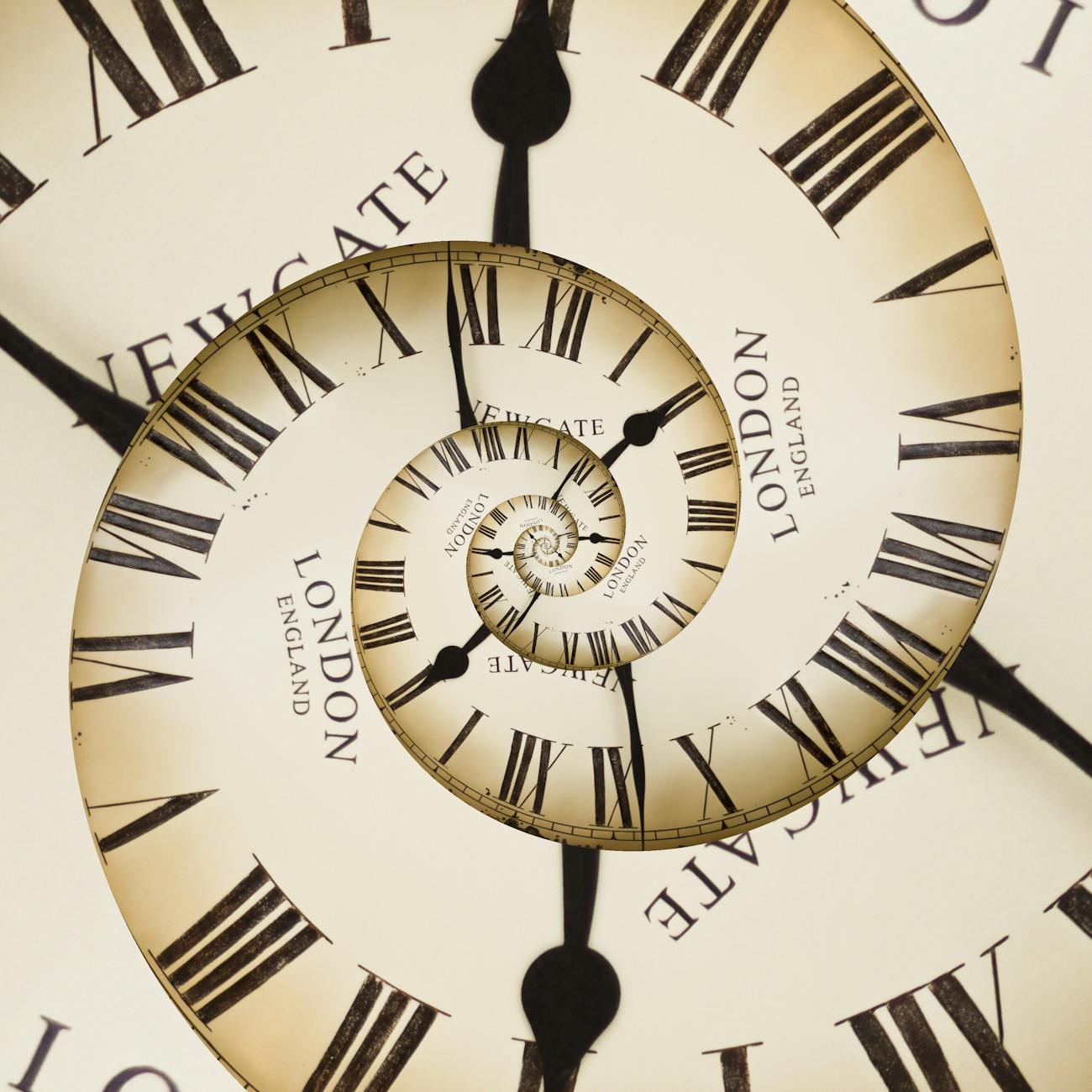
The clock, too, is ceaseless. There is no space on the clock face to mark a “now”.
Maybe the clock is only a map of a timeless territory.
Or, perhaps the clock is a spinning prism through which the mystery of time and timelessness can be seen in different slants of light and shadow.
But even a full circumference of 24 hours will not resolve this mystery. Because everywhere I look, I see only the limitations of human perception, not the limitations of reality itself. So, I can’t “know” time, only these slanted perceptions.
Perhaps time can’t be known because there’s no replication possible. Look, this golden-hued sunrise doesn’t hold quite the same golden hue as yesterday’s. Every morning, the clouds change, branches and leaves have fallen, breaking the light a little differently. And my sensitivities change also.
So far, the earth has experienced about 1,658,195,000,000 mornings, and every one of them was different. Maybe the clock never completes a perfect circle, but spirals beyond measure.
Maybe the techno-futurists are wrong, and we’ll never travel to a previous time, or live forever, because something always dies, no matter what. We will always leave someone behind, or some part of us. Or, we’d return knowing what we didn’t then; which would make it something new; not the past at all.
Our desire to escape the anxieties of time leads us unwittingly towards an inanimate repetition of a deathless world; a perfectly circular and repetitive mechanism; an escape from the spiral of renewal, which requires dying to the past and future, as Krishnamurti pointed out so clearly.
Look, already, the early morning hints of spring have vanished under a wintry sky. I have never known a morning like this.
Questioner (Q): Is there a material or immaterial basis to everything?
Imaginary Philosopher: I wouldn’t ask that. It creates a false dichotomy and presumes too much.
Q: You don’t think it’s an important question?
IP: I think we urgently need to question the small visions driving us towards a cliff. Materialism is a blindingly short-sighted vision that degrades our relationship to earthly life. But I wouldn’t focus on an answer.
Q: Why not?
IP: Any answer to this question is a form of reductive materialism itself, creating dichotomy and conflict. Positive certainty is destructive. We end up thinking we’re absolutely right about something, and those who hold an opposing view become enemies.
Opposing views needn’t be in conflict. Materialism and Immaterialism are only what we see when facing different directions. It’s similar to microscopic and macroscopic visions. The microscope and the telescope don’t argue with each other. Each has limitations, which are partially completed by the other.
Q: Are you saying it’s both?
IP: Yes, that, and more, they’re all limited.
Q: What are the limitations of both views?
IP: Imagine the absurdity of visiting a doctor because your face is stuck in a frown. The materialistic doctor examines the face, and concludes that the cause of the frozen frown is a combination of changed patterns in blood flow, muscular tension, and temperature, recommending muscle relaxants. Such a doctor would dismiss “sadness” as a cause, because the existence of an immaterial state of mind would be pure conjecture. There’s no material proof of a mind that feels sad.
This may seem absurd, but this is how a typical scientist approaches the study of the material world. We measure the physical attributes of the world and don’t even bother to wonder if these complex systems of order indicate an immaterial intelligence of the earth itself. Materialism limits our vision.
But if we adhere to an opposing viewpoint – that only mind or spirit is real – then the body and the earth itself fade in importance, appearing merely as discardable clothing obscuring the spirit, or as mere illusions, or inanimate shells.
Western culture seems to be vacillating between these two extremes. An abstract Platonism that led to a Sky God divorced from earthly life, becoming a puritanical hatred of the body, which are all different forms of idealism.
And then this strange scientific materialism, which also degrades matter and mines the earth as if it were inanimate.
So, both viewpoints are limited.
Earthly life has been demeaned by both extremes, because we lost a “vision” of sacred matter — a materiality unsevered from the immaterial.
Q: Isn’t this vision of “sacred matter” another competing belief?
IP: Yes, it could degrade into another material fetish of a belief. Do we necessarily move from a belief in materialism or a belief in some form of immaterialism to a belief in “sacred matter?” Many believe that we can only move from one positive belief to another, that it’s impossible to relate intelligently to the world without a symbolic structure that guides us. But this belief is also limiting.
Is it possible to not merely question each belief from a new position of belief, but to question the whole category of “belief”, so that one is not merely thinking about previous forms of thought, but relating to every belief with unvested interest, or ultimate uncertainty?
“I think I could turn and live awhile with the animals… they are so placid and self-contained, I stand and look at them sometimes half the day long. They do not sweat and whine about their condition…. … … not one is demented with the mania of owning things, Not one kneels to another nor to his kind that lived thousands of years ago Not one is respectable or industrious over the whole earth” (Whitman, Leaves of Grass)
Love may be eternal, as the saying goes, but it’s also never more than a series of fleeting encounters. What we hold too long and too close becomes blurry, dissolves into fetish. The objects of our love slip our embraces sooner or later.
Or as the saying goes, what we love, we let go. Living things are constantly going. The animal body moves, it breathes, pumps, circulates and leaves only a trace that fades and disperses.
Even the atoms of our bodies are constantly being replaced.
The person we love is a dispersing form. Or, rather, a shape discernable in the gathering and dispersing of material.
I’m watching suspended motes of dust slowly circulating through the room. If this dust formed an intelligent pattern in passing, if the shape of a person could be discerned in the circulating motes, would this suggest a presence beyond the dust itself? Would we intuit the impression of a soul, because something more than matter alone is at work here? Something that gathers and disperses, an immaterial attractor revealed in the passing shape of matter?
But to attribute this “soul” to something utterly non-material and separate from the body does great harm to our understanding of earthly life. It devalues the biology as some “mere” candy wrapper that can be thrown away, almost disparagingly.
The beauty of these paradoxes lies in the cracks that suggest something more. For there is something soulful about an animal body, about the earth itself. And we are too quick to explain it all rationally, materially and mechanically, or leap into a transcendence that betrays our earthly mother.
Rather than inventing some compromise view, I prefer the suspended question, which sees the limits of both and offers no final answer, only a direction of learning. A vision of life that is more than material, and more than non-material. Nothing so black and white. Nor the compromise of gray. Somehow an embrace of both — a soul that shines as a body, a body that burns with soul. Read More »
I’m writing the persons who will replace us. At present we can only see the magnetic flash of someone in utero; that potential, which is more communal than personal. Some fetus audacious enough to see through its own charades.
I’m writing because this is the performance of a new way of being, this is how it begins to take shape. It’s you and I facing our shame, not I alone.
We don’t give birth to a new being by ourselves. This is an alchemical experiment, a shamanic dance. The eyes dance the words, and this ceremony creates someone capable of seeing the Self as a construct of self-deception. A way of being rises from the ashes of who we thought we were.
Imagine the courage it takes to not fool yourself.
Even the imagination of this person can’t be sustained without deception. The effort to do so creates a positive ideal, which is a desire for transcendence, and that desire is opposed to being seen as a fool. It doesn’t want to see how it fools itself. It hides from reality and never acknowledges that it does so.
This is the origins of our political situation also. The system is running from reality as fast as it can, right into the arms of a narcistic dictator.Read More »
Time to summarize where the series on freedom has gone up till now.
The only concern of these essays is the restoration of the earth’s health.
But how can something as pathetic as an essay contribute to the healing of the earth? The same way any other action performed whole-heartedly contributes, the same way any white blood cell encountering a virus contributes to the healing of the whole population: By realizing and metabolizing the world’s poisons as they circulate within this holograph of the whole, called me. By being an example of healing, by facing my diseased self honestly, allowing the old patterns of identification to die, as they should have died thousands of years ago, before the disease suppurated.
Honesty is the painful act of healing. It’s also the most rebellious act one can undertake in a deceitful world.
This isn’t about learning to play the violin while the world burns. None of these essays are about personal advancement or personal adjustments to a world in its death throes. Those concerns make me sick. I mean “sick” as an accurate metaphor, because the world’s sickness is rooted in a frame of mind that is selfish and short-sighted. We are heading towards extinction from too much personal concern.
Abandon false ideas, that is all. There is no need for true ideas. There aren’t any” (Nisargadatta)
Thought tends to run us (ala David Bohm), but it’s such a convincing hallucination that we’re the ones choosing what we think. But usually, we’re just repeating fragments of ideas that have come to us from others, from one-sided, patriotically-distorted historical education, Youtube, echoing chat groups, books, unconscious habits of response in parents and teachers that presume certain “facts” about life (absorbing these philosophies unconsciously). Etc.
How are we supposed to have an idea of our own in this rubble-strewn flood of information? How can we pick and choose what is right or wrong when our basis of decision making also comes from this chaotic flood?
Ironically, we’re not lucid until our thoughts are recognized as a cultural dream into which we were born. We awaken by realizing we’re asleep.
The irony is that real individuality only happens when I realize that thought has carried me away, that beliefs ran me from one blind conviction to another, like cordyceps (the zombie-ant fungus).




 Negative Geography