A Quick Theory of Hell

What if there are areas of Hell where the inhabitants think they are happy? At least, at first.

There, the inhabitants merely suffer perpetual stasis. But this stasis becomes so unbearable after a while that many end up seeking the easy change of a worsening situation to relieve them of the monotony.

And then they get tired of making things harder and join one of the various Societies for the Betterment of Hell. But almost nobody shows up after a while, because the meetings are too monotonous, too many parliamentarian procedures, and nothing ever improves.

So, Hell’s society bounces between two rather mild extremes – the temporary excitements of a worsening self-made crisis and an exhausted return to static monotony.

On a personal level, nobody suffers too much. The nick-nack shelf hangs almost perfectly balanced. Things only roll off now and then. Or maybe you have a low-grade migraine that comes and goes every day. And aspirins are in short supply. (Dope too; the marijuana fields keep getting attacked by new fungi). But there’s also no great suffering at any given moment. (After all, it’s only the “thought” of never-ending migraines that begins to wear you down).

Or, perhaps upon entering hell, you’re given a perpetual membership in Hulu or Amazon Prime or Youtube. Seems nice at first.

But then the prospect of spending the next 5 million years watching re-runs of The Office trends badly. (Also, notice that the “Prospect” of 5 million years occurs to someone as an immediate thought. That’s all it takes to lose heart; you don’t have to wait 5 million years. Hell is an immediate thought).

Also, what makes this hell really hellish is that everyone is free to leave. All they have to do is change their habits. But it’s too much trouble to leave hell; there’s always another youtube short to watch.

Hell is a voluntary surrender facility for the fatally indifferent.

Again, it’s not that hell actually lasts forever. It’s the immediate thought that you’re trapped into remaining in this cornucopia of trivia simply because you’re too indifferent to EVER leave, which is hell.

What eventually drives most of the inhabitants to lower and darker levels of Hell (making room for newcomers) is that immediate but unbearable knowledge of their own freedom to leave. The skies remain too blue here, the trees too green, the flight of the vulture still too serene, to ever let them forget this otherwise passing thought.

The Whitewashed Corridors: An Allegory

Architecture Building” by Anonymous/ CC0 1.0

Remember when I found you in that long, white hallway? There were no obvious lights anywhere, but somehow everything seemed brightly lit, without any shadows.

The majority of the crowd in the hall was drifting past us in small groups, linked arm-in-arm — probably families and friends, or communities, or economic associations, moving at a fairly steady clip. A few loners were running and bumping into people. Lots of “excuse me’s” and “hey, look out’s” could be heard.

I asked you to stand to the side, because that woman to the left just about ran you over, remember? Of course, I was joking.

I introduced myself as a janitor. Not really part of the crowd. But I’d been working in that complex for as long as I could remember.

Perhaps I’m a spirit, because nobody seemed to notice me. I pushed my invisible broom up and down the various corridors, without paying much attention to the hubbub or what this place was all about.

But after what seemed like several thousand years of sweeping floors, I got a little bored. And I got a little curious about the nature of this complex or whatever it is. You were the only ghost like me I’d ever met. You seemed familiar to me. I saw you on the margins of the page, not quite sure why you were here. I told you to join the club. I said, I think it’s time for me to lay down my broom and start exploring this place a little more. I asked you to join me.

So, we picked out somebody at random to see where he was going. Let’s not bother with describing him, other than to say, he walked alone (which was somewhat rare), early middle-aged, somewhat stooped and nervous, constantly checking his watch. Oh, and he was carrying a backpack that looked fairly heavy. That should suffice, we’re not building a character study. We only wanted to find out where everyone was heading.

Now and then we’d pass someone moving in the opposite direction, almost always mumbling feverishly to themselves. Everyone would try to get out of their way. They had bad hair, which seemed to make people nervous.

It was a non-descript hallway, as I said, except for signs that appeared at every turn, or T, or four corners. The first one we passed said, “just around the corner!” But usually, the signs were more specific.

For instance, sometimes the crowd would move slower. Especially if we came to a juncture. The first one I recall was a four corners – left, right or straight. Our man stopped to consider his options.

The sign to the left read, “This way to Profit”, and a portion of the crowd in business attire — using their briefcases as shields to push through the traffic jam — went scampering off in that direction, talking into their cell phones nonstop. 

But we couldn’t see anything different in that direction. It looked like the same white, featureless hall. And we saw another sign at the end of the corridor, but it wasn’t possible to make it out clearly.

To the right, the sign said, “This way to Life Everlasting!” And a portion of the crowd started heading in that direction, walking arm in arm with their children. And others walked alone with their heads bent in solemn procession. And yet that corridor also looked exactly the same as the others. And the man we were following went straight. We thought, maybe we should have picked somebody more interesting. But that wasn’t the point of the trip.

Read More »

Lucid Waking

Dreaming youth by Ernst Barlach
Dreaming youth by Ernst Barlach by Los Angeles County Museum of Art is licensed under CC-CC0 1.0

People talk about lucid dreaming. Just once I’d like to be lucid when I’m awake.

I arose from blessed oblivion again this morning. It’s a shared oblivion that encompasses the origins of the universe itself. We share our beds with galaxies and comets in utero. The oblivion at the core of sleep isn’t the oblivion of lifelessness, nor is it a rejection of earthly existence, but a reunion with the primordial egg of undeceived Being at the heart of earthly life.

Every night we get the chance to recapitulate the origins of the world and awaken with a Big and creative Bang, which is not will, which is not choice, but a spontaneous eruption of something unprecedented in who we are. After all, we can’t choose what exceeds our comprehension.

I love the insistently hinting dreams of early morning. The timeless oblivion of the depths crashing on the shores of waking life, bending the scraps of memory so that they seem like messages in a bottle, warning me of the sleepwalking illusions of “being awake”.

There is a moment in the passage between fluid sleep and the seemingly solid ground of waking when you are neither.  In that suspended space (an eternal space that only appears fleeting when you leave) you realize that the dreams of night were not real after all. And when you turn that same cleansed look towards shore, and peer through all the repetitive dramas of waking life, you see that they are no more solid than the dreams of night.Read More »

A Hidden Optimism: Going On from the Last Essay

In the last essay I seemed to compare people to primordial mud. Of course, I wrote it as a comedy, which is to say, the entire essay is excessively optimistic about people, and is only making a generously indulged joke on behalf of a gifted species at the verge of developing into a new form of life and intelligence. But if people approach it pessimistically (I don’t see how they can, given the parameters of my essays in general), then it would be received as ridicule. But I was writing this in resonance with Beckett’s approach. He also tempts people to read him pessimistically. But everything he wrote was a double-entendre. A different kind of humor is revealed when you discover his hidden optimism.

These essays presume several optimistic things (and I don’t expect agreement and I’m not looking for debate, only the willingness to entertain the angle of vision as long as it lasts):

1) that human beings are troubled, but gifted animals; and

2) That human beings are at the verge of realizing a new form of intelligence, a new way of being.

Hence, the metaphor of a primordial awakening.

Read More »

“That’s the Show, Waiting for the Show”: The Mysterious “Subject” that Hides in the Shadow of Attention

Some might think I’m dawdling over preliminaries. Like I’m endlessly adjusting my coat and tie, but never actually going out on stage and performing anything. All backstage banter.

That’s not wrong. In these essays the subject itself is backstage banter – the behind-the-scenes mumbling in our own heads.

It’s very hard to find anyone raring to talk about the way we frame reality back there. It throws unpleasant light on our habits of denial, repression and justification, which keep us consistent if nothing else. So this subject is almost inherently “uninteresting” to anyone who considers themselves already sane.

Thankfully I don’t. And neither do some of you. However, you’re almost unlocatable as a group. No demographic defines you. So I’m not even addressing you directly. I feel like we’re sitting side-by-side under a tree together, sharing a slightly psychoactive substance. What we have in common is the willingness (I suppose) to recognize a certain insanity in ourselves and not push the subject aside as a dull complacency. We’re willing to see our condition as abnormal, which is a surprising relief. Because if this way of life isn’t “normal”, then we can begin healing. Otherwise it’s just a condition defining us in some conclusive sense. I guess I’d rather be considered insane than evil.Read More »

Coils and Spirals (story)

timelapse of water around a whirlpool in a pond

Pexels.com

A while back I discovered a part of town I hadn’t known. This was odd because I live in a small city. We’re surrounded by farmer’s fields, they press upon the city walls. Farms and farms, their fumes invade every spring and summer, heralded by legions of pillaging flies, forcing our retreat block by block, week by week, until we find ourselves by August or September in the last green oasis for hundreds of pesticide-ravaged miles, which is the city park, a tangle of briars and downed trees, a green confusion which is never easy to find, perhaps never even in the same place.

I hesitated to say anything about my discovery for months, because I was afraid that the news would make me and everyone else who grew up here look stupid, misplacing, for god’s sake, an entire neighborhood.

Of course, my aunt ignored the gist of what I told her to resume arguing that we’ve not only lived here all our lives, but for all eternity. She repeated the argument daily, and said she was condemned to repeat it the next day, too. She would say time is a loop of dramas, sitcoms, tragedies, and other forms of farce, one following the other, the same characters, the same punch lines, but you’d need to have a perspective like hers, spanning billions of years, to notice that you’ve played these roles before. The theory alone was good enough to make my aunt feel trapped in a giant hamster wheel, panting for air. That was her preferred state of mind, anyways, favoring the stability of a known horror over any unsuspected risk, no matter how small, which is why the deep silos of her eyes glowed bloodshot red, and why she tirelessly scanned the world for confirmation of her worst fears, so she could blow them out of all proportion, and feel moderately relieved when her worry proved exaggerated.

It was a preemptive claustrophobia that rebounded in a momentary illusion of spaciousness.Read More »

The Problem with Guardian Angels: A Very Short and Steep Comedy

Madelleine Elizabeth Fitzroy, my client, so to speak, died on May 12th, 2021. The obituary in the Seneca Falls newspaper was thin, but not inaccurate. “Madelleine E. Fitzroy (Sherman) died peacefully in her sleep on May 12th. She was pre-deceased 12 years by her husband Harold Mackinack “Mack” Fitzroy. They had two children, Phillip (Jenner) and Maureen (Johnson), and three grandchildren, Elizabeth, Benjamin and Dwyer. She loved to cook and enjoyed playing cards with her friend.”

That was published this morning, two days since she died.

She loved to cook and enjoyed playing cards with her friend (it should have been plural). Otherwise, that’s about it. I couldn’t have added too much more without delving into private matters. I know so much because I’m her guardian angel, and she was my “better half” as we quip up here sometimes, while waiting.

There wasn’t much else to do but wait, because she didn’t live a very dangerous life. Oh, I had to step in a few times, once when she got stung by bees, and then when she almost choked on a liverwurst sandwich while arguing with her husband. I also steered her away from courting Gene Abbott, although Mack Fitzroy wasn’t much better.

You call us guardian angels but I’m more like her reflection in a higher dimension, so our fates are tied. Tomorrow, on the third day since her bodily death — on what you call “judgement day”, but which we know as True Death — she’ll either rise like a feather or sink like a stone. But up or down my fate is tied to hers.

My job is to convince her to rid herself of all her attachments, because any extra weight will cause a soul to sink, and there are all kinds of rumors about what happens down there.

OK, I’m off to meet Maddy in the “flesh” so to speak. And I’ll write these notes as I go, hovering as it were above myself (and a little to the left), which is a skill reserved for those of us in this dimension, sorry.

There she is, already standing in line, holding the memory of her old suitcase.

Damn it, next to her are 4 or 5 elderly ladies and gents of a similar constitution, all yakkety-yakking away as if they were waiting for a bus to Vegas.

The other guardian angels already look frustrated

“… and so I said to her, ‘you think you’re the only one with troubles like that, I got a son in law who won’t even talk to me until I tap him on the head and say “what’s up, buddy?” and then he only says ‘nothin’’ and goes back to playing with his phone. It wasn’t like this when we were young”

Read More »

The Need for Comedy and Illusion

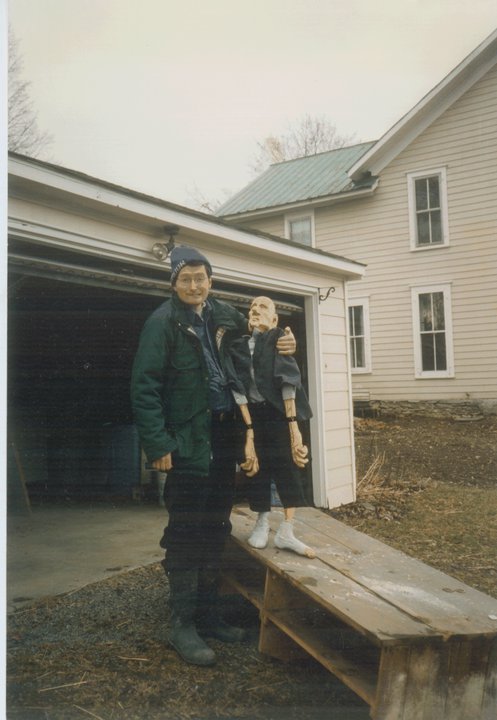
Vladimir and the author.


The problem with essays is that they tempt the writer to speak from a podium of sorts, as if he or she (let’s say he, because I’m talking about myself obviously), as if he were Walter Cronkite, the last representative of the True Believers in solid facts at the center of life, fading out to extremes of fantasy on the left and right.

But that’s not a valid picture of honesty, because there is no solid center if I am learning. The center is precisely the place where suspension and uncertainty live. Nothing is known; all is shifting perspective.

But in saying this I end up sounding like I’m standing at a podium again, and the hypocrisy this generates is fascinating, if nothing else.

Essays generally leave a stench of dishonesty no matter how honest they try to be. I think there’s another way to write essays, and that’s what I’m exploring.

I wish I could ask the reader to bear with me while I say this next sentence, because this statement is just a door to a larger room, but here it is: I’m not really interested in helping anyone. That’s not why I write. I write because I enjoy tracking down and confronting my own dishonesties.

What I am, at best, is honest about my own dishonesties. And I DO think that facing dishonesty is a good thing for the culture, because the culture is not facing its dishonesties, and I’m pretty sure that this will shortly be the cause of our extinction. But even if I feel this way, that’s not my motive.

I think it’s the other way around: I don’t think I can have a motive if I’m honest. I think I can only have a motive to be dishonest. Honesty is merely being without duplicity. There’s no effort involved if there’s no duplicity. So honesty is an empty condition, negated of all efforts, which are in fact efforts to hide from myself. So honesty is incredibly lazy, a slacker of sorts. There’s nothing moral about it. I do nothing and I’m honest. If I do something about it, then I’m squirming, looking for an advantage, an improvement, anything but the truth.

Read More »

A Fly Fable (Which Includes the Amoral of the Story)

Act 1

Eugene yawned. He dreaded another day of banging his head against the glass.

His friend Leslie, however, was eager to get started.

“Yesterday that precocious young fly Skip said he felt the glass in the upper pane softening a little. Let’s get cracking! Today’s the day, I can feel it.”

Eugene stretched his wings and nibbled on sun-dried bacteria. “I’ll be there in a minute.”

Most of the flies stuck between the storm window and the regular window were already banging away.

Eugene stretched his wing again.

His world measured approximately 64 inches by 26 inches by 5 inches. The majority of flies were banging on the glass facing the interior of the house, and not on the storm window to the outside. That’s because the curtains in the little shack were usually closed, which made the interior window into a weak mirror reflecting the trees and fields across the road. And that’s where they wanted to go.

And all memory of night, when they had banged away on the storm window facing the dark fields and trees, had by then faded into legend.

“Eugene thinks he can sit there all day and reap the benefits of our hard work!” a fly named Bixby complained, when he saw Eugene slowly crawling his way towards them.

“Yeh, but guys, how many generations of flies have been trying to get out of this window?” Eugene said, looking down again at the piles of corpses on the sill.

“Oh, listen to Mr doom and gloom!” Bixby said. “Legend has it that a fly named Boris flew out this very window and into those yonder trees!” Bixby shifted a wing to point at a shimmering mirage of a tree. “So how’d he do it? Not by moaning, but by banging that’s how.”Read More »

The Oven Mitt: A Comedy About Psychopathy, Guilt, Fascism and Death

Oven mitt collage element psd

I feel sorry for the left oven mitt because we don’t really need it. Sometimes I wear it when it’s not necessary, just to give it a boost.

This sounds like I’m trying to be cute, but it’s a raw confession. This is no joke: I recently bought a bottle of beet juice because I felt sorry for the bottle. It was like trying to walk past a homeless dog. And I even spoke comforting words to the bottle as it languished in my refrigerator for weeks, before I finally had to throw it out, because it tasted like shit.

It makes me sick to hear how amused I sound by my own antics. But it’s the act of confession that provides some needed respite, and respite always produces a certain giddiness. That’s why priests always thought I was making stuff up in the Confession booth. As a result, I don’t think they gave me sufficient penance. But it’s confusing the way they made us worship a statue, and then believe that a tasteless wafer was the body of Jesus. They encouraged us to blur the line between animate and inanimate just as we were learning in school that nothing is real unless it can be measured, and everything is basically an automaton, including our own biological drives and patterns of thinking.Read More »